For Membership Professionals: Prove a Member Value Proposition in 90 Days

A membership value proposition is a concise promise of outcomes for a named group of members, backed by at least one proof point they can check for themselves. It names who the organisation serves, states the top outcome it delivers, and shows evidence rather than aspiration. Get those three elements right, and recruitment and retention conversations get considerably easier.
TL;DR:
- Effective membership propositions must clearly target specific audiences, specify measurable outcomes, and provide verifiable proof points to build credibility.
- Combining quantitative benefits like CE hours with qualitative drivers such as belonging helps close the perception gap affecting renewal rates.
- Tracking proof points through automated systems and regular cohort analysis ensures the organization delivers on its promises consistently over time.
- Developing a credible value proposition requires research, segmentation, fixed-structure drafting, and testing with members before publicizing.
- Membership platforms that automate tracking of proof points simplify ongoing validation, making it easier to maintain a current and credible value proposition.
Table of Contents
- Membership value proposition defined: the social contract behind it
- Why member value clarity drives recruitment, retention and revenue
- Turning features into proof: quantitative and qualitative value in practice
- How to define your membership value proposition, step by step
- Proving the promise: onboarding, channels and the metrics that matter
- Putting the proposition to work operationally
- What membership teams get wrong about their own value proposition
- A platform-based way to keep proof points current
- Sources
- FAQ
Membership value proposition defined: the social contract behind it
A member value proposition works less like a marketing slogan and more like a social contract. It combines rational tools and resources (what members get) with emotional drivers such as belonging and purpose (why they stay), according to The Membership Guide. That framing matters because most membership organisations sell participation and support, not a physical product, so the contract has to satisfy both a spreadsheet and a feeling.
Defining membership value properly means naming five things clearly, not vaguely gesturing at “great benefits”:
- Target audience — the specific segment you serve (early-career practitioners, small-business owners, retired professionals), not “everyone in the industry.”
- Outcomes — what changes for members because they joined, stated as a result, not a feature.
- Problems solved — the specific friction, risk, or gap your membership removes.
- Evidence or proof points — a number, a case, or a policy win members can verify.
- The one-line proposition — a single sentence that ties the above together without hedging.
That checklist is where a membership proposition for memberships diverges sharply from a typical business value proposition. A software company can lead with features: faster, cheaper, more integrations. A membership organisation is selling an ongoing relationship, so the proposition has to speak to outcomes and belonging simultaneously. A trade association’s members do not renew because of a discount code alone. They renew because the discount, the continuing education hours, and the sense of professional identity all reinforce each other. Strip out the emotional half and you are left with a coupon book. Strip out the rational half and you are left with a mission statement nobody can act on.
This is also where a lot of value proposition for memberships work goes wrong before it starts. Teams draft the emotional language first (community, voice, belonging) because it is easier to write, then bolt on statistics afterwards to sound credible. Reverse that order. Start with what you can prove, then explain why it matters to the member you named.
Why member value clarity drives recruitment, retention and revenue
Organisations that articulate both quantitative and qualitative value in their membership proposition are more likely to report membership growth, according to Pricing for Associations. That is not a coincidence. Prospective members join on a rational calculation (what will this cost me versus what will I get), while existing members renew on a blend of rational proof and emotional attachment. A proposition that only speaks to one side of that decision loses ground at exactly the moment it matters most: the renewal notice.
The perception gap is the real risk. Members’ perceived value and the organisation’s actual delivered value are frequently two different things, and closing that gap depends on deliberate communication and measurement rather than assuming members already know what they are getting, according to Lumi Global.
That gap explains a pattern many membership managers recognise but rarely name: an organisation delivering genuinely strong benefits still sees weak renewal rates because nobody told members what they were actually receiving. Quantitative value (a saved subscription cost, a certification fee waived, a set number of continuing education hours) gives members something to defend to a manager or a spouse when asked why the subscription is worth renewing. Qualitative value (feeling represented, having a voice in policy, belonging to a recognised professional community) gives them a reason to stay even when the rational maths gets close. Renewal decisions rarely rest on one or the other. They rest on both stacking up at the same time.
Turning features into proof: quantitative and qualitative value in practice
Quantitative value is anything a member can put a number against. Discount savings, continuing education (CE) hours delivered per year, the number of events hosted, average time saved on a compliance task, or a policy win with a measurable financial impact on the sector all count. These are useful precisely because they are checkable: a member can compare last year’s stated CE hours against what they actually logged, and if the two match, trust in the proposition builds.
Qualitative value is harder to quantify but no less real. Belonging, professional status, and having a collective voice in industry decisions are the drivers MemberWise groups under Support, Status, Community and Voice. You cannot put a discount code on “feeling represented,” but you can evidence it: a quote from a policy submission your association filed, a testimonial about a mentoring match, attendance figures at a members-only forum.
Pro Tip: Pick two or three proof points you can defend under scrutiny, not ten you hope nobody checks. A shorter list you can prove beats a longer list you can’t.
A practical selection checklist for choosing which proof points to feature:
- Can you produce the actual number on request, today, without a caveat?
- Does it reflect what a typical member experiences, not a best-case outlier?
- Does it map directly to an outcome the named audience cares about?
- Will it still be true in twelve months without a footnote?
If a benefit fails any of those four questions, it belongs in future planning, not in the current proposition.
How to define your membership value proposition, step by step
Defining a credible member value proposition is a process, not a brainstorm. Skipping the research stage is the single most common reason organisations end up with a slogan instead of a contract.
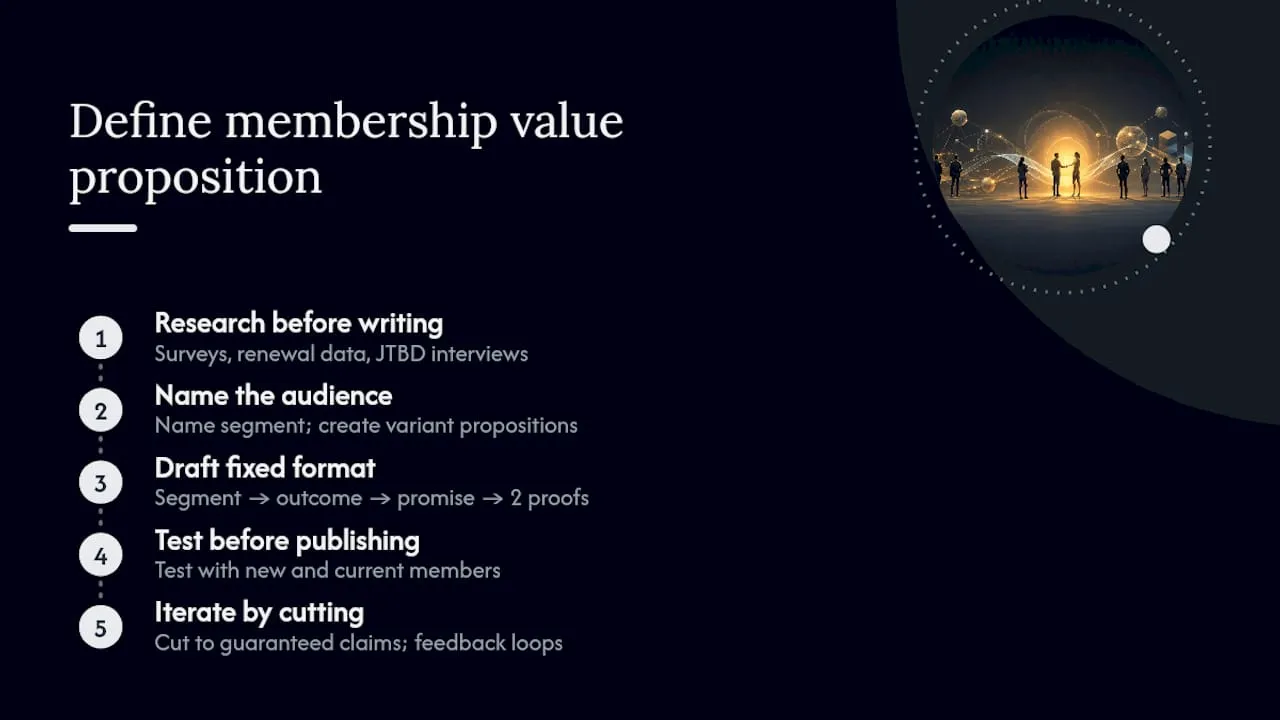
1. Research before you write a word. Move away from generic benefit lists and toward evidence about what members actually need. An approach Research by Design recommends over feature-first drafting. Run short surveys, pull renewal and non-renewal data by segment, and conduct a handful of structured interviews. The most useful interview technique here is a jobs-to-be-done approach: rather than asking “what benefits do you value,” ask “what were you trying to accomplish when you joined, and did membership help you get there.” The Christensen Institute’s jobs-to-be-done framework exists precisely because people rarely articulate their real motivation when asked directly about features.
2. Name the audience before you name the outcome. A proposition written for “our members” in general will always be weaker than one written for “second-year practice owners managing their first compliance audit.” Segment first. If your organisation genuinely serves several distinct groups with different jobs-to-be-done, you may need more than one proposition variant, each still following the same format.
3. Draft in a fixed format, not free prose. Use this structure and do not deviate from it: named segment, top outcome, single-line promise, two proof points, one supporting sentence. For example: “For newly qualified accountants, membership cuts the time to first client sign-off by giving you [name of accredited mentoring programme] and [X] hours of CPD credit recognised by [regulator].” Notice the format forces specificity. It is much harder to hide a vague claim inside that structure than inside a paragraph of marketing copy.
4. Test before you publish. Pressure-test the wording and the delivery with current members and, separately, with people who recently joined, because their expectations diverge, according to Knecht Strategies. Run two or three phrasing variants past a segment of each group. Watch what they push back on. If new members flag a claim as surprising or unfamiliar, that claim is not being communicated early enough in onboarding, regardless of whether it is true.
5. Iterate by cutting, not adding. The instinct after testing is usually to add more proof points to cover objections. Resist it. A credible proposition must be a promise of what the organisation delivers today, not an aspirational goal, according to the National Association of Realtors’ value proposition toolkit. Every claim that survives testing should be one the organisation can operationally guarantee, not one it hopes to grow into. Build feedback loops with frontline staff and renewing members so the proposition gets recut every year rather than left to calcify.
Pro Tip: If a benefit needs a footnote to explain why it’s not quite true yet, it isn’t ready for the proposition. Move it to a roadmap update instead.
Proving the promise: onboarding, channels and the metrics that matter
A proposition only earns trust once it is demonstrably true in a member’s daily experience, not just stated on a website. That is why the first-90-days period carries so much weight: it is the window where a new member either sees the promised outcome show up or quietly concludes the marketing overstated things. Practitioners recommend using a first-90-days strategy specifically to prove value quickly, closing the gap between the sign-up decision and the point where members actually feel engaged, per Knecht Strategies. Design onboarding to deliver one visible, unmistakable outcome tied directly to the proposition within the first 30 days: a guaranteed accredited learning module, or a confirmed invitation to a specialist networking session, rather than a generic welcome email.
Consistency across channels matters as much as the first win. Proof points should appear wherever a member or prospect encounters the organisation, not buried in a single “About Us” page:
- The membership page itself, stated as a specific figure, not “many benefits.”
- Onboarding emails, tied to the specific action the new member just took.
- Event confirmation messages, reinforcing the CE hours or networking value on offer.
- Renewal notices, restating the proof point that was true at sign-up and confirming it held.
A perception gap left unmeasured tends to widen, not close. Because perceived value and actual value diverge without deliberate tracking, according to Lumi Global, organisations need a small, consistent set of metrics rather than a one-off satisfaction survey.
Useful KPIs to track over time include onboarding completion rate within the first 30 days, CE or CPD uptake against the promised figure, engagement rates segmented by joining cohort (not just an organisation-wide average, which hides who is actually disengaging), and renewal rate broken down by whether members used the flagship proof-point benefit. Reviewing these quarterly, by cohort, shows whether the promise made at sign-up is holding up in practice, and gives the team an early warning long before a renewal notice goes unanswered. This same cohort-based tracking supports broader membership recruitment and retention strategies, since a proposition that performs well for one segment and poorly for another usually needs two variants, not one fix.
Putting the proposition to work operationally
Naming proof points is one thing. Keeping them visible and accurate for every member, in every channel, over years rather than months, is where most organisations lose the thread. A membership platform earns its place here by turning the proposition’s proof points into something the system tracks automatically rather than something a manager reconstructs manually before each board meeting.
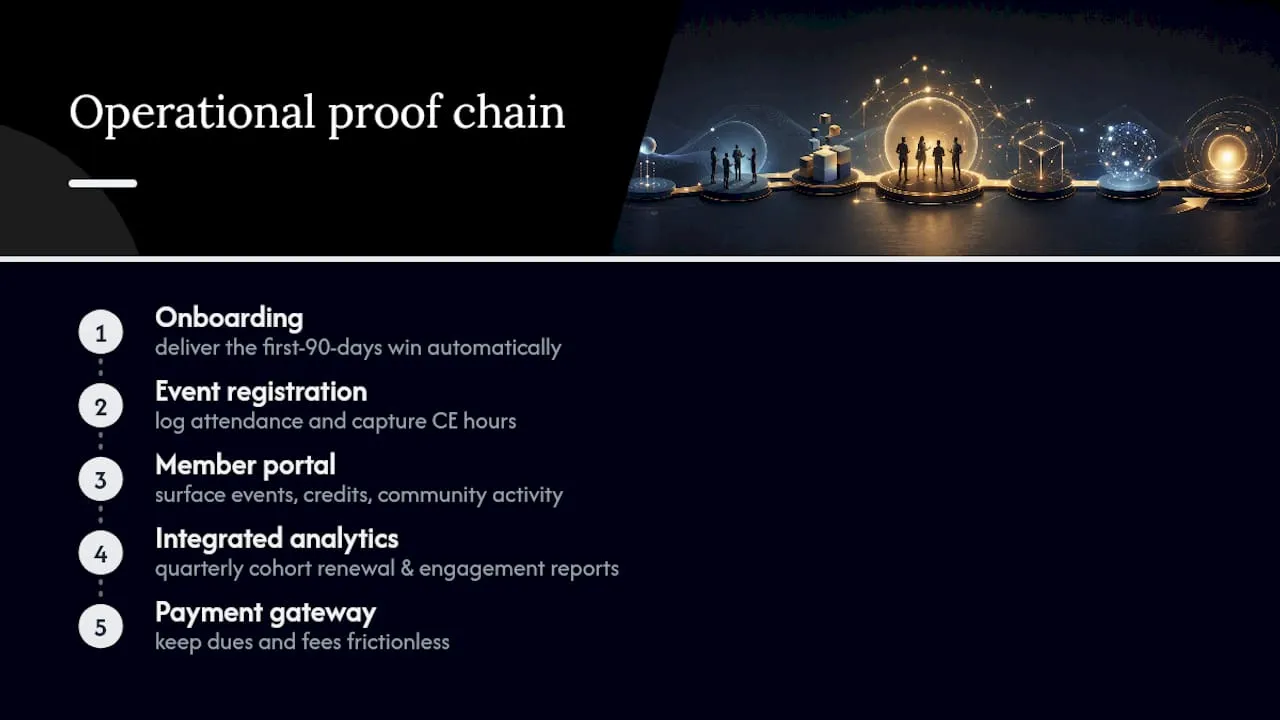
Onboarding workflows can be built to deliver the first-90-days win automatically. Event registration tools can log CE hours the moment a member attends a session, so the “X hours of accredited learning” claim in the proposition stays accurate without anyone chasing spreadsheets. Member portals give people a place to see their own accumulated value (events attended, credits earned, community activity) rather than taking the organisation’s word for it. Integrated analytics turn cohort-level renewal and engagement data into something a membership team can actually review quarterly, and payment gateway integration keeps the transactional side of that proposition (dues, event fees, CE certification costs) frictionless enough that it never becomes the reason a member lapses.
The mechanism matters more than the software brand: whatever platform an organisation uses, the proposition survives only if its proof points are tracked continuously and reported honestly, not reconstructed once a year under deadline pressure.
What membership teams get wrong about their own value proposition
The mistake shows up almost every time in the same place: a static slogan gets written once, approved by a committee, and then never touched again while the organisation itself keeps changing underneath it. A proposition frozen from three years ago rarely matches what the organisation delivers today, and members notice the gap faster than staff do.
The second mistake is reaching for aspiration instead of proof. “We’re building a stronger voice for the profession” sounds fine in a board meeting and means nothing to a member deciding whether to renew. Name a small number of things you can prove right now, test that wording on real members before you publish it anywhere permanent, and let the proposition grow only as fast as your delivery actually does. The organisations that get this right tend to involve members directly in drafting and checking the claims, not just in a satisfaction survey afterwards.
— Rob
A platform-based way to keep proof points current
Everything above works whether you run it through spreadsheets, a marketing team’s calendar, or a dedicated system; the discipline of researching, drafting, testing and proving the proposition doesn’t change. What changes is how much manual effort it takes to keep proof points accurate once your membership grows past a few hundred people.
A membership platform can bring member management, event and CE tracking, CRM, and analytics into one system, so the proof points inside your proposition (CE hours delivered, event attendance, cohort renewal rates) can be logged automatically instead of chased manually before a board report. That matters most in the first-90-days window, where onboarding workflows and member portals can be set up to deliver the specific early win your proposition promises, without a staff member manually tracking who received what. For organisations weighing this against building the tracking themselves, the membership software pricing page lists the Core, Growth, Scale, and Enterprise plans, and the feature overview shows how onboarding, event registration, and analytics connect. If you’re ready to see how your own proof points could be tracked automatically, request a walkthrough of the platform to map your current proposition onto it.
Sources
For a deeper look at the frameworks referenced here, MemberWise’s ultimate guide to member value sets out the Support, Status, Community, and Voice drivers in more depth. The National Association of Realtors’ value proposition toolkit offers a practical drafting template, and Pricing for Associations breaks down how quantitative and qualitative benefits interact in renewal decisions. For audience-led drafting techniques beyond membership specifically, Baby Love Growth’s guide to unique selling propositions is a useful companion piece.
- Membership value propositions — Pricing for Associations
- Discovering our value proposition — The Membership Guide
- Introducing the new ultimate guide to member value — MemberWise
FAQ
What does membership value mean?
Membership value is the combination of measurable benefits (discounts, CE hours, events) and emotional drivers (belonging, status, voice) that a member receives in exchange for joining and renewing. It only becomes a value proposition once those benefits are named for a specific audience and backed by proof, per MemberWise’s framework.
How do you define a value proposition for a membership organisation?
You define it by naming a specific member segment, stating the top outcome they get from joining, and backing that claim with at least one verifiable proof point. Research member needs first through interviews or surveys, draft in a fixed format, then pressure-test the wording with real members before publishing it, as recommended by Research by Design.
What are the three elements of a value proposition?
At minimum, a credible proposition needs a named audience, a stated outcome, and evidence that proves the outcome is real. Many organisations add a fourth element, the specific problem solved, to sharpen the promise further.
What are the key drivers of member value?
MemberWise groups member value into four core drivers: Support, Status, Community, and Voice, and recommends measuring the gap between what members perceive and what the organisation actually delivers, according to its member value guide. Quantitative proof points (discounts, CE hours, events) and qualitative drivers (belonging, recognition) both need representation for the proposition to hold up at renewal.
Does Colossus help organisations prove their membership value proposition?
Colossus supports this through onboarding workflows, event and CE tracking, member portals, and integrated analytics that turn proof points into figures a membership team can report on continuously. Current pricing for the Core, Growth, Scale, and Enterprise plans is listed on the membership software pricing page.