From £349/month: membership software comparison for UK organisations

For UK organisations that need one platform to handle members, payments and events, Colossus Systems is the strongest all-in-one option on the market today. If your needs are narrower, Beacon suits charities chasing Gift Aid efficiency, MemberMojo fits volunteer-run clubs on tight budgets, ClubSpark works well for sports facilities with bookings, and Wild Apricot remains a solid choice for online communities. The right pick depends on how heavily you rely on Direct Debit, Gift Aid and fast onboarding.
TL;DR:
- Platforms like Colossus Systems excel for organizations requiring integrated management of members, events, CRM, and online payments, especially when handling fundraising and Gift Aid is crucial.
- Simpler, volunteer-focused groups benefit from low-cost or free options such as MemberMojo, Zeffy, and Raklet, which prioritize ease of use over advanced features.
- Booking-heavy organizations like sports clubs should prioritize platforms like ClubSpark or Spond that specialize in facility scheduling and community coordination over full CRM capabilities.
- When selecting, organizations must verify native support for Direct Debit, Gift Aid tracking, and VAT considerations, as well as ensure the platform scales with growth without restrictive tier limits.
- Contract terms vary, with many platforms offering monthly billing free of long minimum commitments, but data export rights and cancellation periods should be carefully checked to avoid vendor lock-in.
Table of Contents
- Best membership software UK picks by use case
- How do the leading platforms compare on UK-specific features?
- What Colossus and the other listed platforms actually offer
- How to choose membership software in the UK
- What Colossus brings to the table for UK membership organisations
- Contract terms, minimum commitments and exit fees
- Specialist tool or all-in-one platform: which suits your organisation?
- Ready to see Colossus in action?
- Sources
- FAQ
Best membership software UK picks by use case
Choosing the right platform starts with being honest about your organisation’s dominant workflow. A charity chasing Gift Aid reclaims has different priorities to a five-a-side league tracking match fees, and the “best” answer changes accordingly. This membership software comparison UK guide breaks the market down by the buyer job each platform does well, rather than pretending one tool wins every category.
For charities running fundraising alongside membership, the choice usually comes down to how much of your income flows through Gift Aid and recurring donations. Colossus Systems handles this well because its CRM and payments sit inside the same platform as your events and member communications, so a Gift Aid eligible subscription doesn’t need a separate reconciliation step against your donor database. Gift Aid can apply to membership subscriptions in specific circumstances, but only where the charity collects a signed declaration and confirms the member pays UK tax, so your software needs to track that declaration status cleanly. Beacon is worth a look if fundraising is your only real workflow and membership is a secondary feature, since it was built fundraising-first with HMRC-facing workflows baked in. Donorfy is another option here, particularly for charities that already lean on GoCardless for Direct Debit collection and want a fundraising CRM that treats membership as one revenue stream among several.
For volunteer-run clubs and societies, cost and simplicity beat feature depth almost every time. Nobody running a bowls club or a local history society on evenings and weekends wants to learn a CRM. MemberMojo was built with exactly this reader in mind: renewal reminders, a members’ list, and payment collection without a steep learning curve. Zeffy takes a different route by offering a free tier aimed squarely at small charities and community groups, which matters when your entire annual budget might be a few hundred pounds. Both trade some depth of reporting and integration for the fact that a volunteer treasurer can actually run them without training.
For gyms, sports clubs and leisure organisations, bookings and class scheduling usually matter more than fundraising features. ClubSpark was designed around court and facility bookings alongside membership renewals, which suits tennis clubs, leisure centres and similar operators where “membership” really means “access to a shared resource.” Spond leans more towards community coordination, useful for grassroots sports clubs that need to organise training sessions and matches as much as collect subscriptions. Coacha and ClassForKids sit in a related niche for organisations running structured classes, particularly where parents are booking and paying for children’s sessions rather than the child holding their own membership.
For online communities and creator-led memberships, the calculation shifts again. Wild Apricot has long been a reference point for associations and clubs that want members to self-serve, renewing and updating their own details without staff intervention. Raklet offers a similar engagement-first approach with a lower-cost entry point, useful for smaller online communities that need paid tiers, events and communication tools but don’t yet have the volume to justify enterprise pricing. Join It occupies similar territory, aimed at organisations that want member self-service without a lengthy implementation.
A few buyer-fit notes worth holding onto as you shortlist:
- If Gift Aid reclaims are a meaningful part of your income, prioritise platforms with declaration tracking built in rather than bolted on.
- If your treasurer is a volunteer with limited software experience, weight simplicity above feature count.
- If bookings or class scheduling are your core transaction, check the platform’s calendar and capacity tools before its CRM depth.
- If you expect rapid growth in member numbers, ask about tier limits before signing, since some free and entry tiers cap out quickly.
How do the leading platforms compare on UK-specific features?
The dimensions that matter most for UK organisations rarely show up on a generic feature list. Payment handling, Gift Aid support and where your data actually sits all carry weight that a simple star rating doesn’t capture.
| Platform | Best for | Payments support | Deployment & scalability | Integrations | Support & onboarding | Pricing shape |
|---|---|---|---|---|---|---|
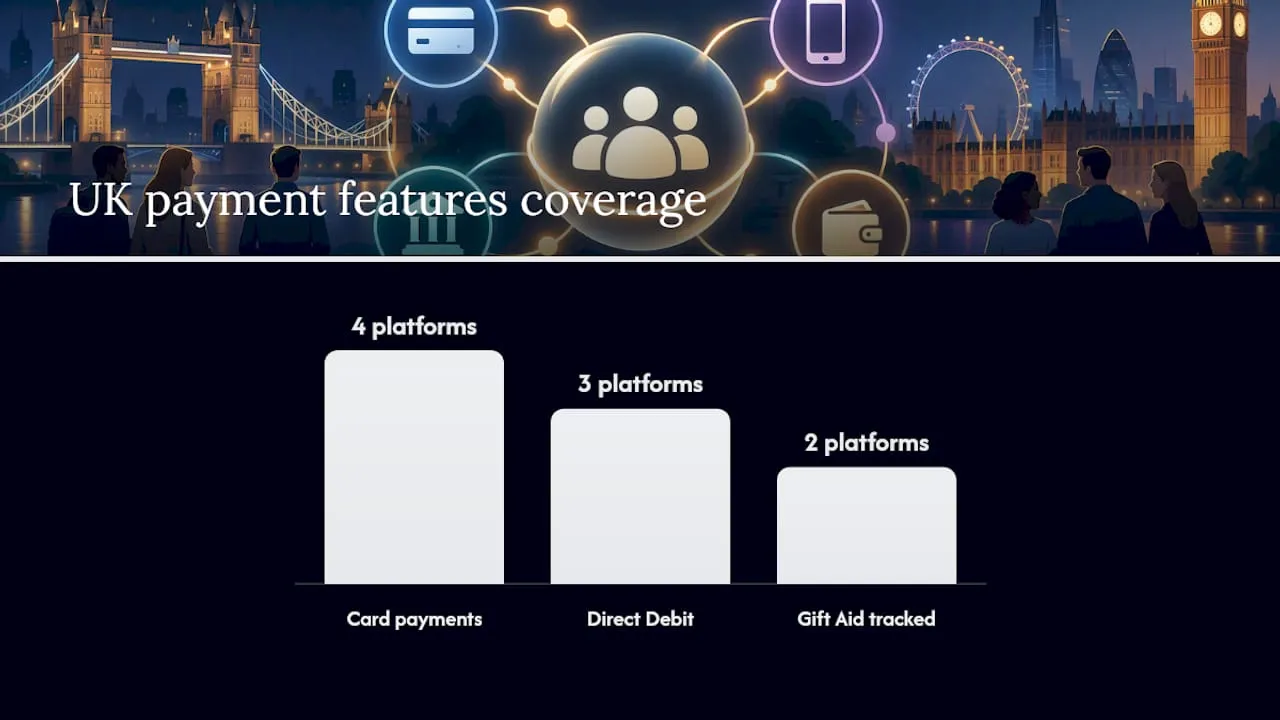
| Colossus Systems | Organisations wanting one platform for members, events and CRM | Card, Direct Debit and Gift Aid tracked workflows | Cloud, scales from small clubs to large associations | CRM, email marketing, e-commerce and payment gateways built in | Guided onboarding across all tiers | Subscription tiers from £349/month |
| Wild Apricot | Associations needing self-service member portals | Card payments, some Direct Debit integrations | Cloud, established at small-to-medium scale | Payment gateways, email tools | Remote support | Per-tier subscription |
| MemberMojo | Volunteer-run clubs and societies | Card and Direct Debit for renewals | Cloud, built for modest member volumes | Basic payment integrations | Remote support | Low-cost subscription tiers |
| White Fuse | Small-to-mid charities wanting an integrated website | Card payments, donations | Cloud | Website builder, donations, membership | UK-based support | Subscription, quote-based |
| Beacon | Charities needing embedded fundraising | Gift Aid tracked donations, card payments | Cloud | Fundraising CRM integrations | UK-focused onboarding | Quote-based |
| ClubSpark | Sports clubs and leisure organisations | Card payments for bookings and memberships | Cloud, scales with facility bookings | Booking calendars, payment gateways | Remote support | Subscription, quote-based |
| Spond | Community groups and clubs | Card payments for fees | Cloud, small-to-medium groups | Basic communication tools | Remote support | Free and paid tiers |
| WebCollect | Small organisations needing simple payment admin | Card and Direct Debit | Cloud, small scale | Basic bookkeeping exports | Remote support | Subscription |
| Zeffy | Very small charities and community groups | Card payments, donations | Cloud, small scale | Basic fundraising tools | Remote support | Free tier |
| Raklet | Small organisations wanting engagement tools | Card payments | Cloud, scales from starter tier | Engagement and communication tools | Remote support | Free starter tier, paid tiers |
| Donorfy | Charities wanting fundraising CRM with membership | GoCardless, card, Gift Aid workflows | Cloud | Broad fundraising integrations | UK-based support | Quote-based |
“Payments support” in the table above means whether a platform natively handles Direct Debit collection (often via GoCardless), card payments, and Gift Aid declaration tracking, rather than requiring a bolt-on tool or manual reconciliation. “Deployment and scalability” reflects whether the platform is built for a handful of volunteers or genuinely holds up at thousands of members without a costly re-platform. “Integrations” covers how much of your accounting, email marketing and payment processing lives inside the tool versus needing a separate subscription elsewhere.
Two UK-specific checks deserve attention before you sign anything. First, UK SaaS subscriptions for charities typically attract VAT, so a quoted monthly price rarely reflects your final invoice, ask the vendor directly rather than assuming a sector exemption applies. Second, Direct Debit collection through GoCardless or a similar processor usually carries a per-transaction fee on top of your software subscription, which matters if you’re comparing a £29 add-on licence against a platform that bundles payment processing into its core price.
What Colossus and the other listed platforms actually offer
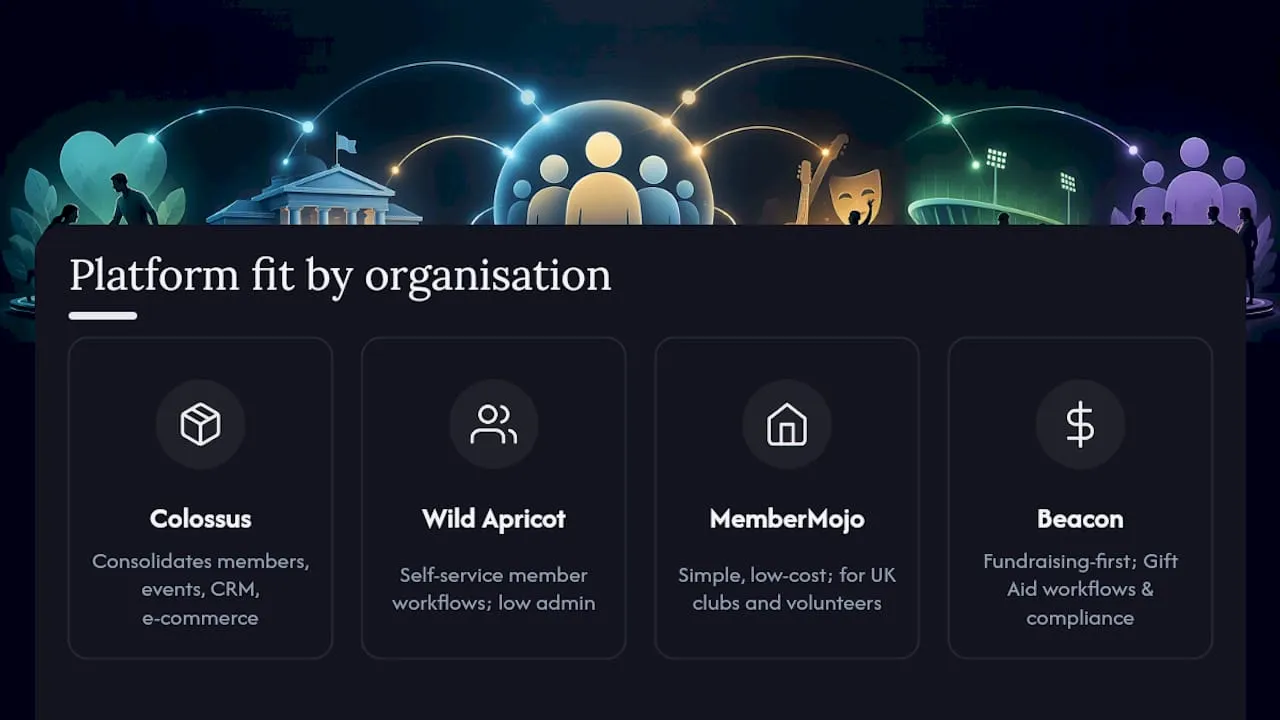
Reading feature lists side by side only tells you so much. What matters is which platform fits your organisation’s actual shape, not the vendor with the longest bullet list. Colossus Systems leads this rundown because it’s the platform this guide is published by, and because its structure genuinely suits organisations trying to consolidate several tools into one.
Colossus Systems brings member management, event hosting, CRM, email marketing and e-commerce into a single configurable platform. Organisations running annual conferences, monthly chapter meetings or an ongoing training programme alongside standard membership renewals get one system rather than three subscriptions stitched together with exports and imports. Pricing runs across several subscription tiers, including options for enterprise-level and contributor licences for limited seats. The platform’s feature set covers payment gateway integration, customisable sales pipelines and member portals, which suits associations that want their events, CRM and communications reported on together rather than reconciled across separate dashboards. Onboarding support may be available at various subscription tiers, which is relevant for organisations migrating years of member records from spreadsheets or legacy systems.
Wild Apricot has been a reference point in the sector for years, largely because of how far it takes self-service. Members update their own contact details, renew subscriptions and register for events without staff intervention, which suits associations with limited administrative capacity. It’s a solid fit for organisations whose membership base is reasonably tech-comfortable.
MemberMojo keeps things deliberately simple. It was built with UK clubs and societies in mind, and its renewal tools and low-cost tiers suit organisations run by volunteers who don’t want to learn a new system every committee handover.
White Fuse combines a website builder with membership and donation tools, aimed at small-to-mid charities that need an integrated web presence as much as a back-office member database. Organisations that don’t already have a website, or want to replace an ageing one alongside their membership system, get a two-in-one benefit here.
Beacon is fundraising-first. Its Gift Aid-focused workflows suit charities where membership subscriptions and donations are closely intertwined, and where HMRC compliance around Gift Aid declarations needs to be airtight.
ClubSpark centres on bookings. Sports clubs and leisure organisations that manage court time, class slots or facility access alongside standard membership fees will find its booking calendar more relevant than a generic member database.
Spond focuses on communication and coordination for community groups, particularly grassroots sports teams that need to organise fixtures and training as much as collect subscriptions.
WebCollect offers UK organisations a straightforward way to manage subscriptions and online payments without the overhead of a full CRM, useful for smaller clubs that mainly need clean payment admin and light bookkeeping.
Memberlytic is built for associations that want structured membership administration paired with communication tools, according to its own comparison of UK membership platforms.
sheepCRM positions itself around UK-based hosting and support, which appeals to organisations with a strong preference for keeping member data and support conversations within the UK, alongside general GDPR-consciousness.
Zeffy offers a free tier aimed at very small charities and community groups, with fundraising features layered on top. It’s a genuine option for organisations with minimal budget where a paid subscription simply isn’t viable yet.
Raklet provides an all-in-one approach with a free starter tier, suiting small organisations that want engagement features (member directories, event listings, payment collection) without committing to a paid plan from day one.
Donorfy is a fundraising CRM with membership capabilities layered in, and its GoCardless support makes it a reasonable fit for charities that treat membership as one income stream among several fundraising channels.
Pitchero serves grassroots sports clubs, particularly football and rugby clubs, with club website and membership tools built around a sporting calendar.
ClubPilot is aimed at UK club management more broadly, and its own rundown of club management software covers similar territory: bookings, membership and communication for member-run organisations.
Join It targets organisations wanting a simple, self-service membership signup and renewal flow without a long implementation process.
Admidio is an open-source option, appealing to technically capable organisations that want full control over hosting and customisation without a recurring licence fee, in exchange for handling their own server maintenance.
ChurchSuite serves churches and faith organisations specifically, with attendance tracking, giving records and rota management alongside membership.
LoveAdmin (Thrive4) focuses on payment collection and administration for clubs, particularly sports and activity providers managing term-time bookings.
ClassForKids and Coacha both serve organisations running structured children’s activities, where parents book and pay for sessions on behalf of a child rather than the child holding an independent membership.
SubscriberCRM and Silverbear sit towards the association and membership-body end of the market, often chosen by professional bodies and trade associations with more complex governance and reporting needs.
Star Chapter (also marketed as StarChapter) is built specifically for chapter-based associations, useful where a national body has multiple regional chapters each needing semi-independent membership management.
MemberClicks and CiviCRM round out the association-focused end of the market, with CiviCRM notable as an open-source CRM option for organisations that want to avoid ongoing licence fees in exchange for managing their own technical maintenance.
How to choose membership software in the UK
A structured evaluation beats a feature-list comparison every time, because the features that look impressive on a sales call aren’t always the ones your treasurer or membership secretary will use weekly. Run through this checklist before you commit to a demo, let alone a contract:
- Confirm payment handling first. Does the platform support Direct Debit collection, card payments and Gift Aid declaration tracking natively, or will you need a separate tool bolted on?
- Check VAT treatment on the quote. UK SaaS subscriptions for charities typically attract VAT, so ask the vendor to confirm the final invoiced amount rather than assuming the quoted price is what you’ll pay.
- Ask about data protection and hosting location. Confirm where member data is stored and what GDPR safeguards the vendor has in place, particularly if your governing document promises members a certain standard of data handling.
- Test the integrations you actually use. Confirm compatibility with your accounting software and email marketing tool before signing, not after migration.
- Ask for a realistic onboarding timeline. Vendors vary widely here; some organisations are live within two to three weeks, others take two to three months depending on data complexity.
- Run a genuine trial. Test the full payment flow, including a refund, and export your data before deciding, so you know exactly what you’d be left with if you ever switch again.
- Check governance fit if you’re a registered charity. The Charity Commission expects trustees to exercise reasonable care over financial systems, so document why you chose your platform.
Watch for a few red flags during this process: vendors reluctant to confirm VAT treatment in writing, platforms that can’t export your full member history in a usable format, and any provider unwilling to let you test the payment flow before you sign.
Pro Tip: Before you commit, ask the vendor to run a live test Direct Debit collection and a data export during your trial period, not just a demo account. This is the single fastest way to spot a platform that looks polished in a sales call but struggles with the practical mechanics you’ll rely on every renewal cycle.
What Colossus brings to the table for UK membership organisations
Colossus Systems was built around the idea that a membership organisation shouldn’t need five separate logins to run its operation. The platform combines member management, event hosting and virtual training, CRM, email marketing and e-commerce functionality within one system, with customisable workflows that let organisations tailor sales pipelines, event registration and communication channels to their own structure rather than forcing a generic template onto every member type.
For payments, such platforms integrate with online payment gateways to handle secure transactions, which matters when membership subscriptions, event ticketing and e-commerce sales all flow through the same organisation. Onboarding support is often offered at various subscription tiers, which is relevant for organisations migrating member records from spreadsheets, legacy databases or previous membership platforms.
Some platforms’ core strengths include consolidation: rather than reporting on membership numbers in one tool, event attendance in another, and email engagement in a third, these platforms bring that data together so trustees and committee members can see the full picture of organisational health in one place. This is particularly relevant for associations juggling chapter structures, recurring events and CRM-driven member communications simultaneously.
Contract terms, minimum commitments and exit fees
Membership software contracts vary considerably in how they lock organisations in, and this is worth scrutinising as closely as the feature list. Many platforms in this comparison offer monthly subscription billing with no long minimum term, which suits smaller clubs and societies that want flexibility if their membership numbers shift. Others, particularly those quoting bespoke enterprise pricing, tend towards annual contracts with a minimum commitment period, often twelve months, in exchange for a better per-member rate.
Exit fees aren’t universal, but data export charges sometimes are, and this is exactly the kind of clause that gets missed until an organisation actually wants to leave. Ask specifically whether your member records, transaction history and event data can be exported in a usable format (a CSV or similar) at no extra charge, and whether that right survives past your contract’s end date or only applies during an active subscription. For charities in particular, trustees have a duty to ensure organisational assets, including data, aren’t held hostage by a vendor relationship that’s no longer serving members well. Read the cancellation notice period carefully too. Thirty days is common, but some annual contracts require ninety days’ written notice before renewal to avoid auto-rolling into another full year.
Specialist tool or all-in-one platform: which suits your organisation?
The honest answer depends on how many distinct workflows your organisation actually runs, not on which option sounds more impressive. A running club that does nothing but manage class bookings and renewals genuinely might be better served by a specialist tool like ClubSpark or Coacha, because a narrower tool built around one job tends to do that job with less friction than a general platform configured to mimic it.
Where the calculation flips is complexity. The moment your organisation runs events, sends regular member communications, tracks a sales pipeline for corporate sponsors, and handles renewals, a specialist tool starts requiring two or three integrations just to get a single view of a member. Each integration is another point of failure, another login, and another monthly fee. That’s where an all-in-one platform earns its cost: not because it’s more feature-rich on paper, but because it removes the reconciliation work between systems that don’t talk to each other cleanly.
A rough rule of thumb: if your organisation has one dominant workflow and modest growth ambitions, a specialist tool keeps things simple. If you’re juggling three or more distinct functions and want one report that actually reflects your whole membership, an all-in-one platform like Colossus Systems is the more sustainable choice, which is exactly why it leads this comparison for organisations outgrowing a patchwork of separate tools.
— Rob
Ready to see Colossus in action?
Some platforms offer an alternative to running multiple disconnected tools for membership, events and CRM. Instead of paying separately for a member database, an events platform, an email tool and a payment processor, a single subscription may cover all of it, with pricing starting at a mid-range monthly fee and scaling up to higher tiers as organisations grow.
Before booking a demo, gather a few details so the conversation is worth your time: your current member count, how your revenue splits across subscriptions, events and merchandise, and which accounting or email tools you’d need Colossus to work alongside. Most organisations move from first enquiry to a live system within a few weeks once these details are ready, though larger associations migrating substantial historical data should budget closer to two months. Check the full membership software pricing breakdown to see which tier fits your member volume, browse the features page for a detailed look at the CRM and events tools, or head to the event management product page if events are your primary driver of member engagement. When you’re ready, get in touch to arrange a demo tailored to your organisation’s actual numbers.
FAQ
What is the best membership software?
There’s no single best platform across every organisation type. Colossus Systems is the strongest all-in-one choice for organisations wanting members, events, CRM and payments in one system, while specialist tools like ClubSpark or MemberMojo suit narrower, single-workflow needs.
What is the best membership software for nonprofits in the UK?
For charities and nonprofits, the right platform usually depends on how central fundraising is to your membership model. Beacon and Donorfy focus heavily on Gift Aid and fundraising CRM features, while Colossus Systems suits nonprofits that also run substantial events and communications alongside membership.
What are the top membership organisations in the UK?
The UK’s largest membership bodies span sectors from professional associations to sports governing bodies and consumer groups, and there’s no single definitive ranking that applies across all of them. What they tend to share is a need for software that scales to thousands of members while still handling Gift Aid, Direct Debit and event registration cleanly.
What is the best free membership management platform?
Zeffy offers a genuinely free tier aimed at small charities and community groups, and Raklet provides a free starter tier for smaller organisations wanting basic engagement tools. Neither matches the depth of a paid all-in-one platform, but both are workable starting points for organisations with minimal budget.