Mandate Lifecycle: Membership Direct Debit Software That Syncs to CRM

Yes, membership organisations should choose direct debit software that automates the mandate lifecycle and syncs payment status directly with your CRM. That single capability determines whether staff spend their week chasing failed payments or running the organisation. Integrated membership platforms often bundle this functionality with CRM and reporting tools, which removes the need to stitch separate systems together.
TL;DR:
- Automating mandate lifecycle management and syncing payment status with the CRM reduces manual admin and prevents record mismatches.
- Software must support digital mandate creation, live status tracking, and bulk updates to handle bank detail changes and cancellations effectively.
- Compliance requires a creditor identifier, clear advance-notice communication, correct file formats, and separate mandate consent, all managed automatically by suitable software.
- Connecting payment status directly to member records speeds up issue resolution and cuts down on time-consuming reconciliation processes.
- Combining Direct Debit with member portals and other payment options offers convenience, reduces failures, and lowers administrative burdens for membership organizations.
Table of Contents
- Why Direct Debit improves membership operations
- Key software features membership organisations must require
- Integration and compliance essentials for Direct Debit collections
- Step-by-step implementation checklist for membership organisations
- Comparing leading membership Direct Debit software options
- Security practices and data protection in membership direct debit software
- Mobile and online payment options alongside Direct Debit
- Publisher perspective: how an integrated platform reduces payment friction
- How Colossus Systems supports membership Direct Debit workflows
- Primary sources and further reading
- Sources
- FAQ
Why Direct Debit improves membership operations
Direct Debit tends to fail less often than card payments, largely because it does not depend on expiry dates or reissued cards. For membership organisations, that difference shows up directly in retention: fewer lapsed members means less time spent re-engaging people who never actually intended to leave. Predictable collection dates also give finance teams a clearer picture of monthly income, which makes budgeting and cashflow forecasting far less of a guessing game.
Good software builds on these natural strengths by automating the admin layer around collections. Industry guidance for membership organisations notes that the real operational burden usually sits in mandate changes and failed-collection handling, and that software automating mandate status tracking and bulk edits cuts this workload significantly.
- Fewer payment failures: Direct Debit avoids the card-expiry and reissue problems that interrupt subscriptions.
- Steadier cashflow: fixed collection dates make monthly and annual forecasting easier to plan around.
- Less manual admin: automated status tracking replaces spreadsheet reconciliation and manual chasing.
Automating mandate status inside the CRM reduces lapses more than running Direct Debit through a standalone processor, according to industry guidance for membership organisations, because staff can act on payment problems the moment they appear rather than discovering them at month-end.
Key software features membership organisations must require
Not all Direct Debit tools are built with membership operations in mind, so it helps to know exactly what to demand before signing a contract. The features below separate genuinely membership-ready platforms from generic payment processors bolted onto a database.
- Mandate lifecycle management: digital mandate creation, live status tracking and the ability to bulk-update mandates when members change bank details.
- CRM or AMS integration: two-way sync so payment status updates member records automatically and triggers follow-ups without manual entry.
- Automated retries and dunning: a configurable retry schedule for failed collections, with escalation messaging before a membership lapses.
- Flexible billing mechanics: support for proration, mid-cycle joiners and fee changes without breaking existing mandates.
- Reporting and file exports: SEPA XML or Bacs-format exports for accounting, plus a self-service portal so members can update their own details.
The most frequent operational failure point in any membership Direct Debit setup is the mandate lifecycle itself, since bank detail changes, cancellations and reissues are where records fall out of sync. Practical guidance on Direct Debit implementations suggests the best mitigation is software that timestamps every mandate change and supports bulk edits, so return files feed straight back into member records instead of sitting in a separate reconciliation spreadsheet.
Pro Tip: Ask any vendor to demonstrate a failed-payment scenario end to end, from the bank return file to the member record update, before you sign anything.
Integration and compliance essentials for Direct Debit collections
Collecting Direct Debit membership fees carries real legal obligations, and software should handle most of them without staff needing to become compliance experts. Associations collecting SEPA Direct Debit need a creditor identifier and a valid SEPA mandate before the first collection, along with a documented process for storing that mandate. Guidance for associations in Germany explains the creditor identifier, mandate requirements and advance-notice obligations that underpin compliant SEPA collections, and provides mandate templates organisations can adapt.
- Confirm your creditor identifier and mandate format before building any sign-up flow, since both are prerequisites for SEPA collections.
- Automate advance-notice mailings, since members must be told before a collection runs, and the required notice period varies by jurisdiction.
- Generate compliant file formats: software should produce SEPA XML or camt.054 return files, or Bacs-equivalent formats, for reconciliation and accounting.
- Keep sign-up and mandate consent separate, since combining the two without explicit confirmation is a common compliance pitfall.
- Build in cut-off checks, since scheduling a collection too close to a bank’s processing deadline is a frequent source of failed payments.
Software that automates SEPA XML generation and processes camt.054 failed-transaction reports removes much of this manual risk, as Cegid’s documentation on Direct Debit management shows for SEPA-compliant collection workflows.
Step-by-step implementation checklist for membership organisations
Launching or switching Direct Debit collections is straightforward when broken into stages, and rushing any one of them is usually what causes member losses.
- Prepare the groundwork: confirm your creditor identifier, finalise a mandate template and select a small pilot group of members.
- Embed the mandate in sign-up: build the digital mandate directly into your joining flow, since combined joining and payment forms reduce drop-off compared with a separate payment step added later.
- Run a pilot collection: process a small batch first, monitor failed items closely and adjust retry timing before rolling out to the full membership.
- Assign clear ownership: name who handles reconciliation and who handles exceptions, so failed payments do not sit unresolved.
- Prepare member communications early: draft the notice you will send members before any fee change, well ahead of the advance-notice deadline your jurisdiction requires.
Pro Tip: Run your pilot group through a full failed-payment and retry cycle before rolling out, not just a successful collection, so you catch process gaps while the group is still small.
Comparing leading membership Direct Debit software options
The market splits broadly into three types of tool. Dedicated CRM-embedded extensions, such as the Direct Debit module documented for CiviCRM, focus on batch processing and accounting-code configuration wired directly into membership records, which suits organisations already committed to that CRM. Standalone Direct Debit management tools, such as Cegid’s product, concentrate on SEPA XML generation, EBICS or FTP transmission and mandate management, and tend to suit organisations that prefer to keep collections in-house rather than through a member-facing portal.
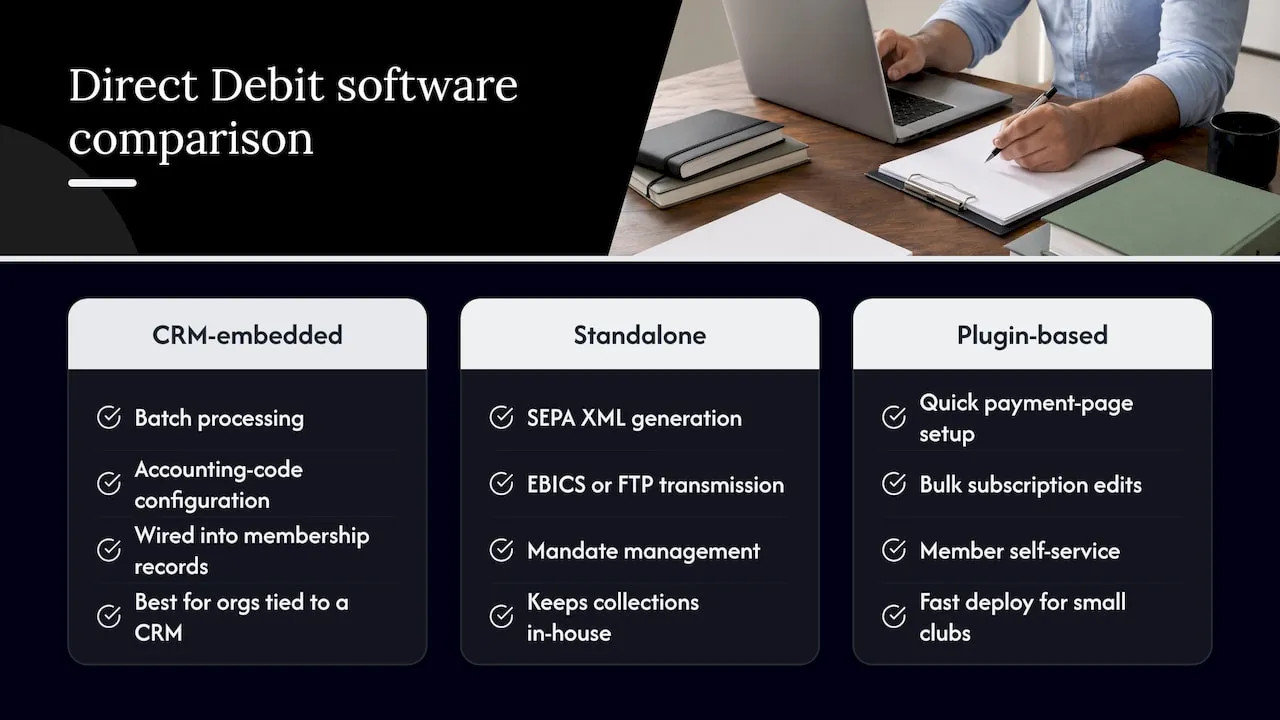
Plugin-based tools, such as WPdirectdebit for WordPress sites, prioritise member-facing convenience: quick payment-page setup, bulk subscription edits and member self-service for pausing or updating payments, which suits smaller clubs and volunteer-run organisations that need something fast to deploy. General subscription billing platforms, including Recurly and Stripe Billing, offer strong automated dunning, proration and flexible billing cycles, but the choice between a dedicated membership platform and a general billing provider ultimately depends on how tightly payments need to integrate with member engagement workflows, not just billing logic. Scalability follows the same pattern: CRM-embedded tools scale with your existing database, while standalone processors scale with transaction volume regardless of your membership system.
Security practices and data protection in membership direct debit software
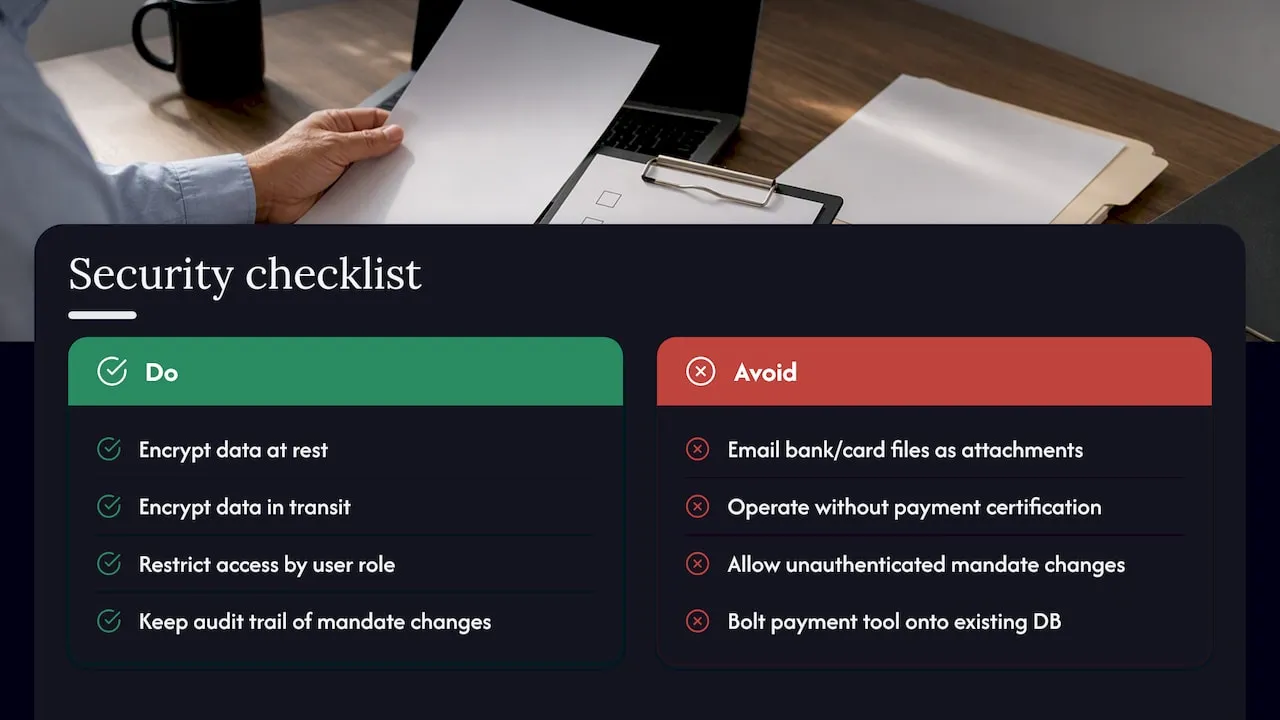
Membership organisations hold bank details for potentially thousands of members, which makes security a baseline requirement rather than a nice-to-have. At minimum, software should encrypt mandate and payment data both in storage and in transit, restrict access to payment records by role, and keep an audit trail of every mandate change, since disputes over authorisation are among the most common member complaints.
File-based reconciliation, using formats such as SEPA XML or camt.054, should happen over secure transmission channels rather than manual email attachments, and platforms handling card or bank details directly should carry appropriate payment industry certification. Member self-service portals need the same scrutiny: a member updating their own bank details should authenticate properly before any change reaches the mandate record. None of this is exotic, but it is exactly the kind of detail that gets skipped when organisations bolt a payment tool onto an existing database rather than choosing software built around mandate handling from the outset.
Mobile and online payment options alongside Direct Debit
Direct Debit remains the backbone of recurring membership fees, but members increasingly expect to manage everything from a phone, not just set up the mandate once and forget it. Software that pairs Direct Debit with an online member portal lets people check payment history, update bank details or pause a subscription without emailing an administrator, which is exactly the kind of member self-service functionality that reduces admin load on small teams.
Card payments and digital wallets still have a role for one-off charges such as event tickets or merchandise, even where the core membership fee runs on Direct Debit. The organisations that get the most value from their software treat Direct Debit and card payments as complementary rather than competing options, routing recurring dues through Direct Debit for its lower failure rate while keeping card payments available for ad hoc purchases.
Publisher perspective: how an integrated platform reduces payment friction
Most payment failures in membership organisations are not really payment problems, they are data problems. A mandate gets cancelled at the bank, the CRM never hears about it, and three months later someone is manually chasing a member who thinks they already left. Centralising CRM, events and payments in one system closes that gap because a mandate change updates the member record the moment it happens, not at the next manual export.
The organisations that struggle most tend to be the ones running payments through one tool and membership records through another, then reconciling the two by hand every month. Shortening that gap between a bank event and a member record update is where most of the admin time actually gets saved.
— Rob
How Colossus Systems supports membership Direct Debit workflows
Colossus Systems brings mandate-friendly sign-up flows, CRM synchronisation and payment reporting together in one platform, which means a bank return file updates a member’s record automatically rather than waiting for someone to notice a failed payment. Our membership management software is built around this connection between payment status and member engagement, so a lapsed mandate can trigger a follow-up sequence without any manual handoff between systems.
Organisations at different stages can start at different points: the Core plan suits smaller membership bodies getting their first automated Direct Debit workflow running, while Growth, Scale and Enterprise add capacity as member numbers and reporting needs grow. Full details of each tier, including the Core plan at £349 per month and the Enterprise plan from £2,500 per month, are on our pricing page. If you want to see how mandate lifecycle automation and CRM sync would work for your organisation specifically, get in touch for a demo.
Primary sources and further reading
For technical compliance detail, see the SEPA guidance for associations covering creditor identifiers and mandate templates, and Cegid’s Direct Debit documentation on SEPA file formats. For CRM selection alongside payment tools, this comparison of CRMs for non-profits is a useful starting point.
Sources
- How associations in Germany can collect membership fees using SEPA Direct Debit | Stripe
- Direct Debit for Membership Extras (README) | Compucorp (GitHub)
- GoCardless Direct Debit for WordPress - WPdirectdebit
FAQ
What is the best software for membership management?
The best option depends on your organisation’s size and needs, but the strongest candidates combine membership records, CRM functionality and payment automation in one system rather than requiring separate tools. Look for platforms that sync mandate status with member records automatically, since that connection is what actually reduces admin over time.
How do I cancel a membership Direct Debit?
Members can typically cancel a Direct Debit mandate directly with their bank at any time, which immediately stops future collections regardless of what the membership organisation’s own records show. Good membership software detects this cancellation through bank return files and updates the member’s status automatically, so staff are not left chasing a payment that will never arrive.
What subscriptions use Direct Debit?
Direct Debit is common for recurring membership dues, gym and club subscriptions, professional association fees and charity donations, largely because it suits fixed, predictable payment amounts collected on a regular schedule. It is less suited to variable, one-off charges, which is why many organisations pair it with card payments for occasional purchases such as event tickets.
Is Direct Debit being phased out?
No, Direct Debit remains a standard and widely used method for recurring payments, including membership fees, across many countries. It continues to be actively supported by banks and payment providers, with ongoing development of digital mandate tools and reporting formats rather than any move away from the method.