Stop Direct Debit Migration Failures: UK Membership Database Software

Pick an integrated, GDPR-aware membership platform that handles Direct Debit, events, member portals, and access controls in one place. Before shortlisting anyone, run a short internal audit of your existing data (fields, mandates, duplicates) and book a demo with two or three providers so you can compare real workflows, not brochures.
TL;DR:
- Membership platforms must support automatic renewal triggers, online member self-service portals, and robust Direct Debit reconciliation with bank records.
- Small organisations benefit from simple hosted apps, while larger bodies require enterprise-level systems with custom workflows and advanced permissions.
- Migration challenges mainly stem from re-establishing Direct Debit mandates, requiring thorough testing, deduplication, and member communication to reduce support calls.
- Ensuring GDPR compliance involves identifying lawful data processing bases, controlling access to sensitive category data, and verifying vendor data protection terms.
- Focus on testing payment failure scenarios in live environments before full migration to avoid costly mandate mishandling and reconciliation issues.
Table of Contents
- What is membership database software UK organisations actually need?
- Which solution categories suit small, medium and large membership bodies?
- What breaks during migration, and how do you avoid it?
- Data protection and compliance checklist for UK membership databases
- Integrations and workflows to prioritise
- How do you choose the right membership CRM software?
- Why Colossus Systems is a practical option for UK membership organisations
- What actually matters when you’re the one signing the contract
- Colossus Systems: trial, pricing and contact
- Sources
- FAQ
What is membership database software UK organisations actually need?
Membership database software UK organisations rely on has to do far more than store names and addresses. It needs to manage the full member lifecycle: joining, paying, renewing, attending events, and leaving, while keeping a clean audit trail throughout.
The core feature set looks fairly consistent across the market, which makes it easier to compare providers on substance rather than marketing copy. Capterra’s listings for UK membership platforms confirm the baseline: member directories, renewals, event registration and payment processing appear across almost every serious product.
What you should expect as standard:
- Member records with custom fields for things like committee roles, qualifications, or accessibility needs.
- A self-service portal where members update their own details and view payment history.
- Subscriptions and renewals that trigger automatically, with grace periods and reminder emails built in.
- Payment processing covering both card and Direct Debit, since a large share of UK membership fees are collected via mandate rather than card.
- Event management for bookings, waiting lists, and attendance tracking.
- Role-based permissions so volunteers and trustees only see what they need to.
- Reporting that produces board-ready figures without a spreadsheet rebuild every quarter.
The Direct Debit piece deserves particular attention. UK organisations typically process mandates through Bacs-approved bureaus or through GoCardless integrations, and reconciliation between what the bank confirms and what your database records needs to happen automatically, not through a monthly manual check. Get this wrong and you end up chasing failed payments by hand, which defeats the point of buying software in the first place.
Which solution categories suit small, medium and large membership bodies?
Organisational scale changes what “good” software looks like. A 200 member local society has different needs from a 40,000 member national association, and buying the wrong tier wastes money in both directions.
- Small organisations (roughly under 1,000 members): lightweight hosted apps tend to fit best. Setup is quick, monthly costs are low, and customisation is limited but rarely missed. The trade off is thin reporting and few integration options as you grow.
- Medium organisations (roughly 1,000 to 15,000 members): mid-market integrated SaaS platforms earn their keep here, combining CRM, events, and payments in one system. Implementation usually takes weeks rather than days, and you will want at least one staff member who understands the admin console properly.
- Large organisations (15,000-plus members, multiple chapters, or complex governance): enterprise-configurable platforms become necessary, with custom workflows, advanced permissions, and dedicated account management. Expect a longer rollout and a genuine internal project owner, not just a willing volunteer.
The trade-offs move in a predictable line: more customisation means more implementation time and more internal support demand, whichever tier you sit in.
What breaks during migration, and how do you avoid it?
Direct Debit mandates cause more migration headaches than any other single item. A mandate created with one provider’s payment setup usually does not carry across automatically to a new system, so you need a plan for re-mandating members or running old and new systems in parallel until every mandate is confirmed.
Before you touch the switch, work through these priorities:
- Deduplicate records so you are not migrating three versions of the same member.
- Check required fields are actually populated, not just present in the schema.
- Flag special-category data (health conditions, ethnicity, religious affiliation) so it migrates with the right access restrictions intact.
- Run a pilot dataset of a few hundred records before committing the full membership list.
- Test payments end to end, including a live mandate collection, not just a sandbox transaction.
- Keep archive audit trails from the old system for at least as long as your data retention policy requires.
Pro Tip: Send a short “what’s changing” email to members before their Direct Debit re-mandates. A silent switch is what generates the support calls, not the switch itself.
Data protection and compliance checklist for UK membership databases
Membership records routinely contain what UK GDPR calls special-category data, things like trade union membership, religious belief, or political opinion, even when nobody intended to collect it that way. This means an ordinary member sign-up form can carry data protection risk that a standard CRM checklist would miss entirely.
Practical guidance on running a compliant membership organisation makes the point clearly: identify your lawful basis for holding this data and register with the ICO unless you qualify for an exemption, and pay the data protection fee if it applies to you.
Most organisations underestimate how much of their membership form counts as special-category data. A “dietary requirements” field for an annual dinner, for instance, can reveal religious or health information without anyone flagging it as sensitive.
Before signing with any vendor, check the following:
- Does the contract include proper data processor terms, not just a generic terms-of-service page?
- Has the vendor completed or supported a Data Protection Impact Assessment (DPIA) where relevant?
- Are access controls granular enough to separate trustees, staff, and volunteers?
- Does the platform log breach reporting and audit trails automatically rather than relying on someone remembering to check?
- If you employ staff to run the database day to day, do you have appropriate insurance and health and safety cover in place, separate from the software question entirely?
Integrations and workflows to prioritise
The integrations that matter most are the ones that remove repetitive admin, not the ones that look impressive in a sales deck. Four categories cover almost every organisation’s needs:
- Payment gateways for both card and Direct Debit, ideally with automatic reconciliation against bank statements.
- Website single sign-on so members do not create a separate login just to renew.
- Email marketing platforms that sync segments automatically rather than requiring manual list exports.
- Accounting software connections so finance teams stop re-entering income data by hand.
An API is enough when your finance or comms team is comfortable building light connections themselves. Native integration matters more for Direct Debit and accounting, where a broken sync means real money going unreconciled. For reporting, check the platform can export clean, audit-ready figures for funders and trustees without a manual reformat every time. If you need to interrogate that member data safely, a private AI assistant that queries a read-only copy of your CRM keeps personal data from ever leaving your organisation’s control, which is a meaningfully lower-risk approach than exporting lists into public tools.
How do you choose the right membership CRM software?
Selection comes down to six areas: security, payments, member and admin experience, customisability, support and service levels, and total cost once you include training and migration, not just the monthly subscription line.
Ask every vendor these questions during the demo, and note how directly they answer:
- Can we export our full dataset in an open format at any time, with no penalty?
- How exactly does Direct Debit collection and failure handling work?
- What is your backup frequency and recovery time if something breaks?
- What SLA governs uptime and support response times?
- Is training included, or charged separately?
- Who owns the data if we leave the platform?
- How are permissions structured for volunteers versus staff?
- Can we see a real audit log, not a mock-up?
- What happens to Direct Debit mandates specifically during onboarding?
- Is pricing published, or negotiated case by case?
Pro Tip: Ask for a live demo using a copy of your own messy data, not the vendor’s polished sample dataset. Real duplicates and missing fields show you exactly how the system behaves under normal conditions.
Red flags worth walking away from: opaque pricing that only appears after a sales call, no data-processing agreement on offer, or an admin console with no visible audit log at all.
Why Colossus Systems is a practical option for UK membership organisations
Colossus Systems maps onto this checklist directly: member records, event management, portals, CRM, and payment gateway integration sit inside one platform rather than three stitched together. The Core plan runs £349 per month, Growth £699, and Scale £1,299, with Enterprise starting from £2,500 for organisations needing deeper configuration, plus a contributor licence from £29 per month for additional staff access.
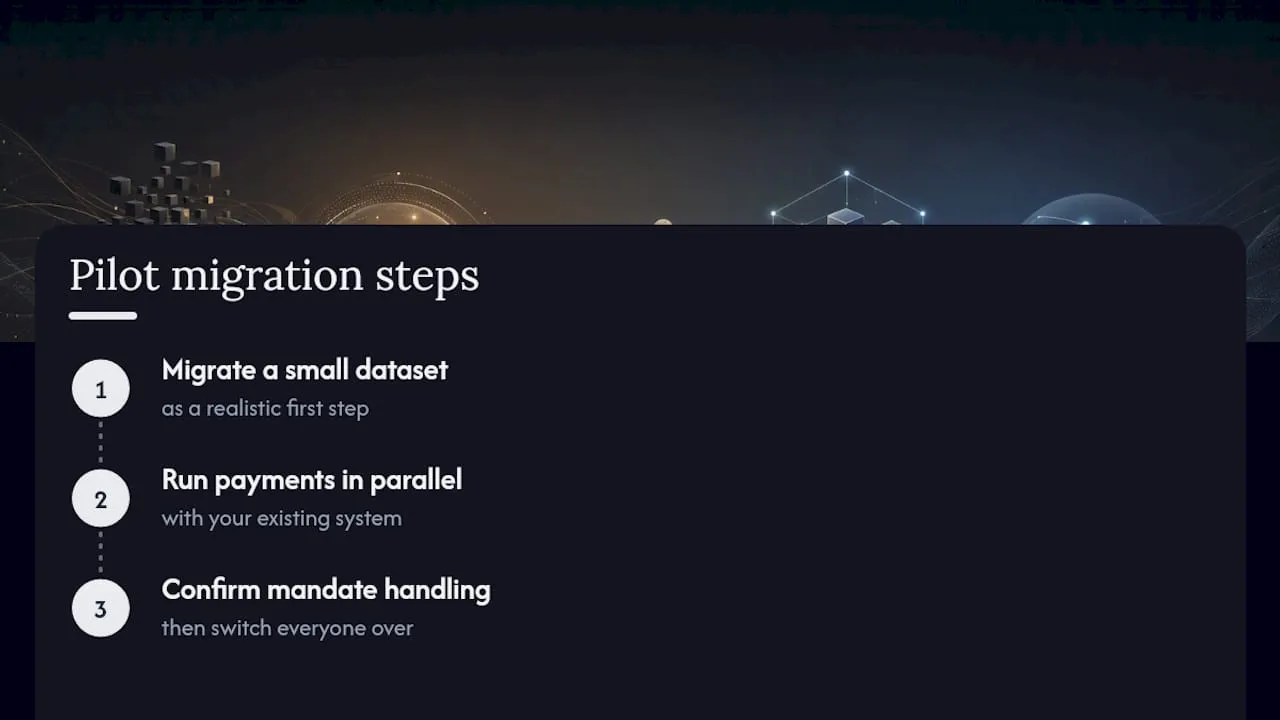
For a realistic first step, scope a pilot: migrate a small dataset, run payments in parallel with your existing system, and confirm mandate handling before switching everyone over.
What actually matters when you’re the one signing the contract
Most membership software comparisons treat every organisation as equally sophisticated, which is nonsense. A 300 member historical society and a 20,000 member professional body face the same GDPR obligations but wildly different implementation realities, and too much advice online ignores that gap entirely.
My honest view, having worked through the practicalities in this piece, is that the Direct Debit migration question gets underrated compared to feature lists. Everyone asks about portals and events during a demo; almost nobody asks the vendor to walk through a mandate failure scenario in real time. That single test tells you more about how a platform will behave under pressure than any features page.
Test your payments flow before anything else, ideally with a real mandate and a real failure case, not a sandbox success story.
— Rob
Colossus Systems: trial, pricing and contact
Colossus brings membership records, renewals, payments, events, and member portals together in one subscription rather than several disconnected tools bolted onto a spreadsheet. That matters most for organisations that have outgrown a basic hosted app but do not want the implementation burden of an enterprise-only platform.
Against the checklist covered above, Colossus’s stated capabilities line up as follows:
- Membership records and self-service portals for member-facing admin.
- Event management for bookings, waiting lists, and attendance.
- Payment gateway integration for card and Direct Debit collection.
- CRM and email marketing tools for renewal reminders and engagement campaigns.
The practical next step is a scoped pilot: pick a small slice of your membership data, test payments in parallel with your current system, and confirm Direct Debit handling before committing further. Review the full feature set against your own checklist, check current pricing and plan tiers, and request a demo to see how a migration would actually run for your organisation.
Sources
- Run a compliant membership organisation | Guvnor
- The Best CRM for Membership Organisations? Explore The Glaziers’ Digital Transformation - Pooka & Co
- Members Portal Pricing, Cost & Reviews - Capterra UK 2026
FAQ
What is the best membership software for nonprofits in the UK?
There is no single “best” option; the right choice depends on member numbers, payment complexity, and whether you need event management alongside a CRM. Integrated platforms like Colossus suit nonprofits that want membership, events, and payments in one subscription rather than several separate tools.
How much does membership software typically cost per month?
Pricing varies widely by feature depth and member volume; some entry-level portals list starting prices around £35 per month, while integrated platforms with events and CRM run higher. Colossus, for example, prices its Core plan at £349 per month, scaling up through Growth, Scale, and Enterprise tiers.
Is there a good free membership management platform?
Genuinely free platforms tend to cap member numbers or strip out payment processing and reporting, which limits their use for anything beyond a very small club. Most UK organisations find a low-cost paid tier delivers far better Direct Debit handling and support than a free option ever will.
What software works best for managing sports club memberships?
Sports clubs generally need strong event and booking tools alongside standard membership records, since fixtures, training sessions, and facility bookings function much like recurring events. A platform that combines event management with Direct Debit collection, rather than treating them as separate systems, usually reduces admin significantly.
Do UK membership organisations need to register with the ICO?
Most organisations holding membership data must register with the ICO and pay the data protection fee unless a specific exemption applies. Membership registers frequently contain special-category data such as religious belief or health information, which raises the compliance bar even for small membership bodies.