Innovative engagement strategies for membership organisations

TL;DR:
- Effective member engagement depends on integrated systems, meaningful participation, and targeted measurement strategies. Building genuine community-driven frameworks involves real authority, bidirectional governance, and accessible communication options for diverse members. Leadership trust improves when metrics are aligned with organizational priorities and decision-making processes.
Member engagement is the lifeblood of any membership organisation, yet many leaders find themselves applying the same traditional tactics and watching participation rates stagnate. The answer rarely lies in doing more of what already exists. Genuinely innovative engagement strategies require a rethink of the underlying assumptions: that demographic representation equals inclusion, that sending more emails equals communication, and that collecting more data equals insight. This article examines the evidence-based approaches that membership organisations and community managers are using right now to build deeper, more durable connections with their members.
Key takeaways
| Point | Details |
|---|---|
| Close integration gaps first | Connecting your CRM, website, and community platform creates the data loop that makes timely, personalised outreach possible. |
| Inclusion requires meaningful roles | Demographic diversity without real participation opportunities does not produce sustained engagement or satisfaction. |
| Two-way communication builds ownership | Members who feel heard and involved in governance are far more likely to champion your organisation. |
| Measure fewer things, better | Aligning a small number of metrics with leadership decision frameworks builds executive trust faster than comprehensive reporting. |
| Email still works when used smartly | 70% of associations use email as a primary tool for recouping lapsed members, making it a channel worth integrating properly. |
Modern member engagement: drivers and obstacles
Member engagement in the context of professional associations and nonprofits sits at the intersection of psychology, operations, and culture. Before any creative engagement technique can succeed, you need to understand what is actually holding engagement back.
One of the most nuanced findings in recent research concerns identity congruence, the degree to which a member sees their own identity reflected in the organisation’s leadership. Gender congruence influences satisfaction among volunteers, and board-level racial congruence can affect how much time members invest. But this cuts both ways. When identity matching raises expectations that the organisation then fails to meet, satisfaction drops sharply. The lesson is that representation is a starting point, not a destination.
Beyond identity, the structural barriers are significant. Three issues come up repeatedly among membership leaders:
- Integration gaps between systems. Member management software, websites, and community platforms frequently do not speak to one another. When engagement signals from your website never reach your CRM, you miss the triggers that would prompt timely outreach.
- Lack of genuine two-way communication. Broadcasting updates is not the same as dialogue. Sustained two-way communication and the use of trusted internal messengers are what actually build member ownership and overcome resistance to change.
- Metrics that do not connect to decisions. Many organisations collect engagement data but struggle to translate it into anything leadership will act on, leaving community managers unable to make the case for investment.
Understanding these obstacles honestly is the first step toward choosing tactics that will genuinely move the needle rather than generate activity for its own sake.
Digital tools that actually move engagement
Technology does not automatically solve engagement problems, but closing the right integration gaps transforms what is possible. The goal is to create what practitioners call a decision loop: a connected system where member behaviour triggers personalised outreach at the right moment, rather than generic communications sent on a fixed schedule.

71% of association and nonprofit professionals have invested or plan to invest in membership management software, and the organisations seeing the strongest returns are those connecting that software directly to their website and communication channels. When a member completes a course, attends an event, or visits a renewal page without converting, a connected system can trigger a targeted response automatically.
Pro Tip: Before adopting any new engagement tool, map your current data flows on paper first. Identify where member behaviour data goes to die, because those dead ends are where your highest-value engagement opportunities are being lost.
Here is what a well-integrated digital approach looks like in practice:
- CRM linked to your member portal. Engagement history, event attendance, and content consumption feed back into member profiles, enabling genuinely personalised communications rather than batch-and-blast emails.
- Automated member journeys. New members receive a structured onboarding sequence; members approaching renewal receive targeted value reminders; lapsed members receive a reactivation series based on their previous behaviour rather than their join date.
- Email supported by low-cost channels. SMS reminders for event attendance, push notifications via a member app, or even simple automated follow-up sequences reduce the manual labour involved in re-engaging lapsed members considerably.
The integration gap between platforms is consistently cited as a top challenge limiting effective engagement. Closing it is less about adding new technology and more about ensuring the technology you already have is properly connected. You can read more about how digital tools drive membership growth when deployed with this integration-first mindset.
Building community-driven participation frameworks
The most durable engagement does not come from what the organisation does to members. It comes from what members do with the organisation. This distinction separates surface-level participation from the kind of sustained involvement that defines thriving communities.
There is a persistent temptation to treat visible diversity as a proxy for inclusion. Research is clear that meaningful participation matters more than demographic similarity alone. Poor fit between a member’s expectations and their actual experience of the organisation is one of the strongest predictors of disengagement. You can have a beautifully diverse board and still haemorrhage volunteers if those volunteers are not given real authority or meaningful work.
“Successful engagement is embraced and championed by members themselves, supported by trusted two-way communication and shared ownership.” Community engagement research
Building a genuinely community-driven participation framework requires structural changes, not just cultural ones. Here is a practical sequence:
- Map existing participation pathways. Identify every formal and informal route a member can take to contribute, from committee roles to content creation. Most organisations discover significant gaps here.
- Create bidirectional governance mechanisms. This means member input that demonstrably changes decisions, not consultation that is noted and filed. A clear follow-through cadence, where you publish what you heard and what you did about it, is what converts sceptics into advocates.
- Assign trusted internal champions. Multi-component engagement approaches that combine education, peer outreach, and local leadership consistently outperform single-channel strategies. Identify members who are already trusted voices and give them a genuine role in the engagement programme.
- Make entry points accessible across cultures and contexts. A single participation model will exclude members whose communication preferences, time constraints, or professional norms differ from the assumed default. Offering asynchronous input options, translated materials where relevant, and flexible volunteering structures broadens real participation without tokenism.
The underlying principle is that effective strategies for audience participation require you to design for voice to action, not just for presence. Members who see their input reflected in outcomes become your most effective recruitment and retention assets.
Measuring engagement: aligning metrics to leadership
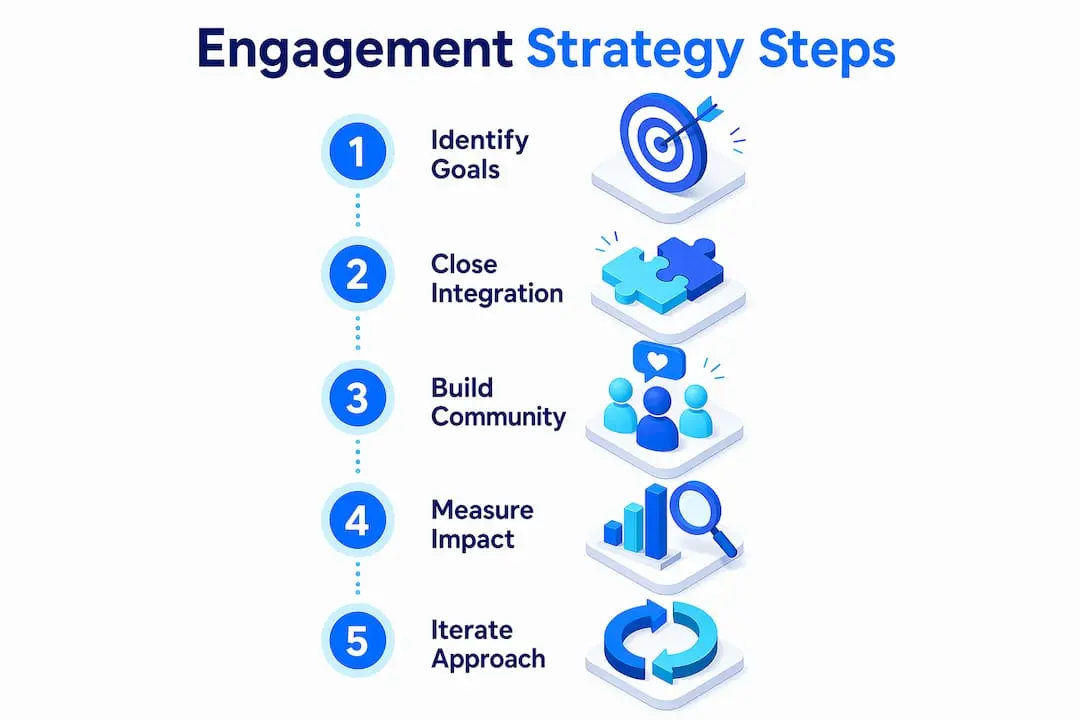
Measurement is where many otherwise solid engagement programmes lose their organisational momentum. The problem is rarely a lack of data. It is an excess of metrics that do not connect to anything executives care about.
The most effective approach is to organise your engagement measurement around value pillars, typically four to six areas that map directly to the priorities your leadership team makes decisions about. Common pillars for membership organisations include: member retention efficiency, content and event value, advocacy and referral behaviour, and product or programme innovation signals. You can find a structured approach to this in step-by-step engagement measurement.
| Approach | What it looks like in practice |
|---|---|
| Comprehensive reporting | Dashboards with 30+ metrics, updated weekly, reviewed by nobody |
| Pillar-aligned measurement | Four metrics tied to renewal rates, event ROI, referral volume, and one innovation signal — reviewed monthly by leadership |
Directional confidence builds executive trust faster than attempting perfect attribution. In practice, this means choosing metrics that clearly point in a direction (“referral rates are up 12% this quarter”) rather than trying to prove exact causation (“our webinar series caused 34 renewals”). Start with two or three measures that leadership already cares about, and add layers of sophistication over time as trust and capability develop.
Pro Tip: When presenting engagement data to senior leadership, frame each metric as an answer to a decision they face: “Should we invest in more events this quarter?” Then show the data that informs that specific question. Generic engagement dashboards rarely change budgets; decision-relevant data usually does.
My honest take on what actually works
I’ve spent considerable time working with membership organisations across different sectors, and the pattern I see most often is this: leaders invest in inclusion initiatives or technology upgrades and then wonder why engagement figures barely shift. The missing ingredient is almost always the connection between the tool and the culture.
I’ve seen organisations deploy sophisticated CRM systems that nobody updates because the staff responsible were never involved in the selection process. I’ve watched diversity initiatives stall because the new members recruited to reflect the community were given observer status rather than real roles. The technology and the representation were there. The ownership was not.
What I’ve found actually works is starting with the question: “What would make a member feel that this organisation cannot function without them?” That sounds like a high bar, but it reframes the design challenge. It moves you away from thinking about engagement as something you deliver and towards thinking of it as something you build together.
The organisations that have genuinely cracked this problem tend to share three traits. They have connected systems so that no engagement signal goes unnoticed. They have participation structures that give members real authority over something meaningful. And they measure in ways that their leadership team actually trusts and acts on. None of that requires a large budget. It requires clarity about what you are trying to build and consistency in building it.
— Rob
How Colossus supports your engagement goals
Putting these strategies into practice requires tools that are genuinely built for membership organisations rather than adapted from generic software.
At Colossus, our platform connects member management and CRM with event planning, email marketing, and analytics in one place, closing exactly the integration gaps described in this article. Our membership management features support automated member journeys, personalised communication sequences, and the real-time engagement signals your team needs to act at the right moment. Whether you are working to reactivate lapsed members, build richer participation pathways, or align your reporting with what leadership actually uses, Colossus gives you the tools to do it without stitching together five separate systems. Talk to our team to see how it fits your organisation.
FAQ
What are innovative engagement strategies for membership organisations?
Innovative engagement strategies in membership contexts refer to evidence-based methods that go beyond traditional communications, combining integrated digital tools, bidirectional governance, and measurement aligned to leadership priorities to produce sustained member participation.
Why is identity congruence not enough to drive engagement?
Research shows that demographic matching alone can raise expectations that, if unmet, actually reduce satisfaction. Meaningful roles and real participation opportunities matter more than visible representation.
How do you measure member engagement effectively?
Focus on a small number of metrics aligned to your leadership’s decision framework rather than comprehensive reporting. Directional confidence builds trust faster than perfect attribution, so start small and add measurement layers over time.
What role does email play in member re-engagement?
Email remains one of the most effective re-engagement channels. 70% of associations use it specifically to recoup lapsed members, and its impact increases significantly when it is part of an automated, behaviour-triggered sequence rather than a one-off broadcast.
How can community managers build two-way communication with members?
Establish clear follow-through cadences: collect member input formally, publish what you heard, and explain what changed as a result. Sustained two-way communication combined with trusted internal champions consistently produces stronger participation and higher member ownership.