How to grow memberships: a 2026 guide for leaders

TL;DR:
- Membership growth depends on coordinated communication, recruitment, and engagement strategies. Improving onboarding, funnel optimization, and multi-channel efforts boosts retention and profitability. Digital platforms like Colossus streamline tracking, automating processes to support sustained membership expansion.
Membership growth is defined as the sustained increase in enrolled members through a coordinated system of value communication, recruitment optimisation, and structured engagement. Knowing how to grow memberships effectively means combining all three elements, not treating them as separate campaigns. Organisations that rely on ad hoc recruitment drives consistently underperform those with repeatable, measurement-based systems. Research confirms that coordinated multi-channel strategies outperform isolated efforts for measurable growth. A 5% increase in retention, according to Bain & Company findings, can drive a 25% to 95% increase in total profits. That single statistic reframes the entire growth conversation: acquisition matters, but retention is where the financial leverage lives.
What foundational elements support membership growth?
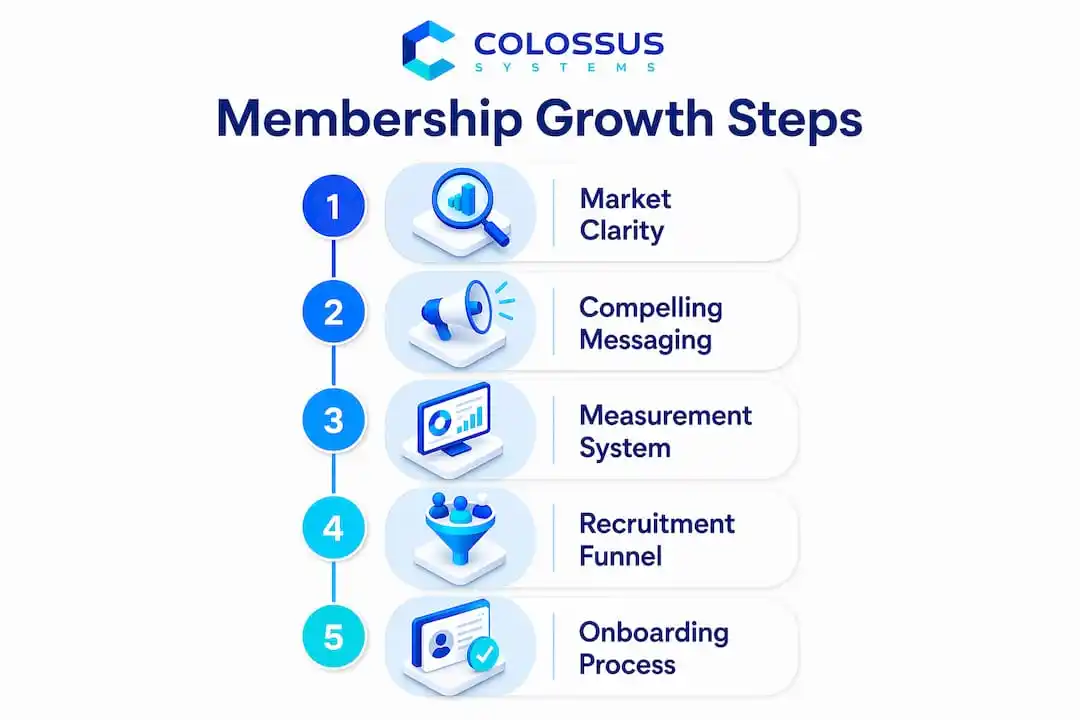
Sustainable membership growth starts with three prerequisites: market clarity, compelling messaging, and a measurement system. Without all three, even well-funded campaigns produce inconsistent results.

Market clarity means defining your total addressable market (TAM) and segmenting prospects by career stage, industry sector, or organisational size. A professional association targeting early-career accountants needs different messaging than one targeting finance directors. Segmentation is not optional; it is the difference between a campaign that resonates and one that is ignored.
Compelling messaging means your value proposition must be outcome-focused. Members do not join for access to a newsletter. They join because membership advances their career, connects them to peers, or solves a specific professional problem. Test your value proposition by asking: “If a prospective member read this in ten seconds, would they know exactly what they gain?” If the answer is no, rewrite it.
Measurement systems are the element most organisations skip. Monthly and quarterly reviews with dashboard tracking are essential for building consistent growth. Without a performance dashboard, you cannot identify which channels convert, which messages resonate, or where prospects drop out of the join process.
The table below compares the three foundational elements by function and common failure mode:
| Element | Function | Common failure mode |
|---|---|---|
| Market analysis | Identifies who to target and how to segment | Targeting too broadly, wasting budget |
| Value messaging | Converts prospects by communicating clear outcomes | Generic benefits that do not differentiate |
| Measurement system | Tracks performance and guides iteration | No dashboard, no review cadence |
Structured recruitment systems outperform ad hoc campaigns because they create feedback loops. Each campaign cycle produces data that improves the next one. Organisations that build repeatable recruitment systems rather than one-off drives compound their growth over time.
How can organisations optimise their membership recruitment funnel?
The recruitment funnel is the path a prospect takes from first awareness to completed membership application. Most organisations lose the majority of interested prospects somewhere in this funnel, not because the value proposition is weak, but because the process creates friction.
-
Simplify the join form. Remove every field that is not required to process the application. Each additional field reduces completion rates. Ask only for name, email, payment details, and one or two qualifying questions. You can collect richer profile data after the member joins.
-
Personalise your calls to action. A generic “Join Now” button converts poorly. Replace it with outcome-specific language: “Access the Career Centre,” “Join 4,000 Finance Professionals,” or “Get Your CPD Tracker.” The message should reflect the segment you are targeting.
-
Test incentives. Discounted dues for the first year, free event access, or a bonus resource pack all reduce the perceived risk of joining. Test one incentive at a time so you can attribute any uplift accurately.
-
Track conversion sources. Use UTM parameters on every campaign link and create unique landing pages for each channel. This tells you whether your LinkedIn ad, email campaign, or event registration page is driving the most joins. Without source tracking, budget allocation is guesswork.
-
Implement retargeting. Prospects who visit your join page but do not complete the application are your warmest leads. Retargeting ads with sequenced messaging, such as a testimonial ad followed by a deadline-driven offer, bring a meaningful proportion of these prospects back to complete their application.
Optimising the join funnel can increase total conversions by 15% to 30%. That uplift requires no additional advertising spend. It comes entirely from removing friction and improving messaging for the prospects already in your pipeline.
Pro Tip: Aim for a lead-to-join conversion rate of 10–15%. If your current rate sits below 10%, audit the join form first. It is almost always the highest-leverage fix available.
For organisations also building their email list as part of recruitment, proven list-building tactics for 2026 apply directly to membership acquisition pipelines.
What multi-channel strategies consistently outperform single-channel efforts?
Traditional tactics like more events or email blasts alone are insufficient. Coordinated systems that connect multiple channels produce results that no single channel can match. The key word is “coordinated”: each channel reinforces the others rather than operating in isolation.
-
Digital referral programmes. Referral programmes with recognition and exclusive access outperform cash incentives. Offer existing members a dues discount, priority event registration, or public acknowledgment for each successful referral. Timing matters: send the referral prompt within 48 hours of a positive member experience, such as after an event or a successful career centre interaction.
-
Events as conversion tools. Events create urgency and trust. Members-only sessions and ambassador pairing at events increase conversion rates for attendees. Assign a member ambassador to each non-member attendee table. The ambassador’s role is to answer questions and share their personal experience, not to hard-sell membership.
-
Segmented email marketing. Segmented email campaigns with automated drip sequences achieve open rates of 20%–30% and lead-to-join conversion rates of 10%–15%. A drip campaign for early-career prospects looks entirely different from one targeting senior practitioners. Segment by career stage, interest area, or engagement history for best results.
-
LinkedIn Lead Gen campaigns. LinkedIn’s Lead Gen Forms allow prospects to submit their details without leaving the platform, which significantly reduces drop-off. Pair paid campaigns with organic content focused on career development, industry insight, and member success stories.
-
Co-marketing with aligned organisations. Partner with non-competing bodies that serve the same audience. A joint webinar, a shared resource guide, or a co-branded event exposes your organisation to a warm, pre-qualified audience at low cost.
Reallocating budget from underperforming channels to high-converting ones is only possible if you track performance by channel. This is where a CRM becomes essential. Colossus integrates CRM and multi-channel coordination so your team can see which channels drive joins and which consume budget without results.
How does structured onboarding improve retention and membership growth?
Onboarding is the period between a member joining and becoming genuinely active. Most organisations treat it as an administrative task: send a welcome email, post out a membership card, and move on. That approach produces passive members who do not renew.
A structured 90-day onboarding programme is the highest-ROI investment in retention available to membership organisations. The 90-day window matters because early member activation within the first 30 days sets engagement habits and determines renewal trajectories. Members who use at least three benefits in their first month are significantly more likely to renew than those who use none.
-
Days 1–7: Welcome and orientation. Send a personalised welcome message from a senior leader. Include a clear “start here” guide that lists the three most valuable benefits for their specific member segment. Do not overwhelm new members with every feature at once.
-
Days 8–30: Guided benefit activation. Prompt new members to complete their career centre profile, register for an upcoming event, and join a relevant community forum or special interest group. Each activation step builds a habit and increases the perceived value of membership.
-
Days 31–60: Deeper engagement. Invite new members to volunteer for a committee, participate in a mentorship programme, or contribute to a member publication. Moving from passive consumer to active participant is the single strongest predictor of long-term retention.
-
Days 61–90: Engagement review. Use an engagement score, a composite metric tracking logins, event attendance, content downloads, and forum activity, to identify members at risk of lapsing. Reach out personally to low-engagement members before the 90-day mark.
Pro Tip: Concentrate your onboarding resources on the first 30 days. This is where engagement habits form. A well-timed personal call or a targeted resource recommendation in week two can determine whether a member renews at the end of year one.
The financial case for onboarding investment is clear. A 5% improvement in retention can increase total profits by 25% to 95%. Onboarding is the most direct lever for achieving that improvement. For a detailed framework, the guide to onboarding new members covers the full process from welcome sequence to 90-day review.
Key takeaways
Membership growth requires a coordinated system of market clarity, funnel optimisation, multi-channel recruitment, and structured onboarding, with retention treated as a growth lever equal to acquisition.
| Point | Details |
|---|---|
| Retention drives profit | A 5% retention increase can raise total profits by 25% to 95%, making onboarding a priority investment. |
| Funnel optimisation pays immediately | Removing friction from the join process can lift conversions by 15% to 30% with no extra ad spend. |
| Multi-channel coordination wins | Coordinated campaigns across email, events, referrals, and LinkedIn consistently outperform single-channel efforts. |
| First 30 days are critical | Members who activate three or more benefits in their first month are far more likely to renew. |
| Measurement enables iteration | Monthly dashboard reviews with KPI tracking are the foundation of consistent, compounding growth. |
What I have learned about growing memberships that most guides miss
The most common mistake I see membership leaders make is treating growth as a marketing problem. They commission a new brochure, run a social media campaign, or add another event to the calendar, and then wonder why the numbers barely move. The real problem is almost always structural.
Referral programmes, when built correctly, convert your existing members into active advocates who drive organic, sustainable growth. That is a system, not a campaign. The organisations I have seen grow consistently year on year are the ones that have built recruitment into their operational rhythm: monthly pipeline reviews, quarterly funnel audits, and a leadership team that treats member acquisition as a core business process rather than a marketing department task.
Career centres deserve a special mention. They are one of the most underused assets in professional associations. A well-run career centre generates revenue, engagement, and converts job seekers into members automatically. That is a passive acquisition channel that most organisations leave dormant. Activating it properly, with job board integrations, employer partnerships, and member-only career resources, can produce a steady stream of new members who arrive already convinced of the value.
The organisations that will grow fastest in 2026 are not the ones with the biggest marketing budgets. They are the ones that measure relentlessly, iterate quickly, and treat every existing member as a potential ambassador. Member advocacy is the ultimate growth engine, and it is built through great onboarding and genuine engagement, not through advertising.
— Rob
How Colossus supports your membership growth goals
Growing a membership organisation requires more than good intentions. It requires the right infrastructure to track, engage, and convert prospects at every stage of the member journey.
Colossus brings together membership management features including CRM, email marketing, event management, and engagement analytics in one platform. Your team can track conversion sources, automate onboarding sequences, and monitor engagement scores without switching between disconnected tools. The event management tools support members-only sessions and ambassador programmes that convert attendees into members. If you want to see how Colossus can support your recruitment funnel and retention goals, contact our team to arrange a demonstration.
FAQ
What is the most effective way to grow memberships quickly?
Optimising your join funnel is the fastest route to growth. Removing friction from the application process can increase conversions by 15% to 30% without any additional advertising spend.
How do you recruit new members to an association?
Use a coordinated approach combining segmented email campaigns, referral programmes, event-based conversion, and LinkedIn Lead Gen. Each channel reinforces the others and produces better results than any single tactic alone.
What is a good lead-to-join conversion rate for membership organisations?
A lead-to-join conversion rate of 10–15% is the recommended benchmark for high-performing membership organisations. Rates below 10% typically indicate friction in the join form or a weak value proposition.
How does onboarding affect membership retention?
Structured 90-day onboarding programmes deliver the highest ROI for retention. Members who activate multiple benefits in their first 30 days are significantly more likely to renew, and a 5% retention improvement can increase total profits by up to 95%.
How can membership organisations use digital tools to support growth?
Platforms that combine CRM, email automation, event management, and engagement tracking give organisations the data they need to identify high-performing channels, automate onboarding, and monitor member activity. For organisations exploring digital fundraising and membership growth, integrated platforms reduce manual work and improve conversion at every stage.