How to effectively manage large memberships: 5 key steps

TL;DR:
- Large-scale membership management requires centralised data, standardized processes, and suitable software.
- Automation of renewals, segmentation, and engagement tracking enhances retention and operational efficiency.
- Human insights and flexible strategies remain crucial despite digital tools’ capabilities.
Managing hundreds or thousands of members is one of the most operationally demanding challenges any organisation can face. When data is scattered, communications are inconsistent, and engagement tracking is manual, members feel neglected and leaders feel overwhelmed. The consequences are real: declining retention, missed renewal opportunities, and reputational damage. This guide walks you through a practical, step-by-step approach to managing large membership bases effectively, covering the digital tools, foundational processes, and proven strategies your organisation needs to thrive at scale.
Table of Contents
- Understanding the challenges of large-scale membership management
- Key foundations: Preparing your organisation for scalable management
- Step-by-step process: Streamlining the management of large memberships
- Measuring success and maintaining engagement over time
- Our perspective: What most guides miss about large-scale membership management
- Take your membership management to the next level
- Frequently asked questions
Key Takeaways
| Point | Details |
|---|---|
| Centralise member data | Centralising records lays the groundwork for efficient engagement and smooth operations. |
| Automate routine tasks | Automation reduces admin burdens and helps prevent errors in large memberships. |
| Track engagement regularly | Ongoing review of member activity enables proactive support and higher retention. |
| Balance tech and personal touch | Digital tools should support, not replace, genuine member connections. |
Understanding the challenges of large-scale membership management
The moment your membership base crosses a certain threshold, the complexity of managing it changes entirely. What once worked with a spreadsheet and a shared inbox quickly becomes unworkable. Volume, variety, and velocity of data all increase simultaneously, and the cracks begin to show.
Large organisations face distinct operational hurdles that smaller ones simply do not encounter at the same intensity:
- Data duplication and outdated records: Member records accumulate errors over time. Without a single source of truth, staff waste hours reconciling conflicting information.
- Communication complexity: Sending relevant messages to thousands of members requires segmentation. Generic outreach alienates members rather than engaging them.
- Engagement blind spots: Without real-time tracking, it is nearly impossible to identify which members are disengaged before they lapse entirely.
- Security vulnerabilities: Large datasets are high-value targets. Inadequate access controls and infrequent audits leave organisations exposed.
- Manual processes at scale: Tasks that take minutes for small teams take days when multiplied across thousands of records.
These inefficiencies are not merely inconvenient. As noted in membership management basics, disorganised operations erode the member experience consistently over time. Similarly, ineffective processes lead to disengaged members and lost revenue, which is a cost no membership organisation can afford to absorb quietly.
“The cost of disorganisation in membership bodies is rarely visible until a critical mass of members decides not to renew. By then, the damage is already done.” — Membership Sector Operations Review
Many organisations also underestimate how poor data governance affects their ability to run fundraising engagement strategies effectively. When your records are unreliable, every downstream activity suffers.
With the challenge now framed, the next logical step is to prepare your organisation for efficient membership management.
Key foundations: Preparing your organisation for scalable management
Before you can manage a large membership base effectively, you need the right structures in place. Scaling chaotic processes simply produces chaos at a larger scale. Preparation is not optional; it is the difference between sustainable growth and operational collapse.
Start with these essential steps:
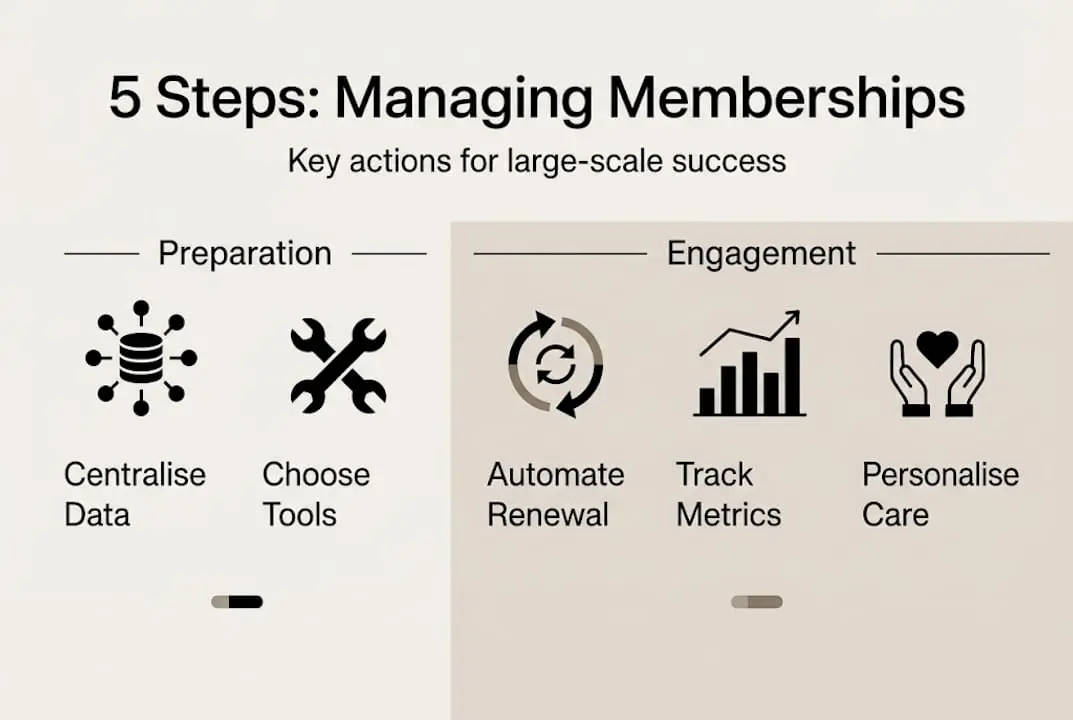
- Centralise your member data: All member records should live in one authoritative system. Eliminate duplicate databases and establish clear data ownership policies across your team.
- Define data standards: Agree on how data is captured, formatted, and updated. Consistency at entry level prevents errors from compounding over time.
- Audit your current tools: Identify what software you are currently using and whether it can scale. Many organisations outgrow their initial solutions without realising it.
- Select software built for your scale: Implementing dedicated membership management software centralises data and automates admin, freeing your team to focus on strategic priorities rather than administrative firefighting.
- Train your team thoroughly: Software is only as effective as the people using it. Budget time and resources for proper onboarding.
Essential tools, training, and resources checklist
| Category | What you need | Why it matters |
|---|---|---|
| Database | Centralised CRM or membership platform | Single source of truth for all member data |
| Communication | Integrated email marketing tools | Consistent, targeted outreach at scale |
| Automation | Renewal and reminder workflows | Reduces manual workload and human error |
| Reporting | Analytics and engagement dashboards | Visibility into membership health metrics |
| Security | Role-based access controls | Protects sensitive member information |
| Training | Onboarding programme for staff | Ensures consistent platform usage across teams |
When evaluating platforms, examine the core features of membership software carefully. Not every solution is built to handle the complexity of large-scale operations. Ask vendors specifically about data migration support, integration capabilities, and performance at volume.

Pro Tip: Involve staff from multiple departments during software selection, not just IT. The people who use the system daily will identify practical gaps that a procurement checklist will miss entirely.
It is also worth reviewing the full range of management software features before committing to any platform, so you are confident the solution can grow alongside your organisation.
Building on a solid foundation, organisations can now tackle the core steps of effective large membership management.
Step-by-step process: Streamlining the management of large memberships
With your foundations in place, you can execute a digital-first, scalable membership management strategy. The following workflow applies regardless of sector, from professional associations to charitable bodies.
- Segment your membership base: Divide members into meaningful groups based on location, membership tier, engagement level, or interests. Segmentation is the prerequisite for relevant communication.
- Automate renewal and reminder cycles: Set up automated workflows to send renewal notices, payment reminders, and lapsed-member reactivation campaigns. Automating tasks like renewals, reminders, and reporting frees time for meaningful engagement that genuinely moves the needle.
- Build an event and content calendar: Plan member touchpoints well in advance. Events, webinars, and exclusive content give members ongoing reasons to remain engaged with your organisation.
- Assign clear ownership to workflows: Every automated process should have a human owner who monitors its performance and troubleshoots issues. Automation does not mean unattended.
- Integrate your communication channels: Ensure your email platform, CRM, and event tools share data. Siloed systems create gaps in your member view and undermine personalisation efforts.
- Review and adjust regularly: Data from your platform should inform decisions monthly, not annually. Trends in engagement or renewal rates often signal problems early.
For a thorough overview of how these steps fit into a broader strategy, the membership management guide provides additional context on aligning operations with organisational goals.
Pro Tip: At scale, communication frequency matters as much as content quality. Sending too many messages trains members to ignore you. Use engagement data to determine optimal sending cadence for each segment.
“Storing large volumes of member data carries legal and ethical responsibilities. Ensure your platform complies with applicable data protection regulations and that access to sensitive records is strictly controlled.” — member data security basics
After implementing these steps, knowing how to measure success and adapt is vital.
Measuring success and maintaining engagement over time
Executing a strategy without measuring its impact is simply guesswork at scale. Your organisation needs clear indicators of membership health, and the discipline to review them consistently.
Key performance indicators (KPIs) worth tracking include:
- Renewal rate: The percentage of members who renew at the end of their membership period. This is the single most telling signal of overall satisfaction.
- Engagement rate: How frequently members interact with your communications, events, and online portals.
- Churn rate: The rate at which members leave your organisation. Rising churn warrants immediate investigation.
- Net Promoter Score (NPS): A measure of how likely members are to recommend your organisation to others.
- Event attendance: Participation rates in organised activities indicate whether your programme of engagement is resonating.
Beyond KPIs, build regular engagement touchpoints into your operational calendar:
- Member surveys (twice yearly at minimum)
- Exclusive member events or virtual sessions
- Personalised anniversary or milestone communications
- Segmented content campaigns based on interest or role
- Peer networking opportunities through online communities
Regular analysis of engagement metrics ensures your organisation can respond to member needs before disengagement becomes departure.
Manual vs automated engagement: A practical comparison
| Engagement activity | Manual approach | Automated approach |
|---|---|---|
| Renewal reminders | Staff send individually, prone to error | Triggered automatically at set intervals |
| Event notifications | Manually drafted per event | Template-driven, personalised by segment |
| Member surveys | Sent ad hoc, low response rates | Scheduled and tracked within the platform |
| Lapsed member outreach | Reactive and inconsistent | Proactive, triggered by inactivity thresholds |
| Engagement reporting | Compiled manually, delayed | Real-time dashboards updated continuously |
Using a dedicated platform such as membership software transforms these activities from burdens into reliable, repeatable processes. Member feedback gathered through surveys and post-event responses should feed directly into operational decisions, closing the loop between member voice and organisational action.
Once you are equipped to measure and improve, consider the hard-won lessons and overlooked insights in large-scale management.
Our perspective: What most guides miss about large-scale membership management
Most articles on membership management treat digital tools as the answer to every problem. They are not. Technology amplifies whatever culture and processes you already have. If your organisation struggles with internal communication or lacks a clear member value proposition, no platform will fix that.
The most successful organisations we observe are those that resist the temptation to automate everything immediately. They use digital tools deliberately, preserving human touchpoints where relationships matter most. A renewal reminder can be automated. A conversation with a long-standing member who is considering leaving cannot.
There is also a persistent myth that one standardised approach works across all membership types. It does not. Organisations that benefit from management software vary enormously in their culture, communication preferences, and engagement expectations. Flexibility and customisation are not optional extras; they are requirements.
The organisations that build lasting member loyalty do so by treating technology as infrastructure, not strategy. Strategy is human.
Take your membership management to the next level
If your organisation is ready to move beyond manual processes and outdated tools, Colossus Systems is built to support exactly this transition. Our platform brings together member management, event coordination, CRM, email marketing, and analytics in one place, designed specifically for organisations operating at scale.
The Colossus Systems features suite addresses the key pain points outlined in this guide, from automating renewals to enabling real-time engagement tracking. For organisations that also run large events, our event management software streamlines registration, attendance, and post-event follow-up seamlessly. Speak to our team today and discover how we can help your organisation grow, retain, and engage your membership base at any scale.
Frequently asked questions
What is the best way to keep large membership data secure?
Use a reputable membership management platform with role-based access controls and scheduled data backups. Strong data security reduces the risk of breaches significantly in large member organisations.
How often should member engagement be reviewed?
Engagement should be reviewed at least quarterly to enable proactive adjustments. Regular analysis of engagement metrics ensures your organisation can respond to member needs before they escalate.
Can digital tools help with member retention?
Yes, digital tools automate renewals and reminders, reducing lapses and supporting continuous engagement. Automating tasks frees your team to focus on meaningful member interaction.
What are the first steps to transition to digital membership management?
Begin by centralising your member data and selecting a platform tailored for large organisations. Implementing dedicated software centralises data and automates administration from the outset.