Emotional Intelligence in Schools: Raising Engagement and Well-Being

Nearly ninety percent of british educators agree that emotional intelligence has a measurable effect on student achievement and classroom harmony. As educational leaders face growing challenges in student well-being and engagement, understanding what emotional intelligence means at a school level becomes crucial. This guide clarifies the core elements of emotional intelligence, highlights direct outcomes for students and teachers, and offers practical steps to transform how schools across Canada, the United States, and beyond support emotional and academic growth.
Table of Contents
- Defining Emotional Intelligence in Schools
- Core Components and Competencies of EI
- Approaches to Implementation in K-12 Settings
- Evidence and Outcomes for Students and Staff
- Common Challenges in Cultivating Emotional Intelligence
Key Takeaways
| Point | Details |
|---|---|
| Importance of Emotional Intelligence | Emotional Intelligence is critical for academic success, encompassing self-awareness, self-management, social awareness, and relationship skills. |
| Impact of EI Programmes | Structured Emotional Intelligence programmes significantly improve classroom dynamics, stress management, and interpersonal relationships among students. |
| Implementation Strategies | Effective integration of Emotional Intelligence requires comprehensive approaches, including curriculum embedding and teacher training to model desired behaviours. |
| Challenges and Solutions | Schools face systemic challenges in fostering Emotional Intelligence, necessitating the development of adaptable assessment tools and staff training to overcome resistance. |
Defining Emotional Intelligence in Schools
Emotional Intelligence (EI) is a sophisticated psychological construct that represents the capacity to perceive, understand, and strategically manage emotions within educational environments. Core mechanisms of emotional intelligence reveal a complex interplay between emotional awareness and academic performance.
At its fundamental level, emotional intelligence encompasses four critical domains: self-awareness, self-management, social awareness, and relationship management. Students with robust emotional intelligence can recognise their own emotional states, regulate their responses, empathise with peers, and navigate social interactions more effectively. These skills are not peripheral but central to academic success and personal development.
Research demonstrates that schools implementing structured emotional intelligence programmes witness significant transformations in classroom dynamics. Emotional learning frameworks enable students to develop sophisticated emotional regulation techniques, improving their capacity to manage stress, communicate effectively, and maintain positive interpersonal relationships. This approach goes beyond traditional academic instruction, recognising emotions as fundamental to learning and personal growth.
Professional Insight: Introduce emotional intelligence assessment tools during early educational stages to help students develop self-understanding and emotional competence.
Core Components and Competencies of EI
Emotional intelligence comprises multiple interconnected competencies that enable students to understand and manage their emotional experiences effectively. Core competency domains include self-awareness, self-management, social awareness, relationship skills, and responsible decision-making, forming a comprehensive framework for emotional development in educational settings.
Each competency domain represents a critical dimension of emotional functioning. Self-awareness involves recognising personal emotions and understanding their impact, while self-management focuses on regulating emotional responses and maintaining impulse control. Social awareness encompasses empathy and the ability to understand others’ perspectives, and relationship skills involve effective communication, conflict resolution, and building supportive interpersonal connections.

The following table summarises how each core emotional intelligence domain supports key aspects of student well-being and educational achievement:
| EI Domain | Focus Area | Impact on Students |
|---|---|---|
| Self-awareness | Recognising emotions | Greater self-confidence |
| Self-management | Regulating responses | Enhanced impulse control |
| Social awareness | Empathy and perspective | Improved peer relationships |
| Relationship skills | Communication, conflict | Smoother collaboration dynamics |
The twelve learnable competencies of emotional intelligence provide educators with a nuanced approach to developing students’ emotional capabilities. These competencies range from realistic self-assessment and emotional regulation to advanced skills like team leadership and trustworthiness. By systematically addressing these areas, schools can create environments that support holistic student development, bridging academic learning with emotional intelligence.
Professional Insight: Implement structured emotional intelligence training programmes that progressively develop students’ skills across different competency domains.
Approaches to Implementation in K-12 Settings
Practical implementation strategies for emotional intelligence in schools require a comprehensive and multi-faceted approach. Successful programmes integrate social-emotional learning across curriculum, classroom practices, and school culture, creating holistic environments that systematically develop students’ emotional competencies.
Key implementation approaches include embedding emotional intelligence training through structured classroom activities, teacher training, and whole-school initiatives. These might involve mindfulness exercises, reflective journaling, peer collaboration workshops, and explicit instruction in emotional regulation techniques. Teachers play a crucial role as emotional intelligence models, demonstrating self-awareness, empathy, and effective communication strategies that students can observe and internalise.
Research-practice partnerships highlight the importance of strategic planning and ongoing evaluation in emotional intelligence programme development. Schools must adopt data-driven approaches, continuously assessing programme effectiveness, adapting interventions to specific student populations, and creating feedback mechanisms that allow for responsive and dynamic emotional learning environments.
Professional Insight: Develop a phased emotional intelligence implementation plan that progressively builds skills across different grade levels, ensuring consistent and age-appropriate emotional learning.
Evidence and Outcomes for Students and Staff
Academic achievement research demonstrates a robust correlation between emotional intelligence and students’ educational success. Students with higher emotional intelligence exhibit significantly improved academic performance, characterised by enhanced motivation, superior stress management, and greater perseverance in challenging learning environments.
The impact of emotional intelligence extends beyond individual student outcomes, profoundly influencing institutional dynamics. School leaders with advanced emotional intelligence competencies create transformative educational environments that support both staff and student development. These leaders demonstrate remarkable capacity to foster positive organisational climates, improve instructional quality, and support teacher well-being through sophisticated interpersonal skills.
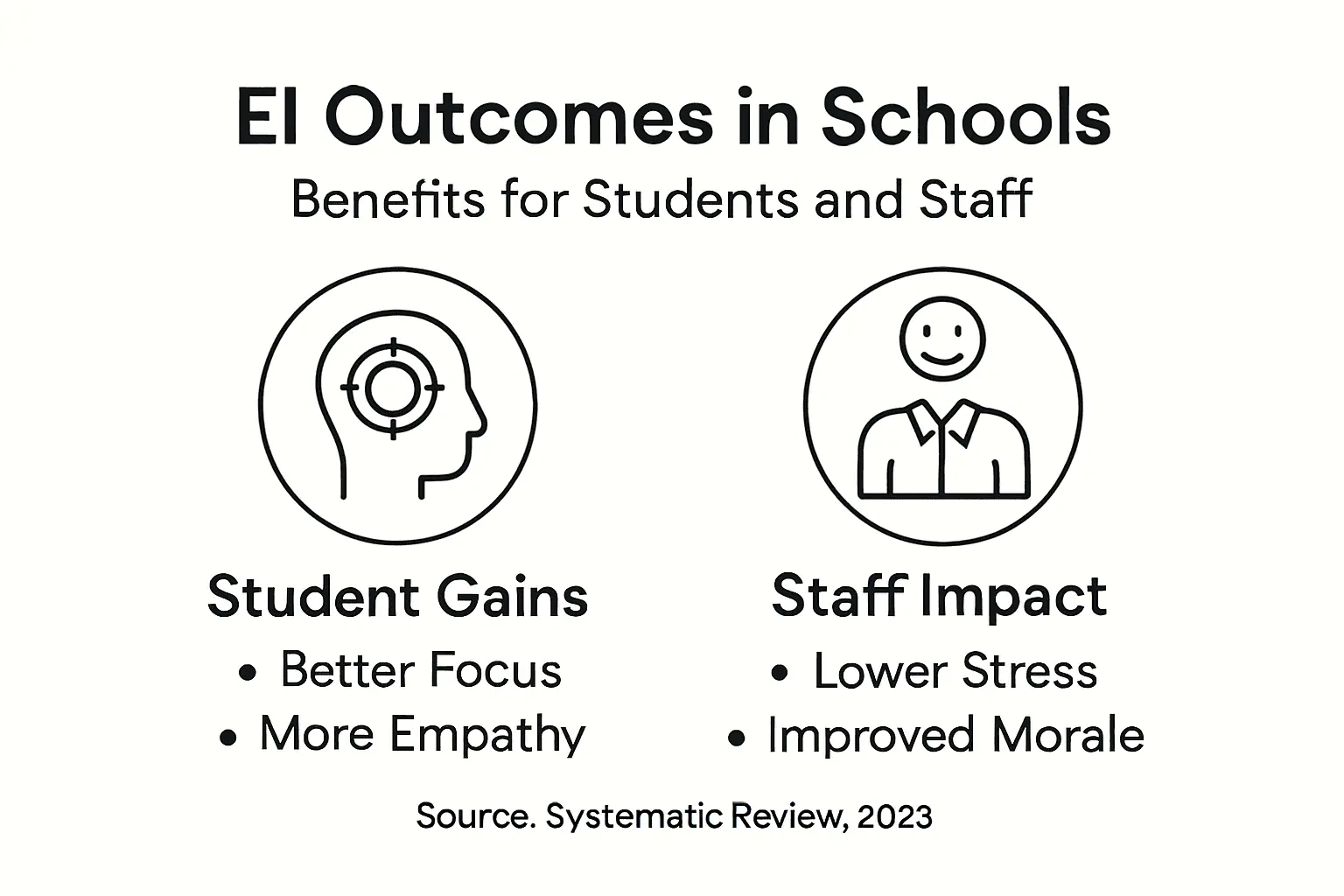
Systematic review findings reveal that emotional intelligence interventions produce measurable benefits across multiple dimensions. Key outcomes include increased academic engagement, improved classroom interactions, reduced behavioural challenges, and enhanced overall psychological well-being for both educators and students. The most successful programmes integrate emotional intelligence training systematically, treating it as a core educational competency rather than an peripheral skill.
Professional Insight: Implement comprehensive emotional intelligence assessment tools that track both individual and systemic progress, enabling targeted intervention and continuous improvement.
Common Challenges in Cultivating Emotional Intelligence
Systemic implementation challenges reveal significant barriers to emotional intelligence integration in educational environments. Schools frequently encounter complex obstacles that impede comprehensive emotional intelligence development, ranging from structural limitations to cultural resistance and resource constraints.
Key challenges include the profound difficulty of measuring emotional intelligence consistently across diverse student populations. Educators struggle with developing standardised assessment tools that capture nuanced emotional competencies while respecting individual and cultural differences. The absence of universally accepted measurement frameworks creates significant variability in programme effectiveness and implementation strategies.
Educational resistance to change presents another critical challenge. Traditional academic environments prioritise cognitive learning over emotional development, creating institutional inertia that undermines emotional intelligence initiatives. This resistance manifests through limited teacher training, insufficient curriculum integration, and inadequate recognition of emotional skills as fundamental to student success. Overcoming these systemic barriers requires comprehensive, strategic approaches that demonstrate tangible academic and personal development outcomes.
The table below contrasts common challenges in cultivating emotional intelligence with potential strategic solutions:
| Challenge | Underlying Cause | Strategic Solution |
|---|---|---|
| Inconsistent EI measurement | Lack of standardised frameworks | Develop adaptable assessment tools |
| Resistance to curriculum integration | Traditional academic priorities | Staff training in emotional learning |
| Limited resources and time | Competing demands on schools | Allocate dedicated EI time/roles |
Professional Insight: Design flexible emotional intelligence frameworks that can be customised to different institutional contexts while maintaining core developmental principles.
Unlock Emotional Intelligence to Transform School Engagement and Well-being
Emotional intelligence plays a crucial role in raising student engagement and fostering well-being in educational settings. However, many schools face challenges such as inconsistent assessment, resistance to curriculum integration, and limited resources to effectively cultivate these vital skills. Colossus Systems offers a powerful, customisable platform designed to streamline your organisation’s member and stakeholder engagement, ensuring your school community thrives emotionally and academically. With tools for comprehensive event planning, seamless communication, and detailed analytics, you can build structured emotional intelligence programmes that evolve with your students’ needs.

Elevate your institution’s capacity to nurture emotional awareness, social skills, and resilient relationships by integrating advanced engagement strategies today. Discover how tailored management and communication solutions can overcome common barriers to emotional learning—all within one unified system. Take the next step towards enhancing student well-being and achieving measurable growth by contacting Colossus Systems now. Explore how our platform supports educational organisations committed to holistic development through targeted engagement and streamlined operations.
Frequently Asked Questions
What is emotional intelligence in schools?
Emotional intelligence in schools refers to the ability of students to perceive, understand, and manage emotions, which is crucial for academic success and personal development.
How can emotional intelligence improve student engagement?
Emotional intelligence enhances student engagement by promoting self-awareness, empathy, and effective communication, leading to better classroom interactions and increased motivation.
What are the core components of emotional intelligence?
The core components of emotional intelligence include self-awareness, self-management, social awareness, relationship skills, and responsible decision-making, all of which contribute to emotional and academic growth.
What challenges do schools face in implementing emotional intelligence programs?
Schools may encounter challenges such as inconsistent measurement of emotional intelligence, resistance to curriculum integration, and limited resources, which can hinder the effective implementation of emotional intelligence initiatives.