Master Effective Meeting Facilitation for Member Engagement

Meetings meant to spark change can instead leave participants disengaged and pressed for time. For Executive Directors and facilitators at international nonprofits, the challenge is turning routine sessions into focused collaboration that respects every member’s role and commitment. By emphasising clear objectives and meticulous preparation, you not only streamline decisions but also foster trust and authentic engagement among diverse teams spanning continents.
Table of Contents
- Step 1: Set Clear Objectives And Prepare Meeting Resources
- Step 2: Establish Engagement Protocols And Define Expectations
- Step 3: Lead Productive Discussions And Manage Participation
- Step 4: Track Actions And Verify Meeting Effectiveness
Quick Summary
| Key Point | Explanation |
|---|---|
| 1. Define clear objectives | Clarify meeting goals to maintain focus and efficiency, preventing distractions and ensuring productive discussions. |
| 2. Prepare meeting resources | Gather all necessary materials and test technology beforehand to facilitate smooth participation for both in-person and remote attendees. |
| 3. Establish engagement protocols | Set clear behavioural guidelines to foster a safe and inclusive environment, ensuring all members feel comfortable contributing. |
| 4. Manage discussions actively | Facilitate engagement by inviting input from quieter members and maintaining focus on the meeting’s core objectives. |
| 5. Track actions post-meeting | Document decisions and action items immediately after meetings to ensure accountability and follow through on commitments. |
Step 1: Set clear objectives and prepare meeting resources
Before your members arrive, you need a laser-focused plan. Without clear objectives, meetings drift into tangents, waste time, and leave participants frustrated. Your first task is defining what you actually want to accomplish and gathering everything needed to get there.
Start by asking yourself these questions about your meeting:
- What specific decisions or outcomes must occur?
- Who needs to participate to make that happen?
- What information or materials will everyone need to engage meaningfully?
- How much time realistically fits each agenda item?
Defining clear meeting objectives gives your session direction and helps participants prepare mentally. For nonprofits and associations, this is especially critical when board members juggle multiple commitments. They arrive expecting efficiency and substance.
Next, prepare your meeting resources thoroughly. Gather all materials—handouts, data reports, voting tools, presentation slides—and arrange them logically before participants join. If you’re running a hybrid meeting, test technology early. If you’re distributing documents, send them ahead so remote and in-person attendees have equal preparation time.
Clear objectives transform meetings from time-consuming obligations into productive gatherings that respect everyone’s calendar and expertise.
Create a working agenda that maps to your objectives. For a two-hour board meeting, perhaps thirty minutes covers strategic updates, forty-five minutes covers the major decision point, and the remaining time addresses member engagement initiatives. This structure signals priorities and prevents one topic from consuming disproportionate time.
Consider your facilitation setup as well. Will you use a whiteboard to capture ideas? Are you recording decisions for follow-up? Do you need breakout sessions for smaller group discussions? Effective preparation of agendas and resources ensures your facilitator can focus on listening and guiding rather than scrambling for missing documents mid-session.

If your organisation uses a membership management platform, leverage it to track attendee confirmations and send pre-meeting resources through those channels. This centralises information and demonstrates professionalism.
Pro tip: _Create a simple checklist two weeks before every meeting: objectives defined, materials compiled, technology tested, agenda shared. This fifteen-minute exercise prevents ninety minutes of frustration.
Here’s how effective meeting preparation steps influence overall meeting success:
| Preparation Step | Result if Addressed | Result if Neglected |
|---|---|---|
| Clear Objectives Set | Focused discussion | Unproductive tangents |
| Resources Prepared | Informed participation | Delayed or confused members |
| Agenda Shared in Advance | Time managed effectively | Agenda overload, lost focus |
| Technology Tested | Smooth hybrid experience | Technical disruptions |
| Attendance Tracked | Full stakeholder input | Missed voices or decisions |
Step 2: Establish engagement protocols and define expectations
Meeting protocols are the invisible guardrails that keep discussions productive and inclusive. When members understand the rules upfront, they participate with confidence rather than anxiety. Your job is articulating these expectations clearly before the meeting begins.
Start by documenting your core engagement protocols. These should cover:
- How members should prepare before attending
- Whether cameras are expected to be on or off during hybrid sessions
- How to raise questions or contributions (hand raising, chat, unmute)
- The expectation around interruptions and turn-taking
- Confidentiality or privacy agreements if sensitive topics will be discussed
- Consequences for disruptive behaviour
Setting explicit behavioural guidelines ensures everyone knows their role and responsibilities. This is particularly important for virtual or hybrid meetings where informal cues get lost. Members from different organisational backgrounds may have completely different meeting norms, so spelling things out prevents confusion and resentment.
Communicate these protocols at least three days before your meeting. Include them in your pre-meeting email alongside the agenda and any preparatory materials. You might say something like: “We’re asking everyone to log in five minutes early and have your camera on during the first ten minutes of discussion so we can build connection.” Specific and kind beats vague and rigid.
Explicit protocols transform silence into safety, allowing members to engage authentically rather than guessing what behaviour is acceptable.
Establishing norms around communication methods and respectful behaviour creates psychological safety. When members know they won’t be interrupted or judged harshly, they contribute more freely. This matters tremendously for associations where members may be peers competing for board positions or advocacy priorities.
Address attendance expectations as well. If this is a critical board meeting, say so. If flexibility exists, communicate that too. Nothing undermines engagement faster than members discovering mid-meeting that their participation actually counted less than others assumed.
Professional tip: Share your engagement protocols as a simple one-page document in your meeting invitation, then reference them briefly at the start of the actual meeting—this reinforces they matter without consuming valuable discussion time.
Below is a summary of common meeting protocols and their practical effect:
| Protocol Type | Reason for Protocol | Practical Effect on Meetings |
|---|---|---|
| Camera Use | Foster engagement | Builds connection, reduces distraction |
| Turn-Taking Rules | Ensure fairness | Equal contribution, less conflict |
| Confidentiality Guidelines | Protect sensitive topics | Promotes trust and openness |
| Pre-Meeting Preparation | Encourage readiness | Speeds up decisions, less repetition |
| Behaviour Expectations | Support inclusivity | Reduces anxiety, prevents disruption |
Step 3: Lead productive discussions and manage participation
Once your meeting starts, your role shifts to active facilitation. You must balance keeping discussions on track whilst ensuring every voice gets heard. This requires genuine attention, strategic interventions, and the confidence to redirect without shutting people down.
Start by framing your discussion around the meeting’s core objective. Remind people briefly what you’re solving for or deciding. Then open the floor deliberately rather than hoping people volunteer. Direct questions work better than open silence: “Sarah, as our membership director, how are you seeing this challenge?” or “Let’s hear from someone who hasn’t spoken yet.”
Manage participation actively through these techniques:
- Use time boxing to allocate discussion slots per agenda item, then hold to them gently
- Paraphrase what you hear to confirm understanding and signal that contributions matter
- Watch for dominant voices and actively invite quieter members to contribute
- Call out tangents kindly: “That’s important, but let’s capture it as an action item and stay focused on today’s decision”
- Use the chat in hybrid settings to let remote participants contribute without fighting for airtime
Creating an inclusive environment where diverse voices are respected means noticing who’s absent from the conversation. Some members are naturally quiet but have valuable perspective. Others dominate out of habit or anxiety. Your job is rebalancing without embarrassing anyone.
Strong facilitation feels invisible because the discussion flows naturally, yet it’s actually the result of deliberate attention and gentle course corrections.
Address conflict or tension head-on but respectfully. If two board members disagree sharply, don’t pretend it didn’t happen. Say: “I hear that you two are seeing this differently. Let’s understand both perspectives before we decide.” This keeps conversations constructive and focused rather than letting frustration build silently.
Take notes visibly. When you write down decisions and action items in real time, members see their contributions matter. Use a shared document if you’re hybrid so everyone watches the same record being built.
Close your discussion deliberately. Summarise what you’ve decided, who’s doing what by when, and what comes next. This clarity prevents the post-meeting email debates that undermine engagement.
Professional tip: If a discussion veers off course, pause and ask the group: “Is this still serving our objective?” rather than shutting it down unilaterally—members feel respected when you invite them to course-correct collectively.
Step 4: Track actions and verify meeting effectiveness
A meeting without follow-up is just a conversation that consumed everyone’s calendar. Your final step is documenting what happened and ensuring people actually complete what was promised. This transforms meetings from talk into tangible outcomes.
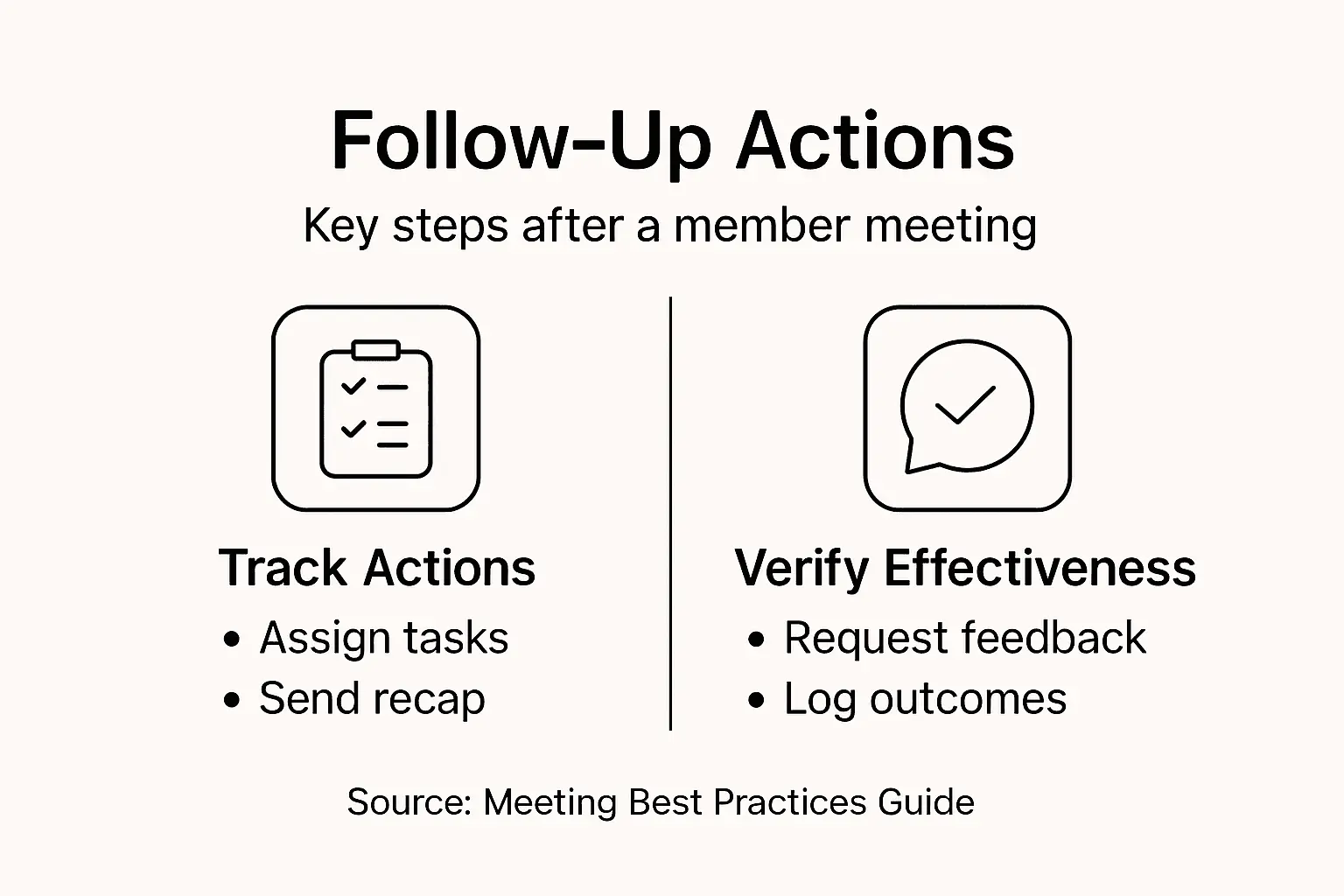
Immediately after your meeting ends, capture the action items in a structured format. You need clarity on three things for each action: what exactly needs doing, who’s responsible, and when it’s due. Vague commitments like “someone should investigate that” guarantee nothing happens.
Your follow-up document should include:
- Specific decisions made and their rationale
- Action items with owners, deadlines, and success criteria
- Key discussion points for those who missed the meeting
- Next meeting date and preliminary agenda items
- Links to any resources shared during discussion
Recording key decisions and assigning ownership with clear deadlines creates accountability. Send this document within 24 hours whilst the meeting is still fresh in people’s minds. This prevents the “I thought you were doing that” conversations that undermine trust.
Verify effectiveness through follow-up. One week before your next meeting, check in on action item progress. Are people on track? Do they need support or clarification? This signals that commitments matter and creates momentum.
Meetings prove their value not in the moment but in what happens afterward. Track ruthlessly, follow up consistently.
Consider gathering brief feedback after quarterly or major meetings. Ask three simple questions: Did this meeting achieve its objectives? Did you feel heard? What should we do differently next time? Measuring perceived effectiveness through participant feedback reveals whether your facilitation actually worked or just felt productive.
If your organisation uses membership software, log meeting outcomes and action items there. This keeps member-related commitments visible and ensures nothing falls through gaps between disconnected spreadsheets.
Watch patterns over time. If the same action items keep reappearing, your meetings might be solving symptoms rather than root causes. If participation consistently drops, your protocols or timing might need adjustment. Data-driven refinement makes future meetings progressively better.
Professional tip: Assign one person to send the follow-up document and track action items—don’t let it fall to whoever remembers, or critical items will slip through the chaos.
Elevate Your Meetings With Colossus Systems
Mastering effective meeting facilitation for member engagement requires clear objectives, structured protocols, and seamless follow-up. Many organisations struggle with unproductive discussions, lost action items, and low member participation. These challenges drain time and enthusiasm from your board and members, making it hard to achieve your essential goals.
Colossus Systems offers an all-in-one SaaS solution designed to streamline your member management and enhance engagement throughout the meeting lifecycle. From customised event planning and integrated communication channels to tracking attendance and action items within a unified platform, Colossus empowers you to lead meetings that deliver real results. Leveraging tools for CRM, email marketing, and virtual training ensures your team stays connected and accountable, transforming every meeting into an opportunity for growth.
Ready to transform your member meetings and boost organisational growth? Discover how our platform supports efficient meeting facilitation by visiting our Contact Us page. Take the next step towards productive, focused, and engaging meetings that respect your members’ time and expertise. Learn more about our membership management tools and unlock the full potential of your gatherings today.
Frequently Asked Questions
What are the first steps to prepare for an effective meeting?
To prepare for an effective meeting, set clear objectives and gather necessary resources like handouts and presentation materials. Start by asking yourself what decisions need to be made and who should participate to accomplish these outcomes.
How can I encourage member engagement during a meeting?
To encourage member engagement, establish clear protocols for participation, such as how to ask questions or share contributions. Communicate these expectations at least three days in advance so that members feel comfortable and prepared to engage.
What techniques can I use to manage discussions effectively?
Use techniques like time boxing to allocate discussion periods and paraphrasing contributions to ensure everyone feels heard. Actively invite quieter members to share their thoughts, ensuring a balanced conversation among participants.
How do I track action items after a meeting?
To track action items effectively, document them immediately post-meeting, specifying what needs to be done, who is responsible, and when it’s due. Send this follow-up document within 24 hours to keep commitments fresh in everyone’s mind.
Why is it important to follow up on meeting outcomes?
Following up on meeting outcomes is crucial because it ensures accountability and transforms discussions into tangible actions. Check in on progress one week before the next meeting to support your members and keep momentum going.
How can I gather feedback on meeting effectiveness?
You can gather feedback on meeting effectiveness by asking participants three simple questions about achieving objectives, feeling heard, and suggestions for improvement. This should be done after major meetings to refine future sessions based on their experiences.
Recommended
- Hybrid Meeting Tips for Boosting Member Engagement Effectively|CS
- Creating Impactful Presentations for Member Engagement Success|CS
- Improving Member Engagement: Proven Strategies for 2025|CS
- Effective Community Engagement Tactics for Lasting Connections|CS
- 7 praktische tips om telefoongesprekken beter maken - AlexandervanDijl.nl - Bel 020 262 1789
- Azure Mentorship Program - IronByte Consulting and Training