Creating Impactful Presentations for Member Engagement Success

Group meetings can easily feel one-sided when members disengage or simply listen in silence. For executive directors and event coordinators, creating presentations that genuinely connect begins with a structured needs assessment. The UNHCR Needs Assessment Handbook stresses coordinated, impartial data collection and analysis as the cornerstone of tailored engagement strategies. Discover how thoughtful preparation, targeted content, and interactive tools help overcome communication challenges and create lasting impact.
Table of Contents
- Step 1: Assess Member Needs And Objectives
- Step 2: Design Tailored Presentation Content
- Step 3: Incorporate Visual Elements Strategically
- Step 4: Integrate Interactive Engagement Tools
- Step 5: Review And Refine Presentation Delivery
Quick Summary
| Key Point | Explanation |
|---|---|
| 1. Assess Member Needs | Understanding member motivations enhances engagement strategies, leading to more relevant presentations. |
| 2. Tailor Presentation Content | Design presentations around specific member interests for improved audience retention and focus. |
| 3. Use Visual Elements | Effective visuals clarify messages and enhance audience engagement, ensuring better information retention. |
| 4. Incorporate Interactivity | Engaging members through interactive tools fosters participation and creates a collaborative learning environment. |
| 5. Refine Delivery Techniques | Continuous practice and feedback improve delivery skills, enhancing overall communication effectiveness and audience connection. |
Step 1: Assess member needs and objectives
Successful member engagement begins with a deep understanding of what your organisation’s members truly want and need. By systematically assessing organisational objectives, you create a strategic foundation for impactful presentations that resonate with your audience.
Effective needs assessment involves several critical components. Start by gathering comprehensive data through multiple channels:
- Member surveys to capture direct feedback
- Individual interviews with key representatives
- Historical engagement data from past events
- Performance metrics measuring current interaction levels
The goal is to develop a nuanced understanding of your members’ motivations, challenges, and expectations. This requires a structured approach that goes beyond surface-level observations. Conducting systematic needs analysis helps identify the gaps between current engagement and desired outcomes.
Successful needs assessment is not about collecting data, but transforming insights into targeted engagement strategies.
During this process, pay close attention to emerging patterns and themes. Look for consistent feedback that reveals underlying member priorities. This might include professional development opportunities, networking preferences, or specific types of content they find most valuable.
Pro tip: Create a standardised assessment template that you can consistently use across different member segments to ensure comparable and actionable insights.
Step 2: Design tailored presentation content
Crafting an engaging presentation requires more than just compiling information – it demands a strategic approach that speaks directly to your audience’s needs and expectations. Developing targeted presentation strategies.pdf?sfvrsn=e329b315_1) is crucial for capturing and maintaining member attention.
To create truly impactful content, focus on these essential elements:
- Audience-centric design: Understand your members’ specific interests and learning objectives
- Clear message hierarchy: Limit your presentation to 3-5 core messages
- Compelling storytelling: Integrate relevant narratives that illustrate your key points
- Visual simplicity: Use clean, uncluttered slides that enhance understanding
- Practical examples: Include real-world scenarios that demonstrate immediate value
The art of presentation design lies in balancing information density with engagement. Crafting high-impact presentation content requires careful consideration of both substance and delivery. Your goal is to transform complex information into digestible, memorable insights that resonate with your audience.
Effective presentations are not about how much you say, but about how well your audience understands and remembers your message.
Consider structuring your content as a narrative journey, guiding members through a logical progression of ideas. Each slide should serve a specific purpose, moving your audience closer to the intended learning outcomes or call to action.

Pro tip: Create a presentation storyboard before designing slides, mapping out your narrative flow and ensuring each element contributes meaningfully to your core message.
Step 3: Incorporate visual elements strategically
Visuals are the silent communicators that can transform an ordinary presentation into a memorable experience for your members. Selecting impactful visual design is crucial for capturing and maintaining audience engagement.
When incorporating visual elements, consider these strategic approaches:
- Clarity over complexity: Choose graphics that illuminate your message
- Consistency in design: Maintain a uniform colour palette and visual style
- Data visualisation: Use charts and graphs that tell a compelling story
- Minimal text overlay: Ensure visuals complement rather than compete with your narrative
- High-quality imagery: Select professional, relevant images that enhance understanding
Effective slide design principles suggest that each visual should serve a specific purpose. Your slides are not decoration – they are strategic communication tools that guide your audience’s understanding and retain their attention.
The most powerful presentations don’t just show information – they create visual narratives that resonate emotionally and intellectually.
Think of your visuals as a visual language that speaks directly to your members’ interests and challenges. Each graphic, chart, or image should be carefully curated to support your core message and create a meaningful connection with your audience.
Pro tip: Conduct a “visual audit” by reviewing your slides with the sound off – if the visuals alone cannot communicate your key points, redesign them.
Step 4: Integrate interactive engagement tools
Transforming passive presentations into dynamic, interactive experiences is crucial for maintaining member attention and fostering meaningful participation. Interactive presentation strategies offer powerful mechanisms to elevate your engagement approach.
Consider implementing these interactive tools to maximise member involvement:
- Live polling: Capture real-time audience perspectives
- Q&A sessions: Enable direct member interaction
- Digital quizzes: Test and reinforce key learning points
- Collaborative annotation: Allow members to contribute insights
- Breakout discussion rooms: Create small group interaction opportunities
Digital engagement technologies demonstrate significant potential for increasing participant motivation and knowledge retention. By transforming your presentation from a one-way communication channel into a collaborative platform, you create opportunities for deeper connections and more meaningful exchanges.
Engagement is not about talking at your members, but creating conversations with them.
Successful interactive tools bridge the gap between presenter and audience, transforming passive listeners into active participants. Your goal is to design experiences that feel inclusive, stimulating, and personalised to your members’ specific interests and learning preferences.
The following table distinguishes passive from interactive presentation approaches:
| Approach Type | Main Characteristics | Member Experience |
|---|---|---|
| Passive | One-way information delivery | Limited involvement |
| Interactive | Dialogue and participation | Active contribution |
Pro tip: Test your interactive tools beforehand to ensure smooth technical implementation and have backup strategies in case of digital complications.
Step 5: Review and refine presentation delivery
Mastering your presentation delivery is the critical final step in creating an impactful member engagement experience. Professional presentation refinement techniques can transform a good presentation into an extraordinary communication opportunity.
Essential strategies for reviewing and enhancing your presentation include:
- Video self-recording: Analyse your performance objectively
- Peer feedback: Seek constructive critique from colleagues
- Audience surveys: Gather direct insights on presentation effectiveness
- Vocal technique practice: Develop clarity, tone, and modulation
- Body language assessment: Understand non-verbal communication signals
Advanced presentation skill development requires continuous learning and adaptation. Your goal is to create a seamless, authentic delivery that connects emotionally and intellectually with your members.
Presentation excellence is not about perfection, but about genuine, adaptive communication.
Consistent practice and willingness to learn from each experience will help you refine your approach. Pay attention to nuanced elements like pacing, energy levels, and how effectively you respond to audience engagement.
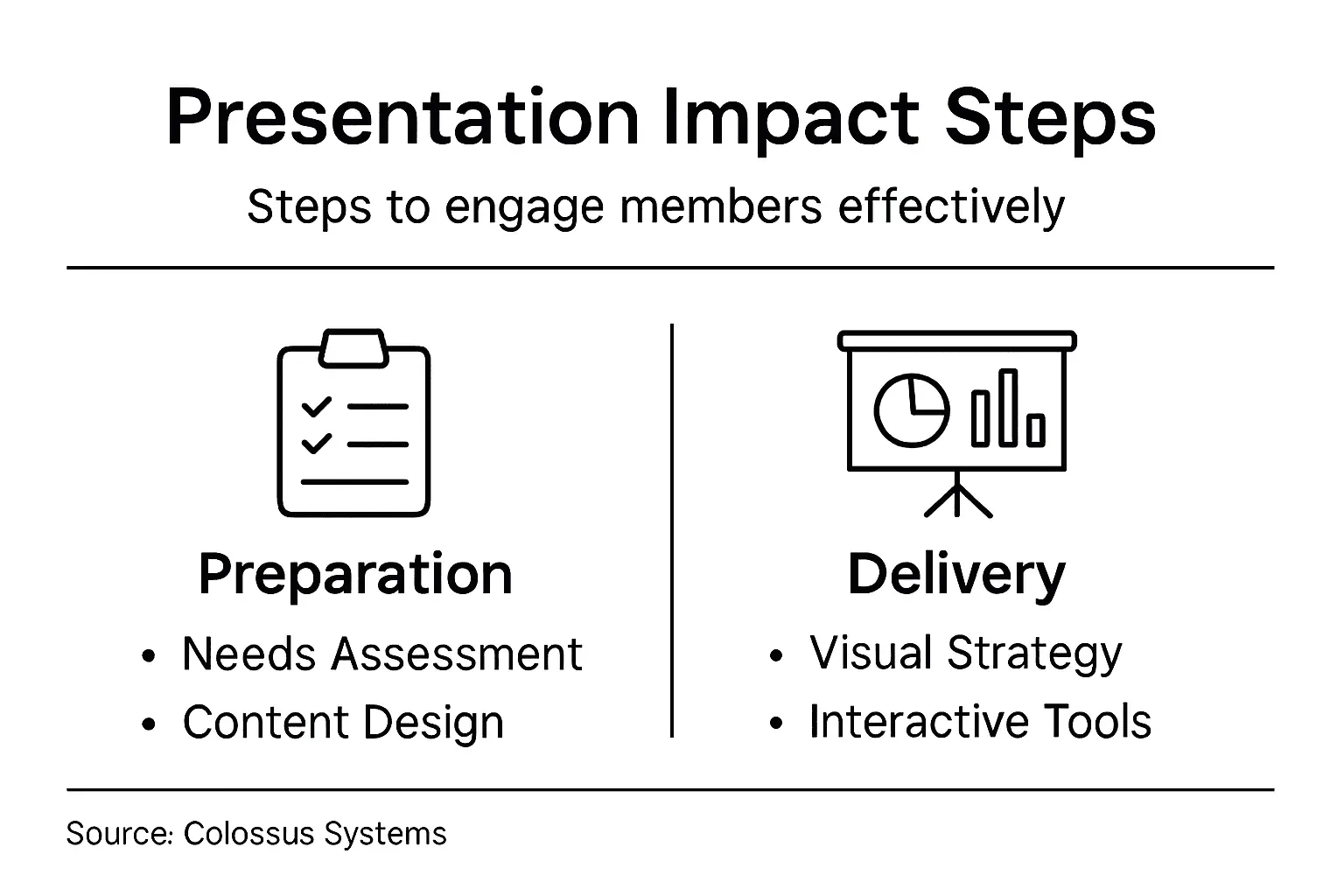
Here is a summary of effective engagement steps and their primary benefits:
| Step | Key Benefit | Typical Outcome |
|---|---|---|
| Assess member needs | Alignment with real priorities | More relevant presentations |
| Design tailored content | Greater audience concentration | Improved knowledge retention |
| Incorporate visuals | Enhanced clarity | Higher engagement levels |
| Use interactive tools | Active participation | Increased member involvement |
| Refine delivery | Polished communication | Stronger audience connection |
Pro tip: Create a personal feedback journal after each presentation, documenting specific moments of success and areas for future improvement.
Elevate Your Member Presentations with Colossus Systems
Creating impactful presentations that truly engage your members requires a strategic approach aligned with their needs and preferences. The article highlights the importance of tailored content, strategic visuals, and interactive tools to transform passive listeners into active participants. Yet, managing these elements while also handling event planning, member communication, and engagement analytics can be overwhelming for many associations and nonprofits.
Colossus Systems offers a comprehensive SaaS platform designed to streamline these challenges by integrating member management, event registration, and communication channels within a single, customisable solution. Our tools help you craft and deliver tailored presentations, leverage interactive engagement features, and analyse member interactions to continuously refine your approach. Experience how a unified platform can turn your presentation goals into measurable engagement successes.
Capture your audience’s attention and foster meaningful connections today with Colossus Systems.
Take the next step in transforming your member engagement. Contact Us to explore how our solutions empower you to create presentations that resonate deeply and drive organisational growth.
Don’t wait to enhance your presentations and elevate your member experience. Reach out now to start your journey with Colossus Systems.
Frequently Asked Questions
How can I assess member needs effectively for my presentations?
To effectively assess member needs, gather data through member surveys, individual interviews, historical engagement data, and performance metrics. Aim to develop a deep understanding of your members’ motivations and expectations to enhance engagement within your presentations.
What elements should I focus on when designing tailored presentation content?
Focus on audience-centric design, clear message hierarchy, compelling storytelling, and practical examples. Limit your presentation to 3-5 core messages to ensure your audience understands and retains the key points.
How can I incorporate visuals into my presentations for better engagement?
Incorporate visuals that enhance clarity and maintain a consistent design style. Use high-quality images and data visualisations that complement your narrative, ensuring each visual contributes meaningfully to your overall message.
What interactive tools can I use to elevate member engagement during my presentations?
Utilise live polling, Q&A sessions, digital quizzes, and breakout discussion rooms to create an interactive experience. These tools foster active participation and help to maintain audience interest throughout your presentation.
What methods can I employ to refine my presentation delivery?
To refine your presentation delivery, record yourself and seek peer feedback to identify areas for improvement. Practise vocal techniques and assess your body language to ensure your communication is engaging and authentic.
How can I ensure my presentations are impactful and resonate with my audience?
Ensure your presentations are impactful by aligning them with the assessed needs of your members and using tailored content. Focus on delivering clear messages while integrating visuals and interactive elements to create a memorable experience for your audience.
Recommended
- Mastering Public Speaking for Leaders: A Step-by-Step Guide|CS
- What Is Membership Engagement? Complete Overview | Colossus Systems
- Improving Member Engagement: Proven Strategies for 2025|CS
- 7 Powerful Community Building Ideas for Member Organisations|CS
- 7 Inspiring Examples of Custom Apparel Designs for Brands – DIYPRINTZ
- Un Business Plan : Comment le présenter?
- 7 Actionable Examples of Content Marketing for Dispensaries