Student lifecycle management: a practical guide for associations

Student lifecycle management (SLM) is the institution-wide practice of managing every learner or member relationship as one continuous, unified journey from first enquiry through to long-term alumni engagement, underpinned by a CRM for outreach and a student information system (SIS) for records. Colossus Systems applies this same model to membership organisations, connecting CRM, event management, learning and billing into a single platform. In practice, SLM means:
- A single member record that persists across every stage
- Defined stages from prospect through to alumni or renewal
- Joined-up workflows and shared KPIs across departments
The organisational effect is measurable: fewer duplicated records, earlier identification of members at risk of lapsing, and a clearer picture of lifetime value.
Table of Contents
- Why does SLM matter for UK membership organisations?
- What are the standard stages of the member lifecycle?
- Which systems do you need to make SLM work?
- How do you implement SLM in seven steps?
- Which KPIs should you track, and how do you show ROI?
- What mistakes do associations make when adopting SLM?
- What does a realistic SLM timeline and budget look like?
- How does Colossus support SLM for membership organisations?
- Key takeaways
- Why associations should treat members as lifecycle customers
- See how Colossus can support your SLM pilot
- Useful sources
Why does SLM matter for UK membership organisations?
Membership bodies face the same structural problem as universities: each department owns a fragment of the member relationship. The events team has attendance data, the CPD team tracks credits, finance holds renewal history, and none of them talk to each other in real time. SLM fixes that by aligning systems and teams around a shared view of every member.
The practical gains for associations are direct:
- Retention: Spotting a member who has missed two renewals and skipped the last three events is only possible when attendance, billing and engagement data sit in one place.
- CPD conversion: Associations running professional development programmes can track credit completion and trigger timely follow-up, lifting course-to-qualification conversion.
- Event attendance: Joined-up communications, based on a member’s history and interests, produce better-targeted invitations and higher registration rates.
- Lifetime member value: When you can see the full arc from prospect to long-term member, you can model revenue more accurately and invest in the right retention interventions.
Operationally, technology across the whole lifecycle reduces duplicated records, simplifies invoicing and removes the manual re-keying that costs staff hours every week. For UK associations running accreditation cycles or fundraising campaigns, that efficiency compounds quickly.
Stat to note: Managing the complete lifecycle is associated with higher enrolment, stronger retention and better completion rates when systems and teams are properly aligned.
What are the standard stages of the member lifecycle?
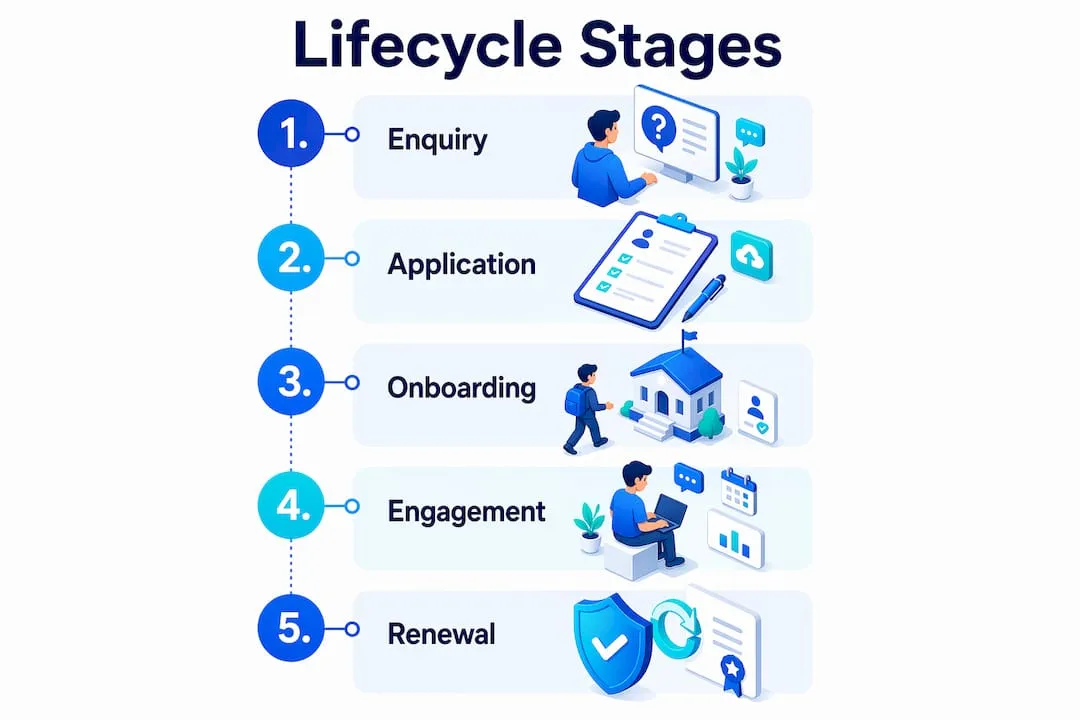
The canonical lifecycle stages run from initial interest through to ongoing alumni or renewal engagement. For membership organisations, they map as follows:
- Prospect/enquiry — Contact details, referral channel, interest area, consent record
- Application/admissions — Application status, eligibility check, supporting documents
- Enrolment/onboarding — Membership tier, payment confirmation, welcome communications sent
- Progression/learning — Course or module selection, attendance, CPD credits accrued
- Performance — Assessment results, accreditation status, financial holds
- Graduation/certification — Award or qualification issued, record updated
- Alumni/renewal — Post-programme engagement, renewal rate, giving or upgrade history
Each stage generates data that is only valuable if it informs the next. Application materials should shape onboarding; CPD history should drive renewal communications; post-programme engagement should feed back into programme design.
The highest-risk moments are the transitions. The gap between enrolment and first active participation, or between a first and second renewal, is where the most members quietly disappear. Targeted interventions at these transition zones — a timely message, an early-warning flag, a personal call — prevent the highest-volume leakage in lifecycle performance.
Which systems do you need to make SLM work?
Data fragmentation is the primary technical barrier to effective lifecycle management. Most associations accumulate separate tools for each function: a CRM for outreach, a spreadsheet for events, a separate LMS for learning, and a finance system that shares nothing with any of them. The architecture you need instead looks like this:
- CRM — outreach, lead nurture, communications history
- SIS / member record — the persistent single record that follows the member through every stage
- LMS — learning delivery, attendance, CPD tracking
- Events and payments — registration, invoicing, financial holds
- Alumni/advancement module — renewal, giving, post-programme engagement
The integration checklist for procurement:
- Unique persistent identifier per member across all systems
- API-based, near-real-time sync between modules
- Event and finance connectors that write back to the member record
- Consent and data governance records compliant with UK GDPR
- An all-in-one SIS that eliminates re-keying by keeping a single record from application through to alumni
Pro Tip: Prioritise record persistence over feature richness when evaluating vendors. A platform that keeps one record across every stage will save more staff time than a feature-rich tool that forces manual data transfer between modules.
How do you implement SLM in seven steps?
Lifecycle management is a strategic shift, not just a software project. Standardising your processes before configuring any system is the single most important prerequisite. Here is a practical sequence:
- Secure executive sponsorship and governance — Appoint a cross-functional steering group with authority to set shared KPIs.
- Map persona-based journeys — Identify your distinct member types (early-career professional, corporate member, international learner) and map their actual journeys before touching any system.
- Audit data and systems — Catalogue every data source, identify duplicates and gaps, and document where re-keying currently happens.
- Standardise processes — Agree on definitions (what counts as “active”? when is a member “at risk”?) before configuration begins.
- Choose a pilot cohort and metrics — Select one membership tier or programme. Define success criteria: target retention rate, CPD completion rate, reduction in admin time.
- Configure integrations and dashboards — Connect systems using unique identifiers, set up an early-warning dashboard combining attendance, engagement and billing data.
- Run the pilot, measure and iterate — Review against success criteria at 90 days. Expand only after the pilot data validates the model.
Roles involved:
- Executive sponsor (authority and budget)
- Data lead (audit, governance, GDPR compliance check)
- Programme manager (journey mapping, process design)
- IT (integration, security)
- Finance (billing connectors, financial holds)
- Frontline membership staff (adoption, feedback)
UK data protection: include a discrete consent and data governance review at step 3. Confirm lawful basis for processing under UK GDPR, update privacy notices, and document consent records before any system goes live.
Which KPIs should you track, and how do you show ROI?
Core metrics for membership organisations:
- Enquiry-to-enrolment conversion rate — percentage of prospects who become active members
- First-to-second year persistence — the renewal rate after the first membership year
- Average lifetime value per member — total revenue over the full membership relationship
- Event attendance rate — registered members who actually attend
- CPD completion rate — members who finish a programme versus those who start
- Renewal/giving rate — annual renewal plus any upgrade or donation activity
A simple ROI calculation for a board presentation: take your current annual renewal rate, model a modest improvement (say, five percentage points), multiply by average member value, and subtract the cost of the platform and implementation. For an association with 2,000 members at £200 average annual value, a five-point retention improvement generates £20,000 in incremental revenue per year before any admin-cost savings are counted.
Member engagement software also reduces the staff time spent on manual chasing, duplicate record correction and ad hoc reporting, which adds a further cost offset that is straightforward to quantify once you have baseline data.
Stat to note: Organisations that align systems and teams around the full lifecycle consistently report improvements across enrolment, retention and completion — the three metrics that drive long-term revenue.
What mistakes do associations make when adopting SLM?
The most common failure is treating the member journey as a linear marketing funnel. A funnel ends at conversion; a lifecycle continues for years. Reorienting your team around lifetime value and long-term engagement rather than acquisition metrics is the cultural shift that makes everything else work.
Other predictable pitfalls:
- Technology before process — Configuring a platform before standardising definitions produces a system that automates the wrong things.
- Ignoring transition zones — The admit-to-enrol and first-to-second-renewal gaps are where most members are lost; few associations monitor them explicitly.
- Over-customising too early — Start with the platform’s standard workflows. Customise only after the pilot proves what your members actually need.
- Weak data governance — Organisational silos are the primary enemy of lifecycle management; without shared metrics, each department optimises for its own stage and the member falls through the gaps.
Pro Tip: Set shared KPIs that reward cross-departmental outcomes — overall retention rate, lifetime value — rather than stage-specific targets. A team measured only on event registrations has no incentive to flag a member who has stopped engaging with CPD.
What does a realistic SLM timeline and budget look like?

| Phase | Typical duration | Primary activities |
|---|---|---|
| Discovery | 4–6 weeks | Stakeholder interviews, data audit, journey mapping |
| Process design | 6 weeks | Standardise definitions, agree KPIs, select pilot cohort |
| Pilot implementation | 8 weeks | Configure integrations, build dashboards, train staff |
| Scale-up | 3–6 months | Extend to additional tiers, refine workflows |
| Optimisation | Ongoing | Quarterly KPI reviews, continuous improvement |
Primary cost drivers for UK associations:
- Integration complexity — the more legacy systems you are connecting, the higher the implementation cost
- Data cleansing — deduplicating years of fragmented records takes significant staff time
- Staff time for process work — journey mapping and process standardisation are internal costs that are often underestimated
- Licences — platform fees vary by member volume and module selection
- Training and change management — budget for this explicitly; under-investment here is the most common reason pilots stall
For fastest returns, prioritise the renewal and CPD tracking modules first. These generate measurable revenue impact within the first cycle and build the internal confidence needed to fund the next phase.
How does Colossus support SLM for membership organisations?
Colossus Systems is built specifically for membership bodies, associations and nonprofits. Rather than adapting a university SIS to a membership context, Colossus provides a unified platform where CRM, event management, LMS, payments and member records operate from a single data layer. That architecture directly addresses the fragmentation problem that undermines most SLM attempts.
A typical association using Colossus can:
- Maintain a single persistent member record from prospect through to renewal
- Run and track CPD events with attendance and credit data writing back automatically to the member record
- Trigger targeted communications based on engagement history, renewal date or CPD status
- Monitor renewal risk through engagement and billing data in one dashboard
| Platform feature | Lifecycle stage | Outcome |
|---|---|---|
| CRM and pipeline management | Prospect/enquiry | Higher enquiry-to-enrolment conversion |
| Event registration and management | Enrolment, progression | Improved attendance and CPD completion |
| LMS and virtual training | Progression, performance | Tracked learning outcomes and credit accrual |
| Payments and billing | All financial stages | Reduced financial holds and faster renewals |
| Analytics and reporting | All stages | Early-warning flags and retention dashboards |
For a pilot, a practical scope is: one membership tier, CRM plus events plus payments connected, 90-day measurement window, with renewal rate and CPD completion as the two primary success metrics.
Key takeaways
Student lifecycle management works because it replaces fragmented, stage-specific tools with a single connected record, shared KPIs and proactive interventions at every transition point.
| Point | Details |
|---|---|
| SLM definition | Managing every member relationship as one continuous journey, from enquiry to alumni, using integrated data. |
| Strategic benefit for associations | Joined-up CRM, events, LMS and billing data improves retention, CPD conversion and lifetime member value. |
| Seven-step pilot | Start with executive sponsorship and process standardisation before configuring any system; pilot one cohort first. |
| Key KPIs | Track enquiry-to-enrolment conversion, first-year renewal rate, CPD completion and average lifetime member value. |
| Colossus Systems | Provides a membership-focused unified platform covering CRM, events, LMS and payments for a practical SLM pilot. |
Why associations should treat members as lifecycle customers
The associations that struggle with retention are almost always the ones measuring the wrong thing. They count new sign-ups, celebrate a sold-out event, and then wonder why renewal rates are flat. The problem is a funnel mindset applied to a relationship that is supposed to last decades.
Lifecycle thinking reframes the question entirely. Instead of asking “how do we get more members?” you ask “how do we make membership more valuable at every stage?” That shift changes what you measure, what you build, and how your teams collaborate. It also makes the student achievement tracking and alumni engagement work that associations often treat as optional extras into core operational functions.
Change management is where most implementations either succeed or stall. The technology is the easy part. Getting a finance team, a programme team and a membership team to share a definition of “active member” and accept a shared KPI is the real work. Start there, and the platform becomes an accelerant rather than a distraction.
See how Colossus can support your SLM pilot
Your members deserve a joined-up experience, and your team deserves data that actually helps them act. Colossus gives membership organisations a single platform covering CRM, events, learning and payments, so you can run a credible SLM pilot without stitching together five separate tools.
The membership management features are built for associations running professional development programmes, accreditation cycles and events at scale. If you want to see how the platform maps to your specific lifecycle stages, the most useful next step is a short demo where we walk through your current member journey and show exactly where Colossus connects the gaps. Get in touch to arrange one.
Useful sources
- UCL Education and Student Lifecycle Portfolio — UCL’s institutional overview of lifecycle stages; useful for grounding the standard stage definitions in a UK higher education context.
- EdTech Magazine — How SLM contributes to institutional success — Practitioner-focused article on CRM, analytics and the lifecycle-versus-funnel distinction.
- Modern Campus — SLM in the age of AI — Covers early-warning dashboards, transition zone optimisation and organisational coordination; directly applicable to membership bodies.
- Educause — Top IT issues (data fragmentation) — Authoritative US higher education technology research body; the data fragmentation findings translate directly to UK association contexts.
- University of Manchester — Lifecycle strategy and process standardisation — Internal strategy document from a major UK institution; strong evidence for the “process before platform” principle.
- Classter — Student information system — Explains how an all-in-one SIS eliminates re-keying; useful reference for procurement conversations.
- Rework — Student lifecycle overview — Practitioner resource linking lifecycle alignment to measurable outcomes across enrolment, retention and completion.
- LeadSquared — What is student lifecycle management? — Clear definition and interaction-capture framing; helpful for explaining SLM to non-technical stakeholders.