What is a campus engagement platform?

TL;DR:
- A campus engagement platform consolidates campus services into a personalized digital environment, improving student retention and experience. It integrates with existing systems to provide real-time data, personalized content, and targeted notifications, supporting timely human intervention. Proper configuration and integration of such platforms foster higher engagement, lower dropout rates, and better institutional outcomes.
A campus engagement platform is a mobile-first, unified digital hub that consolidates fragmented campus services, including event management, club registration, messaging, and academic dashboards, into a single personalised interface. The industry term for the most advanced versions of this technology is Campus Experience Platform, or CXP. Both terms describe the same core concept: replacing the scattered collection of portals and apps that students currently navigate with one coherent digital environment. For educational administrators, the platform is not just a convenience tool. It is a direct lever for improving student retention, belonging, and long-term institutional success.
What is a campus engagement platform and what does it actually do?
A campus engagement platform acts as a presentation layer that stitches together existing campus systems without replacing them. Rather than building yet another database, it pulls data from your Student Information System (SIS), Learning Management System (LMS), and other core tools, then surfaces that information through a single, personalised interface. Students see what is relevant to them. Administrators see what needs attention.

The practical result is significant. A well-configured platform typically replaces 3–5 disparate tools via a single login, eliminating the fragmented experience that drives students away from digital services altogether. That consolidation also reduces the administrative overhead of managing multiple vendor contracts and support arrangements.
The distinction between a legacy portal and a modern campus engagement platform is worth understanding clearly. Legacy portals offer static links and generic announcements. A campus engagement platform delivers personalised content, tracks participation, flags at-risk students, and prompts the next action, all within the same session. The shift from information delivery to guided action is what separates the two.
What core features define a modern campus engagement platform?
Modern platforms share a consistent set of capabilities that separate them from basic communication tools. The table below outlines the primary feature categories and what each one delivers in practice.
| Feature category | What it delivers |
|---|---|
| Event management | Centralised registration, waitlist management, and automated attendance via QR codes or mobile check-in |
| AI-powered communication | Chatbots handling routine queries, freeing staff for complex student needs |
| System integrations | Connections to SIS, LMS, and identity providers via APIs and single sign-on (SSO) |
| Analytics dashboards | Real-time participation data and at-risk student identification for administrators |
| Personalised content | Tailored feeds, push notifications, and nudges based on individual student behaviour |
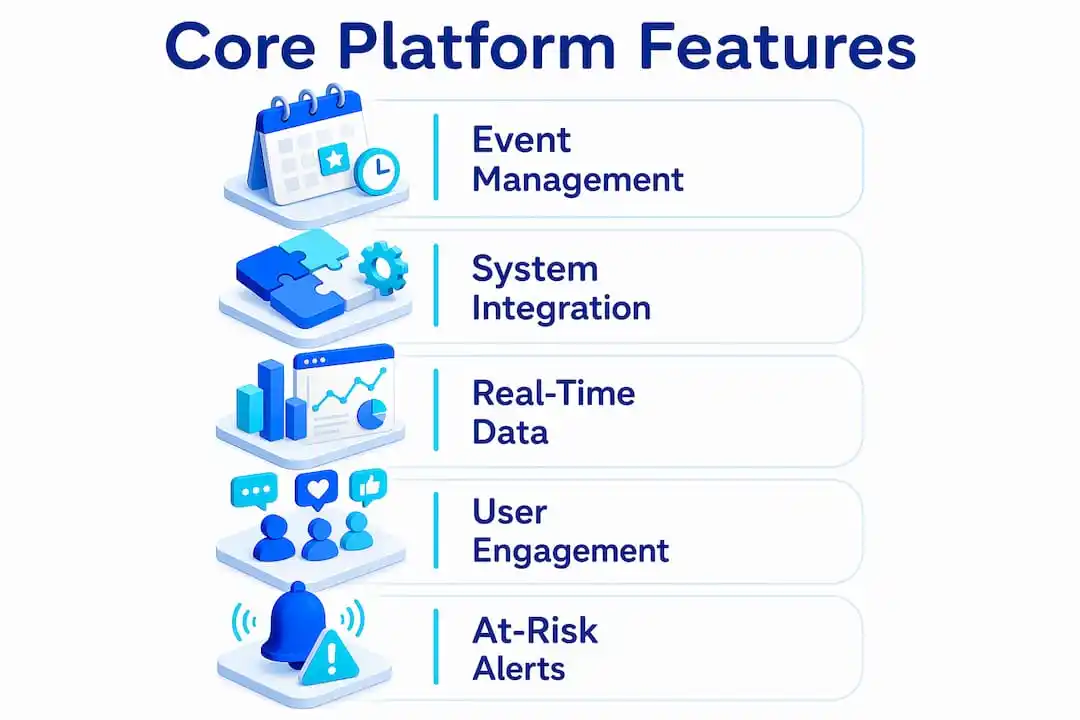
The most capable platforms on the market today offer over 140 integrations with campus systems. That breadth matters because no institution runs on a single vendor’s ecosystem. A platform that cannot connect to your existing tools creates more problems than it solves.
Real-time dashboards are particularly valuable for administrators. Rather than waiting for end-of-term reports, you can identify students who have attended zero events, joined no clubs, and engaged with no digital services, and act before disengagement becomes withdrawal.
Pro Tip: When evaluating campus engagement tools, ask vendors specifically how their dashboards surface at-risk students, not just aggregate participation numbers. Aggregate data tells you how the cohort is performing. Individual-level data tells you who needs a phone call.
The role of technology in engagement is not to replace human contact. It is to make human contact more targeted and timely.
How do campus engagement platforms improve student retention?
The link between digital engagement and student retention is no longer theoretical. University of Houston data tracking over 19,500 students shows that highly engaged students maintain a 95% retention rate and an average GPA of 3.259. That is a measurable institutional outcome, not a soft metric.
The mechanism behind this result connects to social integration theory. Students who feel they belong to a campus community are significantly more likely to persist through academic difficulty. Campus activities, clubs, and events are the primary vehicles for building that sense of belonging. A platform that makes those activities easy to find and join directly supports retention.
Students who engage with campus life through structured digital tools are not just more connected socially. They perform better academically and are far less likely to withdraw. The data from institutions tracking this relationship consistently points in the same direction: engagement is a retention strategy, not an extracurricular afterthought.
The AAC&U 2026 survey confirms that high-impact experiences, including mentorship, internships, and applied learning, correlate directly with student wellbeing and institutional success. Platforms that surface these opportunities prominently, rather than burying them in a general events feed, produce measurably better outcomes.
The benefits of campus engagement extend beyond individual students. Institutions with higher retention rates carry lower recruitment costs, stronger alumni networks, and better reputational standing. The financial case for investing in a well-configured platform is straightforward.
How do campus engagement platforms integrate with existing campus systems?
Integration is where most platform deployments succeed or fail. A campus engagement platform should never replace your SIS or LMS. It should connect to them, draw data from them, and present that data in a way that serves students and administrators without creating a parallel database that falls out of sync.
The technical foundation for this approach relies on two standards: API connections and single sign-on (SSO). APIs allow the platform to pull live data from your existing systems. SSO, often implemented via Active Directory or Azure AD, ensures frictionless user access without requiring students to manage separate credentials. When identity management is weak, adoption suffers. Students will not use a platform that requires a separate login they cannot remember.
A well-integrated deployment follows a clear sequence:
- Audit your existing systems and identify which data sources the platform needs to access.
- Confirm API availability and authentication protocols with each vendor before signing any contract.
- Implement SSO through your institution’s existing identity provider before launching to students.
- Test the data flow between systems in a staging environment with a small pilot group.
- Monitor integration health continuously after launch, not just during the initial rollout.
Pro Tip: Never treat the campus engagement platform as your primary database for student records. Use it as a display and interaction layer only. Any data it collects, such as event attendance or club membership, should write back to your authoritative systems of record via API, not sit in the platform’s own database as the sole copy.
Platforms that unify existing systems into one secure experience can also serve multiple campus groups simultaneously, including prospective students, current students, alumni, and staff, each seeing a tailored view of the same underlying data. That flexibility reduces the need for separate portals for different audiences.
What steps help administrators maximise a campus engagement platform?
Configuration decisions made at deployment determine whether a platform delivers results or collects dust. The most effective administrators treat the platform as a programme tool, not a communication channel.
Start by prioritising the features that connect students to high-impact experiences such as mentorship programmes, internship listings, and applied learning opportunities. These are the activities that the AAC&U research links directly to wellbeing and persistence. If your platform buries them behind general announcements, students will not find them.
Personalised nudges outperform generic announcements in driving student engagement. Behaviour-based notifications that respond to what a student has or has not done, such as prompting a first-year student who has not joined any clubs by week three, are the hallmark of high-engagement institutions. Generic push notifications are noise. Targeted nudges are a student engagement strategy.
- Audit your current tool stack and remove redundant platforms before launching a new one. Students presented with yet another app will disengage immediately.
- Configure the platform to surface concrete next steps, not just information. The NACA principle of reducing cognitive load applies directly here: every screen should answer “what do I do next?”
- Set measurable targets before launch, such as a specific retention improvement or event attendance increase, so you can evaluate the platform’s actual impact at the end of the academic year.
- Assign a dedicated platform administrator who owns configuration, analytics review, and ongoing communication with the vendor.
Pro Tip: Run a tool redundancy audit before your platform goes live. List every digital touchpoint students currently use, from the LMS to the housing portal to the library booking system. Identify which ones the new platform can absorb or replace. Reducing the number of logins students need is itself a student engagement strategy.
Institutions that approach the platform as a unified engagement hub rather than an add-on tool consistently report stronger adoption rates and more meaningful participation data.
Key takeaways
A campus engagement platform delivers measurable retention gains only when it is configured as an active experience layer, not deployed as a passive information portal.
| Point | Details |
|---|---|
| Define the platform correctly | A campus engagement platform is a presentation layer, not a replacement for SIS or LMS systems. |
| Prioritise integration first | SSO and API connections must be confirmed before launch to prevent user friction and low adoption. |
| Link features to retention data | University of Houston data shows highly engaged students achieve a 95% retention rate. |
| Use behaviour-based nudges | Personalised notifications tied to individual student activity outperform generic announcements. |
| Audit tools before deploying | Removing redundant platforms before launch reduces student confusion and increases adoption. |
The feature arms race is the wrong conversation
Rob here. After working with membership organisations and educational bodies on digital engagement for years, the pattern I keep seeing is the same: institutions spend months evaluating feature lists and almost no time asking whether their students will actually use the thing.
The platforms with the longest feature catalogues are not the ones producing the best retention outcomes. The ones that work are the ones that made a deliberate choice about which three or four experiences matter most to their specific student population, and then made those experiences genuinely easy to access. That is a configuration and culture decision, not a technology decision.
The other thing I would push back on is the assumption that a campus engagement platform solves a technology problem. It does not. It solves a coordination problem. The technology is the easy part. Getting student affairs, IT, academic services, and communications to agree on a shared data model and a shared set of priorities is where most deployments stall. The institutions that succeed treat the platform launch as an organisational change project with technology attached, not the other way around.
The future of this space will be shaped by predictive analytics and AI-driven personalisation. But the institutions that will benefit most are the ones that have already done the unglamorous work of cleaning up their data, consolidating their tools, and agreeing on what student success actually looks like at their institution.
— Rob
How Colossus supports engagement and event management
Colossus is built for organisations that depend on member engagement, event coordination, and relationship management to grow. Our event management software handles registration, attendance tracking, and waitlist management in one place, giving your team the real-time visibility that campus engagement requires. The membership management features within Colossus cover the full engagement lifecycle, from onboarding through to retention analytics, with CRM tools that support personalised communication at scale. For organisations managing complex member communities, including those in the nonprofit and educational sector, Colossus provides the infrastructure to connect people to the right experiences at the right time. If you are evaluating CRM tools for nonprofits alongside a campus engagement platform, understanding how CRM and engagement data interact is a critical part of the decision.
FAQ
What is a campus engagement platform in simple terms?
A campus engagement platform is a single digital hub that consolidates campus services, including events, clubs, messaging, and academic tools, into one personalised interface for students and administrators.
How does a campus engagement platform improve student retention?
University of Houston data shows that highly engaged students achieve a 95% retention rate, compared to significantly lower rates among disengaged peers. Platforms that surface relevant activities and send personalised nudges directly support that engagement.
What features should administrators look for in a campus engagement platform?
The most important features are SSO integration, real-time analytics dashboards, automated attendance tracking, and behaviour-based push notifications. Platforms offering API connections to your existing SIS and LMS are the only ones worth serious consideration.
Does a campus engagement platform replace the LMS or SIS?
No. A campus engagement platform acts as a presentation layer that connects to your LMS and SIS via APIs. It displays and organises data from those systems but should never serve as the primary database for student records.
What is the difference between a campus portal and a campus engagement platform?
A legacy campus portal delivers static links and generic announcements. A campus engagement platform delivers personalised content, tracks individual participation, identifies at-risk students, and prompts concrete next steps, all within a single, integrated experience.