Building Community Partnerships for Member Engagement Success

Bringing together different organisations for truly impactful collaborations often feels harder than it should be. For membership managers aiming to strengthen connections in their community, aligning partnership objectives and finding the right allies is a constant challenge. By focusing on a clear organisational needs assessment and engaging partners with complementary strengths, you lay the groundwork for events and programmes that spark lasting member engagement.
Table of Contents
- Step 1: Define Partnership Objectives And Target Organisations
- Step 2: Prepare Engagement Materials And Outreach Channels
- Step 3: Initiate Contact And Align Mutual Interests
- Step 4: Formalise Partnership Agreements And Collaboration Terms
- Step 5: Monitor Partnership Outcomes And Evaluate Effectiveness
Quick Overview
| Main Insight | Explanation |
|---|---|
| 1. Define Clear Partnership Objectives | Establish specific goals to guide your partnerships, ensuring alignment with potential collaborators’ missions and strengths. |
| 2. Develop Comprehensive Engagement Materials | Create communication strategies that invite dialogue, showcasing your organisation’s impact and encouraging cooperative engagement with partners. |
| 3. Initiate Meaningful Contact with Partners | Use a strategic and personalised approach for initial outreach, focusing on mutual interests to build authentic relationships. |
| 4. Finalise Clear Partnership Agreements | Document commitments and responsibilities in a detailed partnership agreement to ensure clarity and protect interests of all parties involved. |
| 5. Systematically Evaluate Partnership Success | Implement a robust assessment framework to monitor results and relationships, emphasising mutual learning and continual improvement. |
Step 1: Define partnership objectives and target organisations
Defining clear partnership objectives and identifying the right organisations is crucial for building successful community partnerships. By strategically mapping out your goals and potential collaborators, you’ll create a solid foundation for meaningful engagement.
Start by conducting a comprehensive organisational needs assessment to understand your current gaps and potential collaboration opportunities. Partnership development strategies recommend focusing on partners who can provide complementary resources and expertise.
Key steps in defining partnership objectives include:
- Identify specific goals your organisation wants to achieve
- Assess potential partner organisations’ mission alignment
- Evaluate each potential partner’s unique strengths and resources
- Determine mutual benefits and expected outcomes
- Establish clear metrics for measuring partnership success
When targeting potential partners, consider organisations across various sectors:
Below is a summary of how different partner types contribute to community collaborations:
| Partner Type | Key Contribution | Unique Advantage |
|---|---|---|
| Government agencies | Regulatory support, funding | Influence on policy decisions |
| Nonprofit organisations | Grassroots engagement, outreach | Strong community trust |
| Private sector businesses | Financial resources, innovation | Access to technology |
| Academic institutions | Research, evaluation expertise | Evidence-based approach |
| Community development groups | Local insight, project facilitation | Deep community connections |
- Government agencies
- Nonprofit organisations
- Private sector businesses
- Academic institutions
- Community development groups
The most effective partnerships emerge from genuine alignment of goals and shared community impact.
Professional tip: Prioritise partners who demonstrate a track record of successful collaborations and share your commitment to measurable community outcomes.
Step 2: Prepare engagement materials and outreach channels
Preparing comprehensive engagement materials and selecting appropriate outreach channels are critical steps in building successful community partnerships. Your goal is to create compelling communication strategies that effectively reach and resonate with potential partners.

Community outreach strategies emphasise the importance of developing materials that promote two-way interaction rather than simply broadcasting information. This means crafting messages that invite dialogue and active participation from potential partners.
Key components of effective engagement materials include:
- Clearly articulated partnership goals and vision
- Compelling narrative about your organisation’s impact
- Professional brochures and digital content
- Tailored communication for different stakeholder groups
- Visual representations of potential collaboration outcomes
Consider multiple outreach channels to maximise your reach:
- Digital platforms (social media, websites)
- Email newsletters
- Local community meetings
- Professional networking events
- Targeted print communications
Successful engagement requires a multifaceted approach that meets potential partners where they are most comfortable.
Professional tip: Develop a communication matrix that matches specific outreach channels to different partner types, ensuring your message reaches the right audience through the most effective medium.
Step 3: Initiate contact and align mutual interests
Initiating contact with potential partners requires a strategic and thoughtful approach that goes beyond simple networking. Your primary objective is to establish meaningful connections that demonstrate genuine value and shared potential for collaboration.
Community engagement principles emphasise building sustainable relationships founded on mutual respect, trust, and collective benefit. This means moving beyond transactional interactions to create genuine partnerships that empower all participants.
Key strategies for initiating meaningful contact include:
- Research potential partners thoroughly
- Understand their organisational goals and challenges
- Prepare a clear value proposition
- Demonstrate how collaboration benefits both parties
- Show genuine interest in their mission
Effective initial contact typically involves:
- Sending a personalised introductory email
- Requesting an informal exploratory meeting
- Sharing relevant organisational materials
- Proposing a specific collaborative opportunity
- Remaining open to their input and suggestions
Successful partnerships emerge from authentic conversations that prioritise mutual understanding over immediate outcomes.
Professional tip: Always approach initial contacts with curiosity and flexibility, viewing the interaction as an opportunity to learn rather than a sales pitch.
Step 4: Formalise partnership agreements and collaboration terms
Transitioning from initial discussions to a formal partnership requires careful documentation and transparent negotiations. Your goal is to create a comprehensive agreement that protects both parties’ interests while establishing clear expectations and collaborative frameworks.
Partnership agreement protocols emphasise the importance of developing precise, legally sound documentation that outlines each organisation’s commitments and responsibilities.
Key components to include in partnership agreements:
- Detailed scope of collaborative activities
- Specific roles and responsibilities
- Financial commitments and resource allocation
- Performance metrics and evaluation criteria
- Conflict resolution mechanisms
- Confidentiality and data protection clauses
- Intellectual property rights
Typical steps in formalising agreements include:
- Draft initial memorandum of understanding
- Conduct collaborative review sessions
- Negotiate specific terms and conditions
- Obtain legal review from respective organisations
- Secure executive-level sign-off
A well-crafted partnership agreement transforms potential collaboration into a structured, accountable relationship.
Professional tip: Invest time in collaborative drafting, viewing the agreement as a joint problem-solving exercise rather than a competitive negotiation.
Step 5: Monitor partnership outcomes and evaluate effectiveness
Evaluating partnership success requires a systematic and collaborative approach that goes beyond simple performance tracking. Your objective is to create a robust assessment framework that captures both quantitative results and qualitative relationship dynamics.
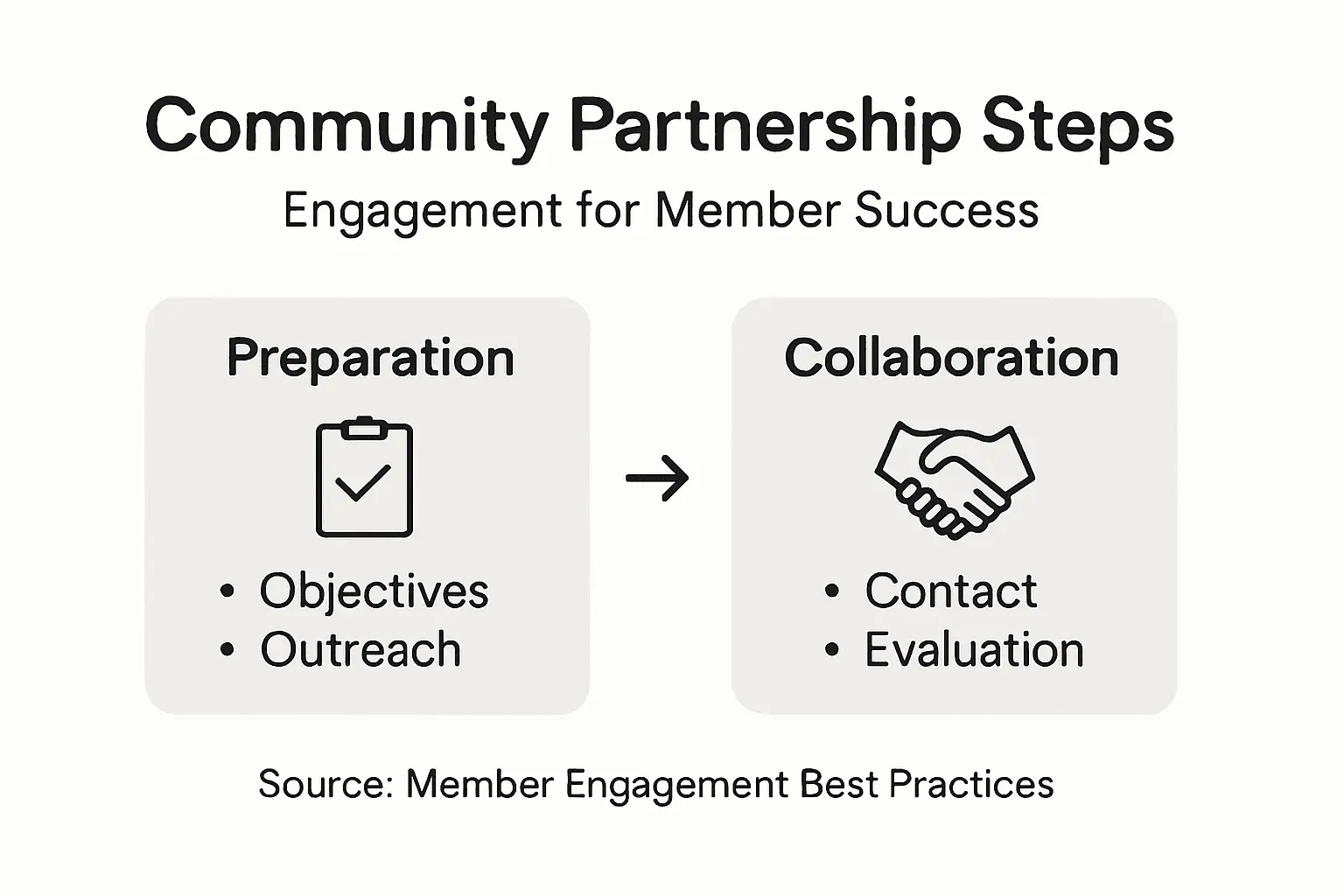
Community engagement evaluation emphasises the importance of involving all stakeholders in measuring partnership impact and learning from collective insights.
Key metrics for comprehensive partnership assessment include:
- Member satisfaction and engagement levels
- Tangible project outcomes and deliverables
- Financial and resource efficiency
- Relationship quality and trust indicators
- Long-term strategic alignment
- Knowledge and skill transfer
- Innovation and collaborative problem-solving
Recommended evaluation process steps:
The table below compares methods for monitoring partnership effectiveness:
| Method | Focus Area | Typical Timing |
|---|---|---|
| Performance indicator review | Quantitative outcomes | Scheduled intervals |
| Stakeholder feedback | Relationship satisfaction | Post-project phases |
| Collaborative assessment | Mutual learning, adaptation | Ongoing/annually |
| Resource audit | Financial efficiency | End of each cycle |
- Establish clear, measurable performance indicators
- Design regular assessment intervals
- Collect both quantitative and qualitative data
- Conduct collaborative review sessions
- Develop adaptive improvement strategies
True partnership effectiveness is measured not just by outcomes, but by the quality of relationships and shared learning.
Professional tip: Create a flexible evaluation framework that views assessment as an opportunity for mutual growth rather than a rigid performance audit.
Unlock the Full Potential of Your Community Partnerships with Colossus Systems
Building strong community partnerships depends on clear objectives, effective engagement, and seamless collaboration. If you are facing challenges in aligning mutual interests or formalising partnerships, you are not alone. Organisations often struggle with maintaining member engagement and measuring partnership outcomes while juggling multiple tools and communication channels. That is where Colossus Systems steps in. Our all-in-one SaaS platform empowers membership-based organisations to streamline member management, event planning, and targeted communication — enabling you to focus on what truly matters: fostering genuine, impactful connections.
Take your member and partner engagement to the next level by leveraging our customisable CRM, automated email marketing, and integrated event registration tools. Whether you need to craft compelling outreach materials or monitor partnership effectiveness with ease, Colossus Systems offers solutions tailored for your growth and success. Ready to transform your community partnerships into sustainable collaborations? Contact us today at https://colossus.systems/contact-us and explore how our platform can help you align objectives, engage stakeholders, and measure impact seamlessly.
Frequently Asked Questions
What are the key objectives to focus on when building community partnerships?
To build successful community partnerships, start by defining specific goals that align with your organisational mission. Identify potential partners whose strengths complement your needs and establish clear metrics to measure the partnership’s success. Aim to complete this assessment within four weeks to set a solid foundation.
How can I effectively prepare engagement materials for potential partners?
Create engagement materials that clearly articulate your partnership goals and organisational impact. Include professional brochures and tailored messaging for different stakeholders, ensuring they invite dialogue and participation. Aim to have these materials ready before your first outreach attempt, ideally within two weeks.
What is the best strategy for initiating contact with potential partners?
Initiate contact by sending a personalised introductory email that outlines mutual interests and opportunities for collaboration. Request an informal meeting to discuss how both organisations can benefit from working together, and prepare materials that share your organisation’s goals. Try to make initial contact within the first month of identifying potential partners.
How do I formalise partnership agreements once discussions are underway?
To formalise a partnership, draft a memorandum of understanding that outlines the scope of activities, roles, and responsibilities. Conduct collaborative review sessions to negotiate specific terms, and ensure legal review from both parties. Aim to have this agreement in place within six weeks of initial discussions to promote commitment.
What metrics should I use to evaluate the effectiveness of a community partnership?
Evaluate partnership effectiveness by measuring stakeholder satisfaction, project outcomes, and resource efficiency. Collect both quantitative and qualitative data regularly to assess relationship quality and long-term alignment. Implement this evaluation framework continuously, reviewing progress at least annually for improvement opportunities.
Recommended
- What Is Membership Engagement? Complete Overview | Colossus Systems
- Effective Community Engagement Tactics for Lasting Connections|CS
- 7 Powerful Community Building Ideas for Member Organisations|CS
- Improving Member Engagement: Proven Strategies for 2025|CS
- Community Portal | AI and Digital Marketing Service by MCNM