One page campus communication strategy for comms teams

A campus communication strategy is a formal framework that sets what to say, who to say it to, when to say it, and how you measure success. It replaces scattered announcements with coordinated, consistent messaging that supports student engagement, institutional safety, and long-term brand trust. The sections below break down every component you need, from SMART objectives to crisis protocols.
TL;DR:
- Messaging should align with academic calendars and key deadlines to avoid overload and ensure timely delivery.
- Cross-departmental workshops and shared tools help prevent overlapping messages and improve message consistency.
- Crisis communication requires predefined roles, templates, and channels to ensure swift, coordinated responses during emergencies.
- Budgeting should focus on objectives and include contingency funds, with resource sharing to prevent bottlenecks and inefficiencies.
- Integrating branding guidelines and accessibility practices into templates enhances trust and ensures messages are inclusive and credible.
Table of Contents
- Why a campus communication strategy matters
- What are the core components of a campus communication plan?
- How do you coordinate communication across campus units?
- What role does crisis communication play in the strategy?
- Building or revising your plan: a practical checklist
- How do you measure whether the strategy is working?
- Who owns which part of the communication plan?
- A one-page template you can adapt today
- Budgeting and resource allocation for communication activities
- Integration with institutional branding and marketing
- Accessibility and inclusivity considerations in communication
- A campus communicator’s honest lessons from the field
- Selected authoritative plans and guides to consult
- Sources
Why a campus communication strategy matters
Institutions without a documented plan tend to rely on whoever shouts loudest that week, usually an overworked comms officer firing off another mass email. Institutional communication improves student engagement and resilience when it follows a coordinated, multi-channel approach rather than one department’s improvised habits.
A structured plan delivers real operational benefits:
- Fewer conflicting messages landing in a student’s inbox on the same day
- Better accessibility, because channel choice becomes deliberate rather than default
- Messaging cadence that follows the academic calendar instead of fighting it
- Clearer accountability when something goes wrong
Ad-hoc messaging feels efficient in the short term. It usually costs more time later, when three offices discover they emailed the same first-years about three unrelated deadlines in the same 48 hours.
What are the core components of a campus communication plan?
Every credible campus communication plan rests on five pillars: objectives, audiences, messages, channels, and a timeline, with measurement threaded through all of them.
- Objectives. Write SMART goals rather than vague aspirations. “Increase open rates for new-student emails by 15% by the end of the autumn term” beats “improve communication” every time.
- Audiences. Segment by lifecycle stage, not just by department. Prospective students, first-years, returning students, graduating seniors, faculty, staff, and alumni all need different framing and different channels.
- Message architecture. Decide your three or four top-line messages per term before you decide how to send them. Channel choice should follow message priority, not the other way round.
- Channel selection. Match urgency and audience to the right mix of email, SMS, social media, and physical signage.
- Calendar and timeline. Build the send schedule around registration deadlines, exam periods, and holidays, not around whichever office finishes drafting first.
- KPIs. Choose two or three metrics per objective, so measurement stays realistic rather than exhaustive.
Pro Tip: Draft your academic-year calendar before you draft a single message. Once you can see every registration deadline, orientation week, and exam period on one page, message timing writes itself.
How do you coordinate communication across campus units?
Large institutions rarely fail because they lack good writers. They fail because twelve departments send twelve versions of the same reminder without knowing the others exist. Practitioners recommend a lifecycle approach paired with cross-departmental process-mapping workshops to surface exactly where message volume overwhelms students.
Running that workshop once a term, with representatives from admissions, housing, financial aid, and student affairs in the room, tends to expose overlaps nobody had noticed. Practical fixes that come out of these sessions include:
- A shared intake form so any unit can request a mass communication through one gate
- A shared master calendar visible to every department, not just comms
- Named communications liaisons in each college or unit, reporting into one coordinator
Pro Tip: Map the student journey from first enquiry to alumni status on a single wall chart. It usually reveals two or three “collision points” where three offices message the same cohort in the same week.
What role does crisis communication play in the strategy?
Crisis communication is the highest-stakes subset of your plan, and it needs pre-authorised decision routes long before anything goes wrong. Crisis communication plans require established authorities, designated spokespersons, and integration with the institution’s Emergency Operations Plan, along with attention to privacy laws such as FERPA where student data is involved.
Build these elements into the crisis layer of your strategy:
- One designated spokesperson or Public Information Officer authorised to speak publicly
- Pre-approved message templates for common emergency scenarios
- A defined channel hierarchy: text alert first, homepage banner and official social accounts next, email as backup
- A monitoring process for misinformation once the initial alert goes out
None of this works if it sits in a separate document nobody reads until the day it is needed.
Building or revising your plan: a practical checklist
A working plan does not need to be elaborate. It needs to be followed. Use this order:
- Set two to four SMART objectives tied to institutional priorities for the year.
- Map your audiences and match each one to preferred channels.
- Build a message map: three or four core messages per term, ranked by priority.
- Lay a calendar over the academic year and slot messages against real milestones.
- Assign approvals so every message has one accountable reviewer.
- Prepare channel-specific templates and train staff on tone and format.
- Publish your KPIs and agree a reporting cadence with stakeholders.
- Review results and adjust the plan each term rather than once a year.
| Step | Owner | Frequency |
|---|---|---|
| Set objectives | Communications manager | Annually |
| Update audience map | Comms liaisons | Per term |
| Approve messages | Designated approver | Ongoing |
| Report KPIs | Communications manager | Monthly |
| Review and revise | Cross-campus committee | Per term |
How do you measure whether the strategy is working?
Measurement only matters if you review it and act. Track a small set of metrics rather than everything your platform can technically report:
- Open and click rates per channel
- Engagement per audience segment (students respond differently to email than to SMS)
- Response time during time-sensitive communications
- Reach against your target audience size
- Outcome metrics tied to your original objective, such as event attendance or form completions
Set benchmarks from your first term’s data, since without a baseline any percentage is meaningless. Run short surveys once a term, A/B test subject lines or send times where volume allows, and hold a monthly review with stakeholders to keep the plan honest rather than aspirational.
Who owns which part of the communication plan?
Bottlenecks appear the moment nobody knows who approves what. A minimal governance model needs five defined roles:
- Communications manager: owns the overall plan and reports on performance.
- Content owner: drafts messages for a specific audience or department.
- Approver: signs off on tone, accuracy, and timing before anything goes out.
- Channel owner: manages the technical side of email, SMS, social, or signage.
- Crisis PIO: speaks publicly during emergencies and coordinates with the Emergency Operations Plan.
A cross-campus communications committee meeting once a month, with representatives from each major unit, is usually enough to keep the guide to communicating on campus principle of centralised expertise intact without becoming another meeting nobody wants to attend.
A one-page template you can adapt today
A compact plan travels better than a fifty-page document nobody opens twice. Aim for one page with these fields:
| Field | What to enter |
|---|---|
| Purpose | One sentence stating why the plan exists |
| Objectives | 2 to 4 SMART goals |
| Priority audiences | Ranked list, e.g. first-years, faculty, alumni |
| Top messages | 3 to 4 core messages for the term |
| Primary channels | Email, SMS, social, signage, in that priority order |
| Calendar highlights | Key academic dates driving the send schedule |
| KPIs | 2 to 3 metrics per objective |
| Roles | Named owners for content, approval, and channels |
Units can adapt the same one-page structure for their own smaller plan, then roll it up into the institutional version each term.
Budgeting and resource allocation for communication activities
Communication budgets usually get set as an afterthought, tacked onto whatever is left after marketing and IT take their share. That approach guarantees a plan built on hope rather than capacity.
Start budgeting from your objectives, not from last year’s spreadsheet. If one goal is improving crisis readiness, that line needs its own allocation for alert software, training, and template development, separate from routine newsletter costs. If another goal targets alumni re-engagement, factor in the cost of a CRM or segmented email platform capable of tracking that specific audience over years, not just terms.
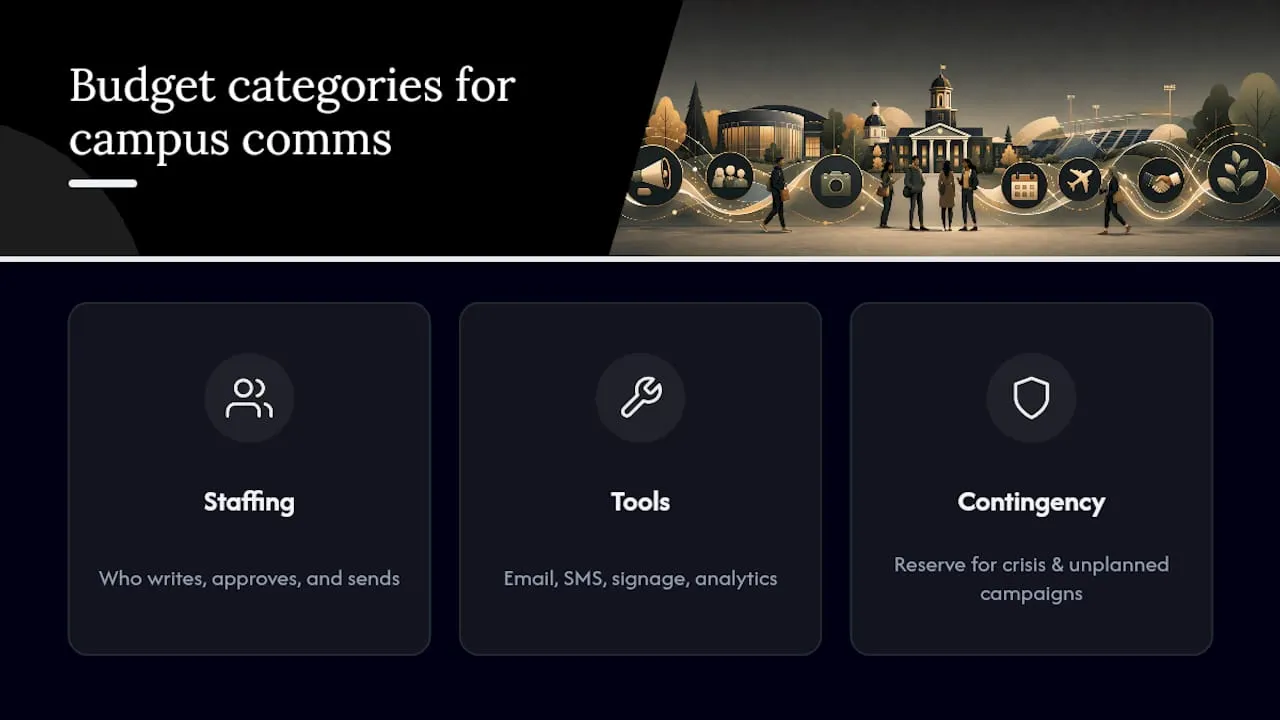
Split the budget into three practical categories: staffing (who writes, approves, and sends), tools (email marketing platforms, SMS gateways, signage systems, analytics), and contingency (crisis response, unplanned campaigns). Contingency gets skipped most often and missed most badly, since a genuine emergency rarely waits for the next budget cycle.
Resourcing also means people, not just money. A single communications manager cannot personally approve every message from every college without becoming a bottleneck. Distributing some approval authority to trained liaisons, backed by shared templates, tends to free up senior time for strategy rather than proofreading. Tools that centralise email marketing, CRM segmentation, and event promotion in one platform can also reduce the hidden cost of juggling five separate logins and five separate invoices across departments.
Review the budget at the same cadence as your KPI reporting. A term that overspent on emergency communications but underspent on routine channels tells you something real about where risk actually sits, not just where the money went.
Integration with institutional branding and marketing
A campus communication strategy that ignores the institution’s brand guidelines creates a strange effect: students receive technically accurate information that looks like it came from a different university depending on which office sent it. Fonts drift, tone shifts from formal to casual mid-thread, and the crest appears in three slightly different colours across one week’s emails.
Marketing and communications teams often operate as separate functions with separate reporting lines, which is exactly how this drift happens. The fix is not merging the departments. It is agreeing shared standards before either team builds a single campaign: a style guide covering tone, logo use, colour palette, and approved templates that every unit, from the library to the athletics department, is expected to follow.
Brand consistency also protects trust during high-stakes moments. A crisis alert that looks visually consistent with routine university communications reads as more credible than one that arrives looking like a generic mass-market blast. Students learn to recognise official channels precisely because the branding stays stable across urgent and routine messages alike.
Practical integration usually means routing major campaigns through a shared review step where a marketing representative checks visual consistency alongside the communications approver checking message accuracy. It also means treating your website, social accounts, and email templates as one connected system rather than three separate projects each owned by a different office with its own preferences.
Accessibility and inclusivity considerations in communication
Accessibility in campus communication is not a compliance checkbox you tick after the message is written. It shapes decisions from the first draft: which channel reaches a student without reliable broadband, which format works for a student using a screen reader, and which language a message needs beyond English.

Multi-channel delivery already helps here, since a single reliance on email excludes students who check text messages far more often than inboxes, and a single reliance on digital channels excludes anyone without consistent internet access. Multi-channel delivery tied to the academic calendar, mixing email, SMS, and physical signage, reaches a wider range of student circumstances than any single channel alone.
Practical accessibility steps worth building into your templates:
- Write alt text for every image used in email or social posts
- Use plain, direct language rather than institutional jargon, particularly in urgent messages
- Provide captions on video content used for orientation or crisis updates
- Offer key documents and major announcements in the languages most represented in your student population
- Test email templates against screen-reader software before rolling them out institution-wide
None of this requires a specialist accessibility team if the templates are built correctly from the start. It does require someone on the communications committee whose job includes checking new templates against these standards before they go into general use, rather than after a complaint arrives.
A campus communicator’s honest lessons from the field
Message fatigue kills engagement faster than bad writing does. The fix is rarely cleverer copy. It is a shared calendar and one intake form, so five offices stop emailing the same students in the same week. Simple templates and a monthly sync beat any elaborate system nobody maintains. Measure something, however small, and adjust next term.
— Rob
Selected authoritative plans and guides to consult
For deeper reading, Appalachian State’s communication planning guide, Oregon State’s crisis communication plan, and EAB’s student communications toolkit offer real templates worth adapting.
Coordinating all of this by hand across a dozen departments is where most plans quietly stall. A platform built for membership and communication management can centralise your audience segmentation, CRM data, and email delivery in one place, so your intake form, calendar, and approval workflow live in the same system rather than five disconnected spreadsheets. If your institution runs regular events, orientation sessions, or alumni gatherings, event management tools built for registration and communication together can save your team from re-entering the same attendee data three times. And if lifecycle segmentation, from prospective student through to alumni, is where your current plan struggles, CRM software designed around audience segmentation makes that split far easier to maintain term after term.
Sources
- Communication planning | University Communications (Appalachian State University)
- Institutional communication strategies in higher education institutions: a systematic literature review
- Corvallis campus crisis communication plan (Oregon State University)
- Optimize your student communications strategy (EAB)