Virtual fundraising event platforms: 2026 guide
TL;DR:
- Virtual fundraising platforms unify auction, ticketing, donor communication, payment processing, and reporting into a single system, boosting efficiency and revenue. They enhance donor engagement through frictionless mobile bidding, strategic bidding windows, and personalized outreach, leading to higher participation. Selecting an integrated, secure, user-friendly platform aligned with your event strategy is essential for successful virtual or hybrid campaigns in 2026.
Virtual fundraising event platforms are all-in-one software systems that combine auction tools, ticketing, donor communication, payment processing, and data analytics into a single interface for nonprofits and educational institutions. Platforms such as ClickBid, Invitario, and CharityAuctions.com have made it possible to manage every stage of a fundraising event without switching between disconnected tools. The result is faster execution, cleaner donor data, and measurably higher revenue per event. This guide explains what these platforms offer, how they improve donor engagement, and how to choose the right one for your organisation in 2026.
What key features should virtual fundraising event platforms offer?
The strongest platforms on the market do far more than host a live stream. All-in-one platforms bundle mobile bidding, ticketing, guest management, and CRM integrations so that event data flows automatically without manual re-entry. That single capability alone saves nonprofits hours of reconciliation work after every event.
Here are the core features your organisation should expect:
- Mobile bidding and online auctions. Donors bid via a unique link on any smartphone, with no app download required. Real-time bid notifications keep competition alive throughout the event window.
- End-to-end event management. Invitations, registration, guest management, and ticketing should all sit within the same system. Invitario integrates all event stages in one platform to maintain consistent branding and data control from the first invitation to the final report.
- Payment processing and compliance. Look for support across 30 or more payment gateways, real-time transaction tracking, and automated attendee access tied to payment status. Platforms such as vFairs carry PCI DSS, GDPR, SOC 2, and ISO 27001 certifications, which removes significant compliance risk from your team.
- Multi-channel donor communications. SMS, email, WhatsApp, and automated reminders should be built into the platform rather than bolted on. CauseMatch and Neon One demonstrate how smart segmentation and automated journeys increase engagement at every stage of the donor lifecycle.
- Reporting dashboards and CRM integration. Post-event analytics should link directly to your donor database so that every bid, purchase, and communication is captured without manual export.
- Hybrid event support. The best platforms handle both in-person and remote participants within a single bidding pool, which is critical for organisations that want to expand their reach without running two separate events.
Pro Tip: Before signing a contract, ask the vendor to demonstrate the full workflow from invitation to post-event report in a live demo. Platforms that cannot show this end-to-end in one session often require third-party tools to fill the gaps.
How do virtual fundraising platforms improve donor engagement?

Donor engagement is where the financial difference between platforms becomes most visible. Mobile bidding events raise 43% more per event than paper-based methods. That figure reflects the compounding effect of frictionless access, real-time competition, and instant checkout.
The engagement improvements follow a clear sequence:
- Remove friction at the point of entry. No-app bidding via unique links means donors participate immediately from any device. Frictionless smartphone bidding with instant notifications keeps donors active rather than waiting for a staff member to update a paper sheet.
- Extend the bidding window strategically. Longer and varied bidding windows sustain competition beyond the live event. Platforms such as Double Good allow fundraisers to launch in minutes and run for days, giving donors time to engage on their own schedule.
- Use notifications deliberately. Push notifications, SMS, and email serve different donor segments. Improving notification strategies drives higher auction participation and reduces drop-off at critical bidding moments.
- Segment communications before, during, and after the event. Generic broadcast messages underperform. Platforms with built-in segmentation allow you to send personalised appeals to lapsed donors, first-time bidders, and major gift prospects simultaneously.
- Incorporate live auctions, paddle raises, and peer-to-peer fundraising. Each mechanic targets a different donor motivation. Combining them within one platform means your team manages one dashboard rather than three separate tools.
- Use post-event data for stewardship. Extensive data integration across fundraising, donor engagement, and event management allows nonprofits to personalise follow-up communications and optimise future campaigns dynamically.
“The organisations that see the greatest return from virtual fundraising are those that treat the platform as a donor relationship tool, not just an event logistics tool.”
Virtual-only, hybrid, and in-person: which format suits your goals?
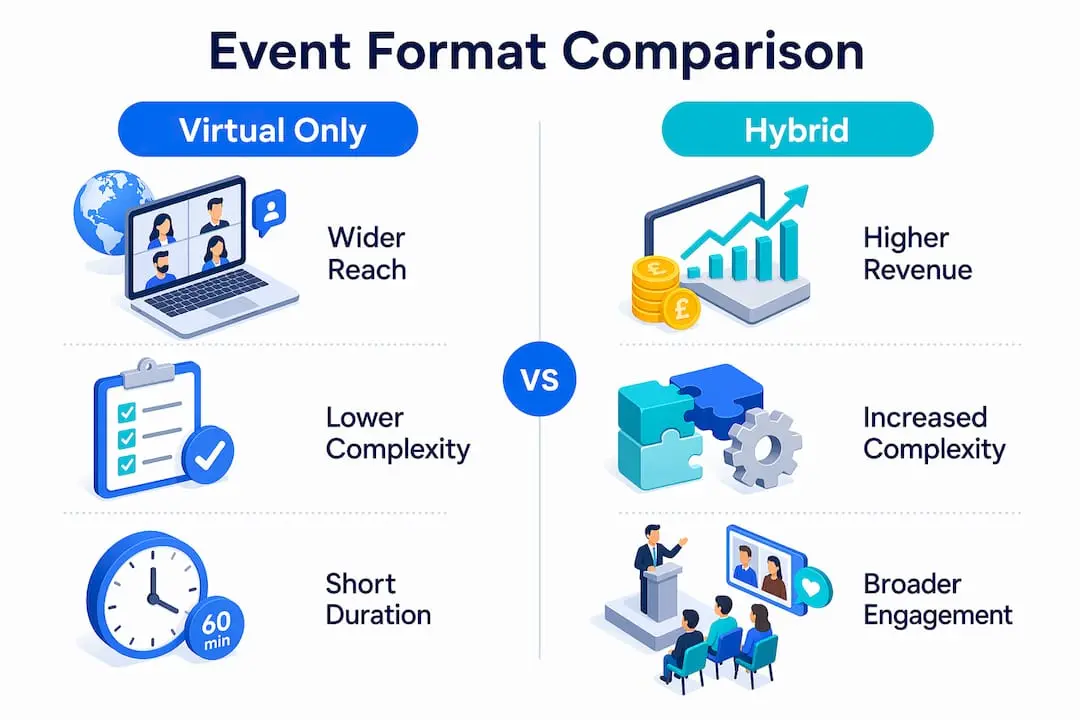
Choosing the right event format is as important as choosing the right platform. Each model carries distinct trade-offs in reach, cost, and donor experience.
| Event format | Reach | Operational complexity | Revenue potential | Best use case |
|---|---|---|---|---|
| Virtual-only | National or global | Low | Moderate to high | Organisations with dispersed donor bases or limited venue budgets |
| Hybrid | Local and remote combined | Medium to high | Highest | Established galas wanting to expand without replacing the in-person experience |
| In-person only | Local | Medium | Moderate | Community-focused events where personal connection drives giving |
Hybrid and online auction formats raise 37% more than in-person events alone. The reason is straightforward: you retain the energy and social pressure of a live room while simultaneously opening bidding to donors who cannot attend in person.
Hybrid formats do introduce complexity, particularly around raffle and auction reconciliation. Chance2Win emphasises avoiding fragmented winner calculations by combining offline cash and cheque entries with online ticket pools into a single drawing. This is a detail many organisations overlook until they are mid-event and managing two separate spreadsheets.
Virtual-only events work well for organisations with geographically dispersed supporters or those running shorter, time-limited campaigns. The lower overhead and faster setup make them practical for educational institutions running term-time fundraisers. In-person events retain their value for community-centred organisations where the social experience is itself a donor motivator.
Pro Tip: If you are running a hybrid event for the first time, assign one staff member exclusively to the remote donor experience. In-person logistics tend to dominate attention, and remote participants disengage quickly when they feel like an afterthought.
How to select the best fundraising platform for your organisation
Selecting from the available digital fundraising solutions requires a structured evaluation rather than a feature-by-feature comparison. Start with your organisation’s specific context before looking at any vendor.
- Define your event types and donor demographics first. A school running a one-day online auction has different requirements from a hospital foundation running a quarterly gala series. Platform selection should follow event strategy, not precede it.
- Evaluate the full feature set against your workflow. Auction types, communication tools, payment options, and CRM integration all matter. A platform that excels at live auctions but lacks post-event reporting will create data gaps that cost time later.
- Assess usability for both donors and your team. A platform your staff cannot configure without developer support is a liability. Equally, a checkout process that requires donors to create an account before bidding will reduce participation.
- Verify compliance and security credentials. Payment security and data privacy are non-negotiable. Confirm PCI DSS compliance for payment processing and GDPR alignment for donor data handling before signing any agreement.
- Understand the true cost. Pricing models vary considerably. Some platforms charge a flat monthly fee; others take a percentage of funds raised. For a small nonprofit, a 5% transaction fee on a £50,000 auction represents £2,500 leaving your cause. Calculate the total cost of ownership across your projected event calendar.
- Request a trial or demo and check user reviews. Vendor demonstrations show best-case scenarios. User reviews on platforms such as G2 or Capterra reveal how the software performs under real event conditions.
For a broader view of event planning options for nonprofits, reviewing established platform comparisons before shortlisting vendors saves considerable evaluation time.
Best practices for running successful virtual fundraising events
Execution quality determines whether a well-chosen platform delivers its potential. The following sequence reflects how high-performing organisations structure their virtual events.
- Plan the full workflow inside the platform before launch. Map every stage from invitation to post-event thank-you within the system. Limiting virtual events to streams only is a common mistake that creates disconnected data and missed engagement opportunities.
- Send multi-channel reminders at defined intervals. A reminder sequence of seven days, two days, and two hours before the event consistently improves attendance and early bidding activity.
- Use real-time notifications to sustain momentum during the event. Outbid alerts and countdown notifications create urgency without requiring your team to manually prompt donors.
- Optimise auction item presentation. High-quality images, clear descriptions, and visible bid increments increase average bid values. Items presented with a story or impact statement outperform those listed with only a title and starting price.
- Incorporate hybrid capabilities to widen participation. Even a modest remote bidding option can add 20 to 30 additional donors to an otherwise in-person event.
- Use post-event reporting for stewardship and planning. Review donor participation data within 48 hours of the event. Identify top bidders, lapsed donors who re-engaged, and items that underperformed. This data directly informs your next online event promotion strategy.
Pro Tip: Set your auction close times to stagger across 10-minute intervals rather than ending all items simultaneously. Staggered closes sustain bidding activity longer and prevent the platform from experiencing a traffic spike at a single moment.
Key takeaways
The most effective virtual fundraising event platforms combine mobile bidding, integrated communications, compliant payment processing, and CRM-linked reporting in a single system, and organisations that use all of these capabilities together consistently outperform those that treat the platform as a single-purpose tool.
| Point | Details |
|---|---|
| Integration is the core value | Platforms that unify bidding, ticketing, payments, and reporting eliminate manual data reconciliation after events. |
| Mobile bidding drives revenue | Events using no-app mobile bidding raise significantly more per event than paper-based or app-dependent alternatives. |
| Hybrid formats outperform in-person alone | Combining in-person and remote participation increases both bidder numbers and total funds raised. |
| Compliance is non-negotiable | Verify PCI DSS and GDPR credentials before committing to any platform handling donor payments or personal data. |
| Post-event data shapes future results | Reviewing donor participation analytics within 48 hours of an event directly improves stewardship and future campaign performance. |
Why integrated platforms are changing how I think about nonprofit fundraising
I have reviewed and worked alongside enough fundraising operations to say with confidence that the biggest inefficiency in most nonprofits is not a lack of donors. It is fragmented data. Organisations run a successful auction, collect cheques on the night, process payments through a separate gateway, and then spend three days reconciling everything into a spreadsheet before they can even begin thanking donors. That delay costs relationships.
What integrated virtual fundraising platforms do is collapse that gap. When bidding, payment, and donor records all update in real time within one system, your team can send a personalised thank-you within hours of the event closing. That speed matters more than most organisations realise. Donors who receive timely, specific acknowledgement give again at higher rates.
The other shift I have noticed is in how donor expectations have changed by 2026. Supporters now expect the same quality of digital experience from a charity auction that they get from a commercial retailer. Clunky checkout flows and app download requirements are not minor inconveniences. They are reasons donors abandon their bids. Platforms that prioritise the donor-facing experience, not just the back-end reporting, are the ones worth your organisation’s investment.
My honest advice: do not select a platform based on its feature list alone. Select it based on how it performs at the moment a donor decides to bid. That moment is where fundraising is won or lost.
— Rob
How Colossus supports your fundraising and membership goals
Colossus offers event and membership management software built specifically for nonprofits and membership-based organisations that need more than a standalone fundraising tool. Our event management software handles registration, attendee management, and communication workflows within the same platform that manages your membership records and donor relationships.
When your event data, CRM records, and communication history sit in one place, your team spends less time on administration and more time on donor engagement. Colossus integrates with leading payment gateways, supports customisable registration workflows, and provides the analytics your organisation needs to make informed decisions after every event. Explore our full platform features to see how Colossus can support your next virtual or hybrid fundraising event.
FAQ
What are virtual fundraising event platforms?
Virtual fundraising event platforms are integrated software systems that manage online and hybrid fundraising events, combining auction tools, ticketing, donor communications, payment processing, and reporting in a single interface. Platforms such as ClickBid and Invitario are widely used examples in the nonprofit sector.
How much more do mobile bidding events raise compared to traditional methods?
Mobile bidding events raise 43% more per event than paper-based methods, according to CharityAuctions.com data. The increase reflects the combined effect of frictionless access, real-time competition, and instant checkout for donors.
Do hybrid fundraising events outperform in-person-only events?
Hybrid and online auction formats raise 37% more than in-person events alone, as reported by CharityAuctions.com. The revenue gain comes from combining the social energy of a live room with remote donor participation in a unified bidding pool.
What compliance standards should a fundraising platform meet?
A fundraising platform should hold PCI DSS certification for payment security and comply with GDPR for donor data handling. Platforms such as vFairs also carry SOC 2 and ISO 27001 certifications, which provide additional assurance for organisations handling sensitive supporter information.
How do I integrate a fundraising platform with my existing donor management system?
Most leading platforms offer API integrations or native connections to CRM systems, allowing donor records, event participation data, and payment history to sync automatically. Reviewing donor management integration options before selecting a platform helps avoid data silos that slow down post-event stewardship.