Cut Hidden Membership CRM TCO and Fees for Associations & Nonprofits

Expect membership CRM pricing to start at a moderate entry-tier monthly cost and rise considerably with member volume, payment processing and premium support. Most vendors price on a tiered or per-contact model rather than a flat fee. Your real cost depends on member count, integrations and support level, so the next step is gathering your requirements and requesting a demo or a bespoke quote before comparing numbers.
TL;DR:
- Most membership CRM pricing starts around £50 to £300 a month for small organizations and can rise to over £2,500 monthly for large, multi-site groups, depending on the tier and features.
- Hidden costs such as onboarding, data migration, support upgrades, and transaction fees can significantly increase the total expenditure beyond the advertised base price.
- Payment gateway fees, especially for card or direct debit transactions, are often charged separately and must be itemized in vendor quotes to avoid surprises.
- Negotiating fixed setup, migration, and support costs, along with clarifying exit policies and future price adjustments, can lead to substantial savings.
- Vendors often structure plans to match organization growth, so assess whether a tier will suit your current and near-future member volume to avoid overpaying or frequent upgrades.
Table of Contents
- What are the typical membership CRM pricing models?
- What hidden fees inflate membership CRM subscription plans?
- How do you calculate total cost of ownership over a contract term?
- What should you ask vendors before comparing quotes?
- Do charities get discounts on membership CRM software?
- How do you negotiate better membership CRM pricing?
- What should you check in cancellation policies and exit fees?
- Lessons from membership procurement and where the money actually goes
- Get a membership CRM quote built around your organisation’s size
- Sources
- FAQ
What are the typical membership CRM pricing models?
Vendors rarely price membership CRM software the same way twice, which is exactly why comparing quotes feels harder than it should. Before you can judge whether a number is fair, you need to know which pricing model you’re actually looking at.
Per-user or per-seat pricing charges you for each staff member who logs into the system. This suits smaller associations with a lean administrative team, since you’re not paying for capacity you don’t use. It becomes expensive fast for organisations with distributed chapters or volunteer coordinators who all need access.
Per-contact or per-member pricing scales with your database size rather than your staff count. A charity with 500 members and one administrator pays less than a professional body with 50,000 members and the same single admin login. This model rewards lean teams but punishes growth unless the tiers are generous.
Organisation-tier pricing bundles a set of features, member limits and support levels into named plans, typically Starter, Growth and Enterprise or similar labels. You pick the tier that matches your rough size and needs, rather than calculating exact per-user or per-contact costs. This is the most common structure among membership-specific platforms because it simplifies the buying decision.
Flat-instance pricing charges one fee regardless of user or member count, usually reserved for enterprise contracts where the vendor has already priced in expected volume during negotiation.
Here’s how these models tend to map onto organisation size:
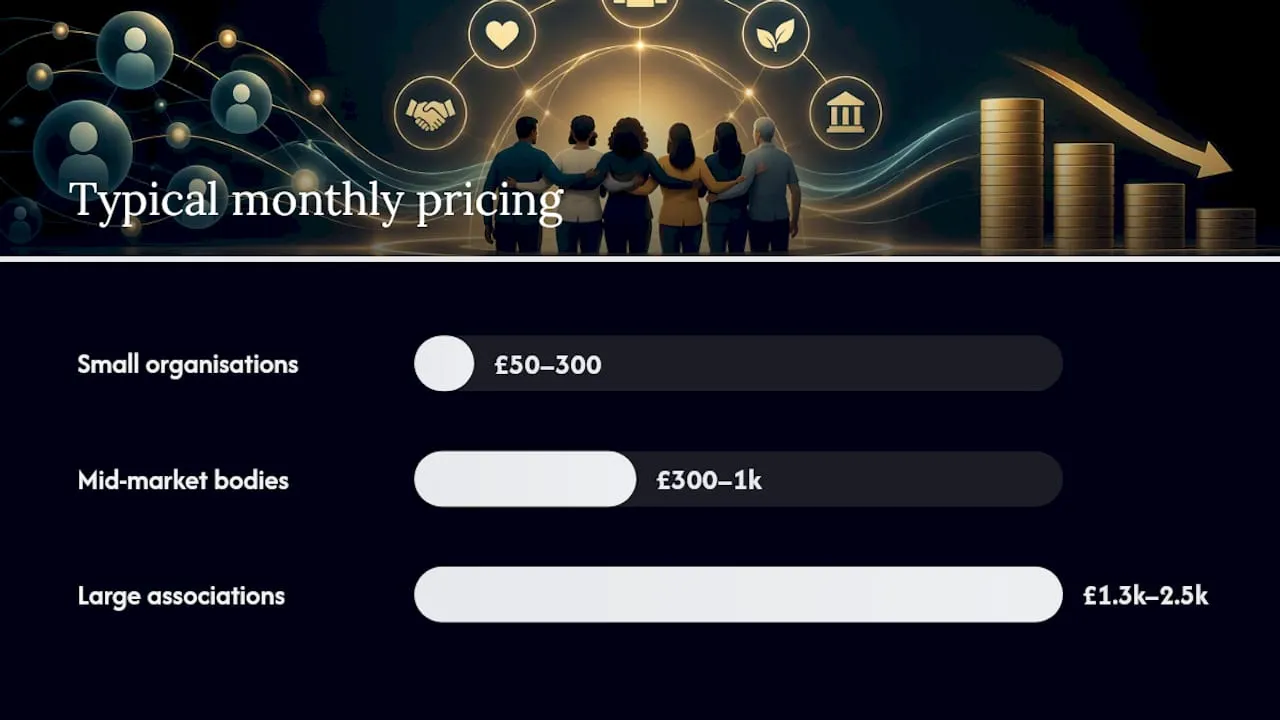
- Small associations and grassroots charities (under 1,000 members): contact-based or entry-tier organisational pricing, often £50 to £300 a month
- Mid-market membership bodies (1,000 to 10,000 members): organisation-tier pricing with add-ons, typically £300 to £1,000+ a month
- Large associations and multi-chapter networks (10,000+ members): enterprise or flat-instance contracts, often £1,300 to £2,500+ a month with negotiated terms
- Federated or multi-site organisations: usually enterprise tiers regardless of raw member count, because of the added complexity of managing multiple portals or chapters
Public benchmark figures back this up. Vendor pricing pages listed on the Digital Marketplace show entry tiers starting in the low hundreds of pounds monthly, climbing to four-figure starting points for enterprise packages. For example, sheepCRM publishes tiered plans starting from £299 a month, while other platforms such as Glu list entry pricing around £50 a month for smaller member volumes. Some vendors structure plans with tiers designed to match organisations as they grow rather than forcing a jump to enterprise pricing the moment a member threshold is crossed.
The lesson for procurement leads is straightforward: don’t compare a headline number in isolation. A £299 entry price and a £349 entry price might cover wildly different member allowances, support hours or included modules. Ask what’s actually inside the tier before you rank vendors by price alone.
What hidden fees inflate membership CRM subscription plans?
The subscription line is rarely the whole story. Comparison research on vendor pricing consistently shows that per-contact tiers, optional support plans and one-off setup fees materially change which vendor ends up cheaper once you look past the advertised starting price.
The most common extras to budget for:
- Onboarding and setup fees: a one-off charge for account configuration, often waived on higher tiers but common on entry plans
- Data migration: moving your existing membership records, event history and payment data into the new system, which vendor documentation often treats as a chargeable professional service rather than a bundled feature
- Premium support tiers: faster response times, dedicated account managers or phone support usually cost extra above a base email or ticket system
- Third-party integrations: connecting accounting software, email marketing tools or event platforms sometimes requires a paid add-on or a higher plan tier
- Premium modules: features like advanced analytics, learning management or e-commerce functionality may sit behind an additional fee even within a named plan
Pro Tip: Ask every shortlisted vendor to itemise setup and migration costs in writing before you sign anything. A verbal “usually included” during a sales call means nothing once the invoice arrives.
Payment processing deserves its own line item because it’s easy to overlook. If your organisation collects membership dues or event fees through the platform, you’ll pay a per-transaction fee to whichever gateway handles the payment. Stripe’s published UK pricing sets out per-card-transaction costs that apply on top of your CRM subscription, and these fees are typically the member organisation’s responsibility, not the vendor’s, even though the vendor usually handles the integration.
For recurring dues specifically, direct debit collection through a provider like GoCardless is often cheaper per transaction than card payments, which matters considerably if you’re processing thousands of renewals a year rather than one-off event tickets. Get this fee structure written into your quote request, not left as a footnote you discover after go-live.
How do you calculate total cost of ownership over a contract term?
A subscription price tells you almost nothing about what you’ll actually spend over a one, two or three-year contract. Total cost of ownership, or TCO, is the figure your board or finance committee actually needs, and building it is a five-step process.
- Start with the baseline subscription. Take the monthly or annual tier price for the plan that matches your member count and required features.
- Add one-off onboarding and migration costs. Ask vendors for a fixed quote here rather than an hourly estimate, which tends to run over.
- Layer in payment processing fees. Estimate your annual transaction volume (dues renewals, event tickets, donations) and apply the gateway’s per-transaction rate.
- Include internal staff time. Someone has to manage the migration, train staff and administer the system ongoing. This is a real cost even if it doesn’t appear on an invoice.
- Add a contingency line. Integrations, data clean-up and unexpected support needs almost always cost more than the initial estimate. Ten to fifteen percent of your first-year total is a reasonable placeholder.
Cost lines vary significantly depending on organisation size, from small charities to large networks, with subscription, onboarding, payment processing, staff time, and contingency costs all contributing to total ownership.
At small scale, the subscription and migration fee dominate the total. At mid-market and enterprise scale, payment processing volume and staff time start to outweigh the subscription line itself, which is exactly why negotiating transaction fees matters more as you grow.
Billing frequency changes the effective monthly number too. Vendors commonly discount annual commitments against monthly billing, though locking into a longer contract also reduces your short-term flexibility if your membership numbers or needs shift. Model both the annual and monthly scenario before you commit, particularly if your membership base is growing quickly and you might need to change tiers within the contract term.
What should you ask vendors before comparing quotes?
A pricing page tells you the starting number. It rarely tells you what breaks that number, and that’s where procurement leads get caught out after signing.
Build these questions into your RFP or initial sales email:
- What is included in the base subscription, and what triggers an upgrade to the next tier?
- Are onboarding, data migration and training charged separately, and can you provide a fixed quote?
- Which payment gateways are supported, and what are the per-transaction fees for card and direct debit?
- What happens to pricing if our member count grows by 20% or 50% within the contract term?
- Is there a charity or nonprofit discount, and does it apply to the base price, add-ons, or both?
- What are the exit terms, including data export format and any cancellation fees?
Score the responses against four criteria rather than price alone: cost predictability (how much could the bill move without warning), included integrations (what you’d otherwise pay extra for), support SLA (response times and escalation paths), and exit terms (how easily you can leave if the platform doesn’t work out).
Pro Tip: Treat vagueness as a red flag, not a formality. A vendor who can’t give you a written onboarding quote within a few days probably can’t give you a predictable invoice in year two either.
Watch for quotes that bundle “unlimited support” without defining response times, or that quote a headline price excluding a mandatory setup fee disclosed only after you ask directly. Some vendors also offer free trials or freemium tiers to test core functionality, which is worth requesting before you commit budget to a full evaluation, especially if you’re choosing between two closely matched shortlisted options.
Do charities get discounts on membership CRM software?
Many membership CRM vendors offer reduced pricing for registered charities and nonprofits, though the discount structure varies considerably between providers. Some apply a flat percentage off the standard tier price, others offer a discounted entry tier not available to commercial buyers, and a few simply waive setup fees for verified nonprofits rather than discounting the ongoing subscription.
sheepCRM’s pricing FAQ, for example, addresses charity discounts and VAT treatment directly on its public pricing page, which is a useful benchmark for what a transparent nonprofit pricing policy should look like. If a vendor’s website doesn’t mention a charity rate at all, ask directly during your first sales conversation. It’s a common enough request that most providers have a policy, even if it isn’t advertised.
Annual billing incentives are separate from charity discounts but often stack with them. Paying yearly instead of monthly typically saves somewhere in the range of one to two months’ subscription cost, since vendors prefer the predictable cash flow and reduced churn risk that annual commitments bring. The trade-off is reduced flexibility if your budget or membership numbers shift mid-term.
If you’re a registered charity working with a tight annual budget, it’s worth asking whether the charity discount and the annual-billing discount can be combined, and getting that answer in writing before you sign. A membership platform built with nonprofit workflows in mind from the outset often makes this conversation more straightforward, since discount policy tends to be established rather than improvised on the call.
How do you negotiate better membership CRM pricing?
Vendors expect negotiation on anything above entry-tier pricing, particularly once you’re discussing organisation-tier or enterprise plans where the published price is really a starting point for conversation rather than a fixed number.
The strongest negotiating position comes from clarity, not aggression. Walk into a sales call with your exact member count, expected growth over the contract term, required integrations and preferred payment gateway already defined. Vague requirements invite vague, higher quotes because the vendor has to price in uncertainty on your behalf.
Contact sales directly, rather than relying on the self-service checkout price, whenever you’re above roughly 2,000 to 3,000 members, need multiple integrations, or are considering a multi-year commitment. This is where discounts, waived setup fees and custom support terms genuinely get negotiated, and it’s also where you can push to have payment processing rates reviewed rather than accepting the platform’s default gateway terms.
Multi-year contracts are a reasonable lever if you’re confident in the platform, since vendors will often trade a longer commitment for a lower effective monthly rate. Be cautious about locking in before you’ve completed onboarding and confirmed the platform actually performs as demonstrated. A one-year term with a favourable renewal clause is usually a safer starting position than jumping straight to three years on a vendor you haven’t used in production yet.
Always ask what happens to your price if your membership grows. A vendor confident in its own tier structure will answer this without hesitation.
What should you check in cancellation policies and exit fees?
Cancellation terms matter more in membership CRM contracts than in most software categories, because your member data, payment history and event records are harder to migrate away from than a simple productivity tool.
Check the notice period required to cancel, which commonly ranges from 30 days to a full quarter depending on contract length. Confirm whether cancelling mid-term on an annual contract entitles you to any refund for unused months, since many vendors treat annual payments as non-refundable regardless of when you leave.
Data export is the detail procurement leads miss most often. Ask specifically what format your member records, transaction history and communication logs will be exported in, and whether that export is free or charged as a professional service. A vendor that charges a substantial fee to hand back your own data at the end of a contract is a meaningful red flag worth raising before you sign, not after you’ve decided to leave.

Some contracts include an early termination fee calculated as a percentage of the remaining contract value. If you’re negotiating a multi-year term, it’s reasonable to ask for that fee to be capped or removed in exchange for accepting a longer initial commitment. Get the full cancellation clause reviewed alongside the pricing table, not as an afterthought once the rest of the contract looks acceptable.
Lessons from membership procurement and where the money actually goes
Procurement teams almost always focus on the subscription line and almost always underestimate everything around it. The pattern shows up repeatedly across membership organisations of every size: the headline price gets scrutinised in detail, while payment processing fees, staff onboarding time and integration costs get waved through as afterthoughts. That’s backwards. On a mid-sized association’s contract, transaction fees and staff time frequently outweigh the subscription itself within two years.
The trade-off that matters most isn’t feature breadth versus price. It’s whether a broad, unified platform actually reduces your total spend compared with stitching together cheaper point solutions that each need their own integration, support contract and staff training time. An all-in-one approach, of the kind Colossus’s feature set is built around, tends to win that comparison once you account for integration costs rather than losing on sticker price alone.
Negotiate setup and support terms as hard as you negotiate the subscription rate. Vendors have more flexibility there than most buyers assume, and it’s where genuine savings tend to hide.
— Rob
Get a membership CRM quote built around your organisation’s size
Most membership CRM pricing forces an early guess: pick a tier now, and hope you don’t outgrow it in eighteen months or overpay for headroom you’ll never use. Some membership CRM vendors price around organisational stage instead, with tiered plans designed so a small association isn’t paying enterprise rates and a fast-growing network isn’t stuck rebuilding its setup every time membership numbers jump.
Entry tiers often suit smaller associations and charities running lean administrative teams who need member management, events and CRM without enterprise complexity. Growth and Scale tiers fit organisations adding chapters, expanding event programmes or needing deeper CRM and marketing integration as membership climbs. Enterprise-level plans typically cover federated networks and large associations that need custom workflows, dedicated support and volume-based terms rather than fixed public pricing.
Rather than piecing together separate tools for events, CRM and payment integration, a unified platform folds those costs into one predictable line, which is exactly the comparison worth running against your current shortlist. Check the full pricing breakdown by tier and request a personalised quote, or get in touch to book a demo built around your actual member count and integration needs.
Sources
Check vendor pricing pages directly before budgeting: sheepCRM’s fees and FAQ cover setup and charity terms, Digital Marketplace listings show public starting prices, and Stripe and GoCardless publish the payment-processing rates that sit on top of any subscription. A third-party nonprofit CRM comparison is also useful for cross-checking market tiers.
FAQ
How much does membership CRM software cost in the UK?
Entry-tier membership CRM plans typically start from a moderate monthly price, with mid-market and enterprise tiers reaching significantly higher monthly costs once you add member volume, support, and integrations. Colossus’s plans start at £349 a month for Core, scaling to Growth, Scale and Enterprise depending on organisation size.
What is the best software for managing club memberships?
The best fit depends on member count, budget and whether you need events, e-commerce and CRM in one platform rather than separate tools. Smaller clubs often manage well on entry-tier or contact-based plans, while growing membership organisations tend to benefit more from an all-in-one platform covering membership management, events and CRM together.
Will CRM be replaced by AI?
AI is increasingly built into CRM platforms as a feature, automating tasks like data entry, member segmentation and communication drafting, rather than replacing the CRM system itself. The core function of tracking member relationships, payments and engagement history still requires a dedicated platform, with AI acting as a layer on top rather than a substitute.
Is there a 100% free CRM for membership organisations?
Some vendors offer free trials or limited freemium tiers to test core features, but a fully free plan capable of handling payment processing, events and growing member databases is rare in this category. Free tiers are useful for early evaluation, though most membership organisations move to a paid tier once they need payment integration or support beyond the basics.
What setup or hidden fees should I budget for beyond the subscription?
Budget for onboarding, data migration, premium support tiers and payment processing fees, which are commonly charged separately from the base subscription. Card payments through providers like Stripe carry a per-transaction fee, while recurring dues collected via direct debit through GoCardless are often cheaper per transaction, so both should be itemised in any quote before you sign.