Master software development with free online courses in 2026

Many believe quality software development education demands thousands in tuition fees, but 2026 offers a different reality. Free online courses now deliver comprehensive curricula covering full-stack development, algorithms, and real-world projects with completion rates that rival paid programmes. Whether you’re a student exploring tech careers, a professional pivoting industries, or someone enhancing existing skills, accessible platforms provide structured learning paths with verified credentials. This guide reveals how to master software development through carefully curated free resources that build genuine expertise without financial barriers.
Table of Contents
- Comprehensive Overview Of Top Free Software Development Courses
- Learning Methodologies And The Importance Of Interactive Coding
- Advanced Topics And Career Application For Different Learner Types
- Explore Software Solutions To Support Your Learning And Work Journey
- FAQ About Free Online Software Development Courses
Key takeaways
| Point | Details |
|---|---|
| Project-based learning | Free courses emphasise hands-on coding with portfolio projects that demonstrate job-ready skills to potential employers |
| Interactive completion rates | Writing code actively during lessons triples course completion compared to passive video watching |
| Verified credentials | Platforms issue recognised certificates upon completing projects and assessments, supporting career transitions and advancement |
| Flexible learning paths | Self-paced curricula accommodate beginners through advanced developers with modular content spanning 300 to 1800 hours |
Comprehensive overview of top free software development courses
Selecting the right learning platform shapes your development journey significantly. The Odin Project offers a free, open-source full-stack web development curriculum covering HTML/CSS, JavaScript, databases, React, NodeJS, Ruby on Rails, with project-based learning and community support. This structured approach guides learners through frontend and backend technologies whilst building a portfolio of deployed applications. The curriculum emphasises practical problem-solving over theoretical memorisation, preparing you for actual development work.
Another powerhouse platform, freeCodeCamp provides a comprehensive free full-stack developer curriculum spanning approximately 1800 hours with modular certifications in Responsive Web Design, JavaScript Algorithms, Front-End Libraries, Python, Databases, Back-End, earning verified certificates upon project completion and exams. Each certification requires building five projects that demonstrate mastery of specific technologies, creating tangible proof of your capabilities for employers or clients.
Both platforms prioritise job readiness through portfolio development. You’ll create responsive websites, interactive applications, and full-stack projects that showcase your abilities. The community support systems provide mentorship, code reviews, and collaborative learning opportunities that mirror professional development environments. For career changers especially, these structured paths remove guesswork about what to learn next.
Notable free course options include:
- The Odin Project: Full-stack JavaScript or Ruby paths with Git workflows and deployment practices integrated throughout
- freeCodeCamp: Modular certifications allowing focused skill development in specific technologies like React or Python
- MIT OpenCourseWare: Computer science fundamentals including algorithms, data structures, and software construction theory
- Fullstack Open: Modern web development covering React, Redux, Node.js, MongoDB, GraphQL, and TypeScript
- GeeksforGeeks: Targeted bootcamps in data structures, competitive programming, and system design
These platforms serve different learning styles and goals. The Odin Project suits those wanting comprehensive full-stack knowledge with strong community interaction. freeCodeCamp appeals to learners preferring modular progression with formal certifications. MIT OpenCourseWare provides theoretical depth for those pursuing computer science understanding alongside practical skills. Exploring free software development courses nonprofits can reveal additional specialised resources tailored to specific organisational needs.
Learning methodologies and the importance of interactive coding
How you learn matters as much as what you learn. Research demonstrates that interactive, hands-on coding triples completion rates versus passive video lectures, achieving 43.7% completion compared to the 6 to 20% industry average for free and paid MOOCs. Writing every line of code yourself builds muscle memory and problem-solving intuition that watching tutorials cannot replicate. Your brain processes information differently when actively constructing solutions rather than observing someone else’s process.

The most effective free courses incorporate immediate feedback loops. You write code, see results instantly, receive error messages that guide debugging, and iterate until solutions work correctly. This cycle mirrors professional development workflows where continuous testing and refinement produce quality software. Platforms embedding interactive coding environments directly into lessons remove friction between learning concepts and applying them.
Learner preferences strongly favour self-paced interactive formats. A JetBrains survey of 18,000 learners revealed self-paced online tutorials rated highest, with popular platforms including Udemy at 30%, Coursera at 20%, and JetBrains Academy at 15%, whilst formal computer science studies ranked as least preferred. This preference reflects the flexibility and practical focus that working professionals and career changers require. You control pacing, revisit challenging concepts, and skip material you’ve already mastered.
Pro Tip: Code alongside every tutorial rather than just watching. Pause videos, replicate examples in your own environment, then modify code to test your understanding before continuing.
Many free courses now incorporate Agile methodologies, Git version control, and collaborative workflows into their curricula. You’ll learn to manage projects using tools like GitHub, write clear documentation, and participate in code reviews. These practices prepare you for team environments where communication and process matter as much as coding ability. Understanding training and development courses online boost results through similar interactive principles applied across different learning contexts.
“The difference between knowing syntax and thinking like a developer comes from writing hundreds of lines of code, making mistakes, debugging them, and understanding why solutions work. Interactive platforms compress years of trial and error into months of focused practice.”
This methodology shift explains why completion rates for interactive courses vastly exceed traditional lecture formats. When you’re actively building rather than passively consuming, motivation sustains itself through visible progress and growing capabilities.
Advanced topics and career application for different learner types
Free courses now extend far beyond introductory material, serving diverse learner profiles from complete beginners to experienced developers seeking specialisation. For career changers, freeCodeCamp and The Odin Project provide verified certificates and portfolio projects that lead to employment, with numerous success stories documenting transitions from unrelated fields into software roles. These platforms understand that career changers need more than skills; they need proof of competency that hiring managers recognise.
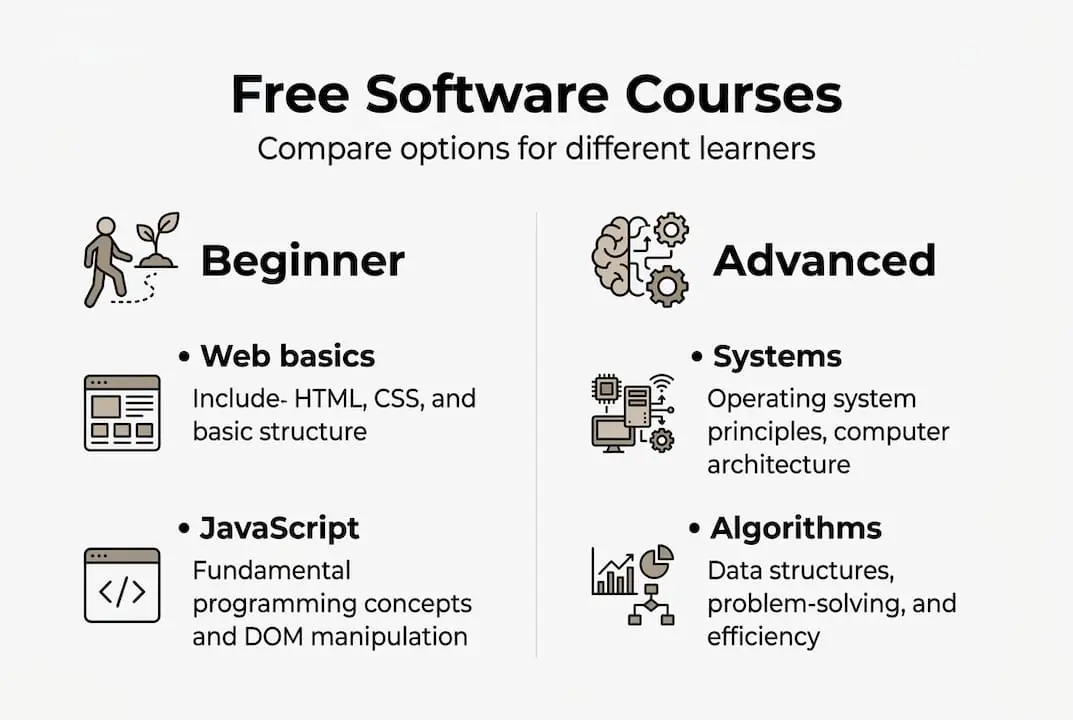
Professionals seeking advanced knowledge can access MIT OpenCourseWare’s computer science curriculum covering software construction, algorithms, and system design, or Fullstack Open’s deep exploration of modern web technologies including TypeScript, GraphQL, and advanced React patterns. These courses tackle concepts like immutability, type systems, and architectural patterns that separate junior developers from senior engineers. The theoretical foundation complements practical skills, enabling you to make informed decisions about technology choices and system design.
Different learner types benefit from tailored approaches:
| Learner Type | Recommended Focus | Duration | Credentials | | — | — | — | | Complete beginners | HTML/CSS/JavaScript fundamentals with simple projects | 300 to 500 hours | Portfolio of 5 to 10 projects | | Career changers | Full-stack path with verified certifications | 800 to 1200 hours | Platform certificates plus deployed applications | | Professionals upskilling | Advanced frameworks, TypeScript, testing, architecture | 200 to 400 hours | Specialised project demonstrating expertise | | Computer science students | Algorithms, data structures, software engineering theory | 400 to 600 hours | Academic-level problem sets and implementations |
Advanced topics accessible through free resources include:
- Software development processes: Agile, Scrum, test-driven development, continuous integration
- Algorithms and data structures: Sorting, searching, graph algorithms, dynamic programming, complexity analysis
- System design: Scalability patterns, database optimisation, caching strategies, microservices architecture
- Testing and quality assurance: Unit testing, integration testing, end-to-end testing, debugging strategies
- Security fundamentals: Authentication, authorisation, common vulnerabilities, secure coding practices
Pro Tip: Balance your learning by combining beginner-friendly projects that build confidence with advanced theoretical courses that deepen understanding, creating a well-rounded skill set that adapts to various development challenges.
The portfolio you build matters immensely for job applications. Employers value seeing deployed applications with clean code, proper documentation, and evidence of problem-solving ability. Free courses guide you through building these portfolio pieces whilst learning, so you’re simultaneously gaining skills and creating proof of competency. Understanding virtual training best practices can enhance how you structure your learning sessions for maximum retention and application.
Certificates from reputable free platforms carry weight because they require demonstrating skills through projects and assessments, not just watching videos. Hiring managers increasingly recognise that motivated self-learners who complete comprehensive free curricula often outperform graduates of expensive bootcamps or degree programmes. Your ability to learn independently, solve problems, and build functional software matters more than where you learned.
Explore software solutions to support your learning and work journey
As you develop software skills, understanding the tools and platforms that power modern organisations becomes invaluable. Colossus Systems provides membership management software features alongside event management software and CRM software that help membership-based organisations streamline operations and engage their communities effectively.
These platforms demonstrate real-world applications of web development, database management, and user experience design principles you’re learning. Whether you’re building projects for your portfolio, contributing to open-source initiatives, or eventually working with organisations that rely on such systems, familiarity with comprehensive management solutions enhances your practical knowledge. Many developers find opportunities working with associations, nonprofits, and professional groups that depend on robust software for member engagement, event coordination, and relationship management.
FAQ about free online software development courses
How long does it typically take to complete free software courses?
Completion times vary significantly based on your starting knowledge, available study hours, and chosen curriculum depth. Complete beginners following comprehensive full-stack paths like freeCodeCamp or The Odin Project typically invest 800 to 1200 hours over 12 to 18 months when studying part-time. Focused learners dedicating 20 to 30 hours weekly can complete foundational certifications in three to six months. Advanced specialisation courses require 200 to 400 additional hours depending on complexity.
Are certificates from free courses recognised by employers?
Employers increasingly value verified certificates from platforms like freeCodeCamp and The Odin Project because they require demonstrating skills through completed projects and assessments, not passive video watching. Your portfolio of deployed applications carries more weight than the certificate itself, serving as tangible proof of your capabilities. Many hiring managers specifically seek candidates who’ve completed these rigorous free programmes, recognising the self-motivation and problem-solving abilities required.
What strategies improve completion rates for free coding courses?
Interactive coding where you write every line yourself triples completion rates compared to passive video consumption. Set specific weekly goals for modules or projects rather than vague intentions to “learn coding.” Join community forums or study groups for accountability and support when stuck. Build projects that genuinely interest you rather than only following tutorials, applying concepts to problems you care about solving. Schedule consistent study blocks treating them as unmissable appointments.
Can career changers with no prior experience succeed with these courses?
Absolutely. Many successful developers began their journeys through free online courses after careers in unrelated fields. The structured curricula on platforms like freeCodeCamp and The Odin Project specifically design learning paths for complete beginners, assuming zero prior knowledge. Success requires consistent effort over months, willingness to struggle through challenging concepts, and persistence when debugging frustrating errors. Numerous documented cases show career changers securing developer roles within 12 to 24 months of starting free courses.
Do free courses cover real-world projects and job skills?
Top free platforms emphasise practical, job-ready skills through project-based learning that mirrors professional development work. You’ll build responsive websites, interactive web applications, APIs, databases, and full-stack projects using industry-standard tools and workflows. Curricula incorporate Git version control, testing practices, deployment processes, and collaborative coding patterns that employers expect. The portfolio you create demonstrates capabilities directly applicable to entry-level and mid-level development positions.
What programming languages should beginners prioritise in free courses?
JavaScript remains the most versatile starting point because it powers both frontend and backend development, offering the widest range of job opportunities. Python serves as an excellent alternative for those interested in data science, automation, or backend systems, with simpler syntax that beginners often find approachable. Most comprehensive free courses teach multiple languages as you progress, so your initial choice matters less than consistent practice and project completion. Focus on understanding programming concepts that transfer across languages rather than memorising syntax.