Master conflict resolution in organisations for teams

Conflict in organisations is unavoidable, yet how you handle it determines whether your team thrives or struggles. Communication breakdowns and personality clashes account for 60% of workplace disputes, directly impacting member satisfaction and collaboration. Poor conflict management erodes trust, reduces productivity, and drives talented members away. This guide equips leaders and managers with proven strategies to identify conflict sources, apply effective resolution techniques, and build resilient teams that turn disagreements into opportunities for growth and innovation.
Table of Contents
- Identifying Sources Of Organisational Conflict
- Preparing For Conflict Resolution With The Thomas-Kilmann Conflict Mode Instrument
- Executing Conflict Resolution Strategies And Early Intervention
- Verifying Outcomes And Fostering A Lasting Positive Culture
- Discover Tools To Support Your Conflict Resolution Efforts
Key takeaways
| Point | Details |
|---|---|
| Communication and personality issues drive most conflicts | Survey data shows 60% of workplace disputes stem from these two factors alone |
| The Thomas-Kilmann model provides a practical framework | Five conflict styles help leaders choose appropriate responses based on assertiveness and cooperativeness |
| Early intervention dramatically improves outcomes | Addressing conflicts within 48 hours increases resolution success rates by 60% |
| Training creates lasting cultural change | Equipped teams report better psychological safety, cohesion, and performance after conflict resolution training |
Identifying sources of organisational conflict
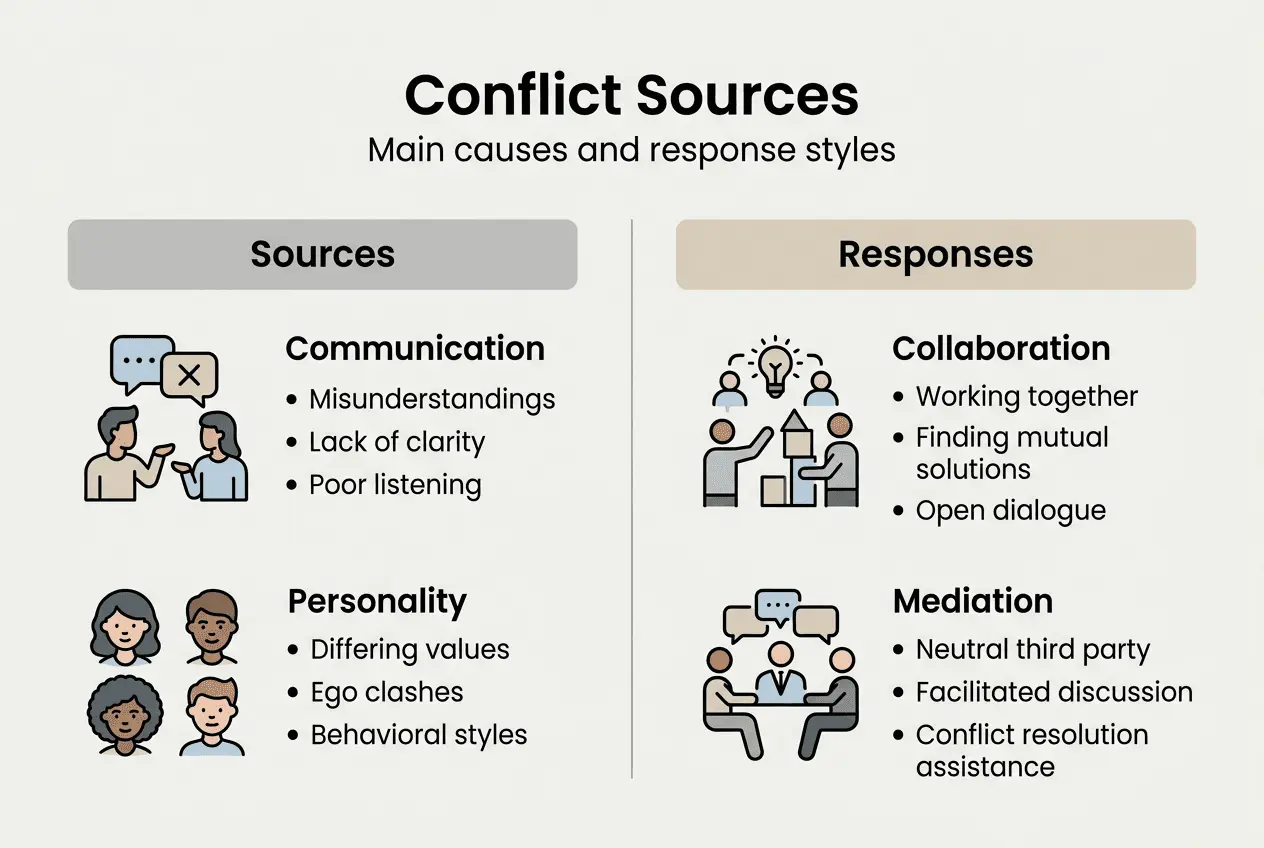
Understanding what triggers conflict helps you address problems before they escalate. Most disputes in membership organisations stem from predictable patterns that leaders can learn to recognise and manage proactively.
Communication issues cause 35% of conflicts, whilst personality clashes account for 25%. Resource scarcity, role ambiguity, and power struggles make up the remaining 40%. When team members lack clarity about responsibilities or compete for limited budgets, tension builds quickly. Unclear communication channels compound these problems, creating misunderstandings that spiral into larger disputes.
Recognising these root causes allows you to tailor your approach. A conflict rooted in resource scarcity requires different handling than one stemming from personality differences. The following table breaks down major conflict sources and their relative impact:
| Conflict source | Percentage impact | Primary characteristics |
|---|---|---|
| Communication breakdowns | 35% | Misunderstood messages, poor listening, unclear expectations |
| Personality clashes | 25% | Incompatible work styles, values differences, interpersonal friction |
| Resource scarcity | 15% | Competition for budgets, time, staff, or materials |
| Role ambiguity | 10% | Unclear responsibilities, overlapping duties, authority confusion |
| Power struggles | 15% | Competition for influence, decision-making authority, or recognition |
Identifying the specific trigger helps you choose the right conflict resolution techniques for organisations. Communication issues often require structured dialogue sessions, whilst resource conflicts may need transparent allocation processes.
Pro Tip: Create a simple conflict log that tracks disputes by category. After six months, patterns emerge that reveal systemic issues requiring organisational changes rather than individual interventions.
Watch for early warning signs in your teams. Increased absenteeism, reduced participation in meetings, or sudden changes in communication patterns often signal brewing conflicts. Members who previously collaborated well may start avoiding each other or communicating only through intermediaries. These behavioural shifts deserve immediate attention before positions harden and resolution becomes more difficult.
Preparing for conflict resolution with the Thomas-Kilmann conflict mode instrument
The Thomas-Kilmann model balances assertiveness and cooperativeness to define five distinct conflict styles. Understanding these styles helps you select appropriate responses based on the situation’s urgency, importance, and relationship dynamics.
Assertiveness measures how vigorously you pursue your own interests, whilst cooperativeness reflects your consideration of others’ needs. These two dimensions create five styles: competing (high assertiveness, low cooperativeness), collaborating (high on both), compromising (moderate on both), avoiding (low on both), and accommodating (low assertiveness, high cooperativeness).
Each style serves specific situations effectively. Competing works when quick, decisive action matters more than consensus, such as during emergencies or when implementing unpopular but necessary policies. Collaborating takes more time but produces innovative solutions that satisfy all parties, making it ideal for complex issues affecting multiple stakeholders. Compromising delivers acceptable solutions quickly when time constraints prevent full collaboration.
The following comparison shows when each style fits best:
| Conflict style | Best used when | Advantages | Disadvantages |
|---|---|---|---|
| Competing | Quick decisions needed, unpopular actions required | Fast resolution, clear direction | Damages relationships, suppresses input |
| Collaborating | Stakes are high, relationships matter | Innovative solutions, mutual satisfaction | Time-consuming, requires willing participants |
| Compromising | Time is limited, partial satisfaction acceptable | Quick agreement, maintains relationships | Nobody fully satisfied, may miss creative options |
| Avoiding | Issue is trivial, cooling-off period needed | Prevents escalation, saves energy | Problems fester, resentment builds |
| Accommodating | Relationship preservation crucial, issue minor | Maintains harmony, builds goodwill | Own needs unmet, may enable poor behaviour |
Most leaders overuse one or two styles based on personality and past experiences. Effective conflict resolution requires flexibility to match your approach to each situation’s unique demands.
Pro Tip: Use the collaborating style whenever possible for significant disputes. Whilst it requires more effort initially, it transforms conflict into opportunities for innovation and strengthens relationships by demonstrating genuine respect for all perspectives.
Assess your natural tendencies honestly. Do you avoid difficult conversations until problems explode? Do you compete reflexively, viewing every disagreement as a contest to win? Self-awareness about your default style helps you consciously choose more effective approaches. Consider having team members complete the Thomas-Kilmann assessment to understand their preferences and discuss how different styles can complement each other during conflict resolution in groups strategies.
The model also reveals why conflicts sometimes intensify. When a competing person clashes with another competitor, neither yields, and positions become entrenched. When two avoiders interact, problems never get addressed. Recognising these dynamics helps you intervene strategically to shift the interaction toward more productive patterns.
Executing conflict resolution strategies and early intervention
Speed matters tremendously in conflict resolution. Addressing conflicts within 48 hours increases resolution success by 60% compared to delayed interventions. Early action prevents positions from hardening and reduces the emotional intensity that makes resolution difficult.
Follow these steps when conflict emerges:
- Recognise the conflict immediately through changed behaviours, communication patterns, or direct reports from team members.
- Gather information privately from involved parties to understand each perspective without making premature judgements.
- Facilitate direct communication between parties in a neutral setting where both feel safe expressing concerns.
- Guide the conversation toward interests rather than positions, helping parties articulate underlying needs and concerns.
- Explore multiple solution options collaboratively, encouraging creative thinking beyond initial demands.
- Agree on specific actions, timelines, and follow-up mechanisms to ensure accountability.
- Monitor progress through scheduled check-ins to verify the resolution holds and address any emerging issues.
Direct communication between conflicting parties often resolves issues faster than formal processes. Create a private space where both parties can speak freely without audience pressure. Your role is facilitating dialogue, not imposing solutions. Ask open questions that help people articulate their true concerns rather than defending positions.
“Early intervention is not just about speed; it’s about catching conflicts whilst they remain problems to solve rather than battles to win. The first 48 hours represent a critical window when parties still view each other as colleagues rather than adversaries.”
When informal conversations fail to resolve disputes, structured mediation becomes necessary. Bring in a trained mediator who can remain neutral whilst guiding parties toward mutually acceptable solutions. The mediator controls the process but not the outcome, ensuring both parties participate equally and focus on interests rather than blame.

Pro Tip: Establish clear guidelines for informal mediation before conflicts arise. When everyone understands the process and knows it focuses on solutions rather than punishment, they engage more willingly and honestly during actual disputes.
One mid-size organisation reduced dispute time and resource usage by 50% after implementing conflict resolution training for all managers. The training equipped leaders to recognise early warning signs and intervene before positions hardened. This proactive approach saved thousands of hours previously spent on formal grievance processes and improved overall team morale.
Document agreements clearly. Vague understandings lead to future disputes when parties remember commitments differently. Write down specific actions, responsible parties, deadlines, and success measures. Both parties should review and approve the written agreement to ensure shared understanding. Schedule follow-up meetings to verify progress and address any implementation challenges before they reignite conflict.
Consider how managing conflict affects membership success in your organisation. Members notice when leadership handles disputes fairly and efficiently. They lose confidence when conflicts drag on unresolved or when resolution processes feel arbitrary or biased. Your conflict management approach directly influences member retention and satisfaction.
Verifying outcomes and fostering a lasting positive culture
Resolution success requires verification, not assumption. Schedule follow-up conversations with involved parties two weeks and six weeks after initial resolution. Ask specific questions about whether agreed actions occurred, whether the underlying issue feels resolved, and whether working relationships have improved.
Measure resolution effectiveness through multiple indicators. Team performance metrics often reveal whether conflicts truly resolved or simply went underground. Watch for changes in collaboration quality, project completion rates, and voluntary participation in team activities. Anonymous surveys can capture honest feedback about psychological safety and trust levels that direct conversations might miss.
Equipped teams report improved psychological safety, cohesion, and performance after conflict resolution training. These improvements compound over time as team members develop confidence in their ability to address disagreements constructively. The organisation benefits from reduced turnover, higher engagement, and better decision-making as diverse perspectives get heard rather than suppressed.
Building a conflict-resilient culture requires ongoing effort beyond individual dispute resolution. The following practices create environments where conflicts get addressed early and constructively:
- Normalise healthy disagreement by modelling respectful challenge of ideas during meetings and decision-making processes.
- Provide regular training in active listening, emotional intelligence, and negotiation skills for all team members.
- Establish clear escalation paths so people know exactly how to raise concerns without fear of retaliation.
- Celebrate examples of constructive conflict resolution to reinforce desired behaviours and outcomes.
- Create psychological safety by responding to mistakes and disagreements with curiosity rather than blame.
- Maintain transparency about organisational decisions, resource allocation, and performance expectations to prevent misunderstandings.
- Encourage direct communication by making it safe and expected rather than requiring intermediaries for difficult conversations.
Leadership behaviour sets the tone for organisational culture. When leaders avoid difficult conversations, dismiss concerns, or handle conflicts through power rather than dialogue, team members learn to do the same. Conversely, when leaders acknowledge mistakes, invite feedback, and resolve disputes collaboratively, these behaviours spread throughout the organisation.
Developing conflict management skills supports team success across all organisational levels. Invest in training that goes beyond theory to provide practical tools and supervised practice. Role-playing exercises help people develop muscle memory for difficult conversations. Peer coaching creates accountability and ongoing skill development beyond initial training sessions.
Transparency and mutual respect form the foundation of conflict-resilient cultures. When people trust that decisions follow fair processes and that their perspectives matter, they engage disagreements constructively rather than defensively. This trust develops slowly through consistent leadership behaviour that matches stated values.
Consider how conflict resolution capabilities contribute to building organisational resilience for nonprofits. Organisations that handle internal conflicts well adapt more quickly to external challenges. They leverage diverse perspectives for better problem-solving and maintain cohesion during stressful periods when conflicts typically intensify.
Regularly assess your organisational conflict climate. Anonymous surveys asking about trust levels, communication quality, and perceived fairness provide baseline data and track improvement over time. Share results transparently and involve teams in developing action plans to address identified issues. This participative approach builds ownership and demonstrates genuine commitment to cultural improvement.
Discover tools to support your conflict resolution efforts
Effective conflict resolution requires more than good intentions; it needs systems that promote clear communication and accountability. Colossus Systems provides membership management software features designed to reduce the misunderstandings and communication gaps that fuel organisational conflicts.
Our integrated platform streamlines member interactions through centralised communication channels, reducing the message fragmentation that creates confusion. The CRM software tracks all member touchpoints, ensuring everyone accesses the same information and preventing disputes caused by inconsistent messaging. When team members share a single source of truth, conflicts based on miscommunication decrease significantly.
The event management software clarifies roles and responsibilities during planning and execution, addressing the role ambiguity that causes 10% of workplace conflicts. Clear task assignments, transparent timelines, and automated reminders keep everyone aligned and accountable.
Pro Tip: Using integrated software promotes transparency and accountability in team interactions. When processes are visible and documented, disputes about who said what or who committed to which actions largely disappear, allowing teams to focus energy on productive collaboration rather than defensive positioning.
FAQ
How can leaders recognise early signs of conflict in their teams?
Leaders should watch for communication breakdowns, increased tension, withdrawal from collaboration, or recurring disputes among members. Behavioural changes like avoiding certain colleagues, reduced participation in meetings, or communicating only through intermediaries signal brewing conflicts. Early detection allows faster resolution and prevents escalation into formal disputes that consume significant time and resources.
What are the most effective conflict resolution styles for organisations?
Collaborating and compromising styles often produce lasting solutions in professional associations because they balance relationship preservation with problem-solving. Collaborating works best for significant issues affecting multiple stakeholders, whilst compromising delivers acceptable solutions under time constraints. Avoiding may suit trivial issues or when cooling-off periods help, but competing should be used cautiously and only when quick, decisive action outweighs relationship considerations.
How does conflict resolution training benefit team performance?
Training improves negotiation success rates, psychological safety, and collaboration quality across organisations. Teams equipped with conflict resolution skills report reduced dispute time, higher member satisfaction, and better decision-making through constructive disagreement. The benefits compound over time as conflict resolution techniques for organisations become embedded in daily interactions rather than reserved for crisis situations.
When should formal conflict resolution processes be initiated?
Formal processes should follow if informal mediation fails, conflicts escalate despite intervention attempts, or disputes involve serious policy violations. Early informal intervention through direct dialogue and facilitated conversations helps avoid costly formal procedures that damage relationships and consume organisational resources. Reserve formal processes for situations where power imbalances, legal concerns, or entrenched positions prevent informal resolution.