How to boost member loyalty: proven strategies

TL;DR:
- Member loyalty is vital for organizational success, as emotional investment and community engagement outperform transactional rewards. Building trust, perceivable value, and personalised interactions foster long-term loyalty while well-designed programmes and continuous measurement enhance retention. Genuine relationships, combined with strategic use of data and technology, drive sustainable member engagement and advocacy.
Member loyalty is the bedrock of any thriving membership organisation, yet most leaders underestimate how quickly it erodes. Knowing how to boost member loyalty is not just about stopping cancellations. It is about building an organisation where members feel so connected, valued, and engaged that they would never consider leaving. A 5% retention increase can drive earnings growth of 25% to 95%, and loyal members spend significantly more than new ones. This guide covers the preparation, execution, and measurement strategies that membership leaders actually need.
Table of Contents
- Key takeaways
- How to boost member loyalty: core principles
- What you need before launching loyalty initiatives
- Building emotional connection and personalised engagement
- Designing effective member loyalty programmes
- Measuring success and improving over time
- My honest take on what actually drives loyalty
- How Colossus can support your loyalty strategy
- FAQ
Key takeaways
| Point | Details |
|---|---|
| Retention drives revenue | A small improvement in member retention produces disproportionately large gains in earnings and member spend. |
| Preparation is non-negotiable | Gathering meaningful data and aligning your values with member expectations must come before any loyalty initiative. |
| Emotional connection outperforms discounts | Earned access, status, and community belonging create deeper loyalty than transactional rewards alone. |
| Programme design matters | Simple, flexible, progression-based loyalty programmes consistently outperform complex, coupon-driven ones. |
| Measure and adapt | Tracking retention rates, engagement scores, and feedback loops is what separates lasting loyalty from short-term gains. |
How to boost member loyalty: core principles
Before reaching for tactics, it helps to understand what member loyalty actually means. It is not simply the act of renewing a subscription. True loyalty is emotional investment. It is the member who recommends your organisation unprompted, who defends it when criticism arises, and who participates because they want to, not because leaving feels inconvenient.
The financial case is clear. Loyal members spend 67% more than new members, and the cost of replacing a lapsed member far exceeds the cost of retaining one. In the nonprofit sector, overall donor retention sits at just 43%, with new donor retention falling as low as 19%. These figures translate directly to membership organisations and reveal just how much value walks out the door through ordinary churn.
Several core drivers consistently predict member loyalty:
- Perceived value. Members stay when what they receive clearly exceeds what they pay.
- Trust. Confidence in your organisation’s leadership, communications, and intentions keeps members engaged long-term.
- Community. Belonging to something meaningful is a powerful anchor. Relationships formed within your organisation are hard to replicate elsewhere.
- Recognition. Members who feel seen and acknowledged for their contributions are far less likely to disengage.
The barriers to loyalty are equally instructive. Irrelevant communications, opaque governance, confusing member benefits, and a lack of genuine interaction are the most common churn accelerants. Understanding both sides of this equation is where effective strategies for member engagement begin.
What you need before launching loyalty initiatives
Many organisations skip straight to designing loyalty programmes without doing the groundwork. That approach wastes resources and often produces programmes that members ignore.
Start with your data. Demographics tell you who your members are, but behavioural data tells you what they actually value. Which events do they attend? Which content do they consume? Which communications do they open? This is the layer of insight that makes personalisation possible rather than performative. A CRM that captures member interactions across every touchpoint is not a luxury here. It is the foundation.
Next, align your organisational values with member expectations. Members join an organisation because its purpose resonates with them. If your internal priorities have drifted from that founding promise, loyalty will drift too. Conduct periodic values alignment exercises with your leadership team, and cross-reference the outcomes against member feedback.
Here is a practical overview of the tools and competencies your organisation needs in place:
| Tool or competency | Purpose | Priority level |
|---|---|---|
| CRM platform | Tracks interactions, segments members, personalises outreach | High |
| Member feedback system | Gathers satisfaction data and surfaces emerging issues | High |
| Community platform or portal | Creates space for peer-to-peer interaction | Medium |
| Analytics and reporting | Measures engagement, retention, and programme performance | High |
| Event management software | Facilitates member gatherings that deepen connection | Medium |
Set specific, measurable loyalty goals before you act. “Improve member satisfaction” is not a goal. “Increase 12-month retention from 71% to 80% by Q4 2026” is. Clear targets allow you to evaluate every initiative objectively and course-correct without guesswork.
Pro Tip: Before investing in a loyalty programme, run a quick lapsed-member survey. Ask former members directly why they left. The answers will almost certainly surprise you and reshape your priorities.
Building emotional connection and personalised engagement
The most durable loyalty is built through how members feel when they interact with your organisation, not through the rewards they accumulate. This is where most membership organisations have the greatest untapped potential.
Creating spaces for meaningful interaction is the starting point. Member forums, special interest groups, peer mentoring structures, and exclusive events all provide the conditions for the relationships that anchor loyalty. When a member’s closest professional contacts are fellow members of your organisation, their barrier to leaving becomes extremely high.

Personalised communication is the next lever. Generic newsletters sent to your entire database do not build loyalty. Segmented, relevant content that acknowledges where an individual member is in their journey does. Closing the feedback loop publicly, by announcing changes your organisation made in response to member input, builds trust and turns passive members into active contributors. This principle from the customer experience world applies with equal force to membership organisations.
The data supports a personalisation-first approach. 89% of Gen Z and 87% of millennials are willing to share their data in exchange for personalised offers and experiences. Younger members in particular expect your communications and benefits to feel tailored to them.
Loyal members can also become your strongest advocates. Consider a formal member ambassador programme where your most engaged members receive early access to new initiatives, exclusive briefings, or recognition on your platforms in exchange for championing the organisation within their networks.
Pro Tip: Avoid building loyalty purely on discounts. Price-sensitive members are the easiest to win and the easiest to lose. Focus instead on earned access, progression through status tiers, and recognition that cannot be bought.
“Successful loyalty programmes focus on cross-channel engagement and earned access rather than discounts alone, creating deeper emotional bonds.” Retail Tech Innovation Hub
Designing effective member loyalty programmes
Not all member loyalty programmes are created equal. The ones that genuinely increase member retention share certain structural features, and understanding them will help you build something worth investing in.
The most common programme types include:
- Points-based. Members earn points for participation, event attendance, referrals, or purchases, and redeem them for benefits.
- Tiered membership. Members progress through levels based on tenure, engagement, or contribution, with escalating privileges at each tier.
- Exclusive access. Priority invitations to events, early content access, or private networking spaces reward committed members.
- Experiential rewards. Unique experiences such as behind-the-scenes access, one-to-one sessions with experts, or special recognition at events create memories that purely transactional rewards cannot match.
The best programmes treat loyalty as a behaviour change engine, using progression, scarcity, and earned benefits to motivate engagement over time. This is very different from simply offering a discount on renewal.
Redemption is where many programmes lose members. 40% of consumers sometimes forget to redeem rewards, and the frustration of discovering expired points or complex redemption rules accelerates disengagement. Make redemption effortless, visible, and flexible from day one.
| Programme model | Key strength | Common pitfall |
|---|---|---|
| Points-based | Easy to understand and track | Can feel transactional if rewards are irrelevant |
| Tiered membership | Creates aspiration and progression | Complexity at higher tiers can confuse members |
| Exclusive access | High perceived value, low cost to deliver | Difficult to scale without diluting exclusivity |
| Experiential rewards | Builds emotional memory and advocacy | Resource-intensive to execute consistently |
Starbucks offers a useful benchmark from outside the membership sector. Its loyalty shift towards engagement-focused benefits contributed to 4% year-over-year active membership growth, reaching 35.6 million members. The lesson is straightforward: when you stop optimising for discount redemption and start optimising for genuine engagement, members respond.
Technology plays a supporting role here. AI-driven personalisation can match rewards to individual member preferences at scale, while a well-configured CRM ensures that no engagement signal goes unnoticed. Automating routine loyalty programme communications frees your team to focus on the high-value human interactions that genuinely move members along the engagement curve.
Pro Tip: Review your loyalty programme rules every six months. A programme that felt fresh at launch can quickly feel stale. Small updates, new reward categories, or a limited-edition benefit create momentum and give members a reason to re-engage.
Measuring success and improving over time
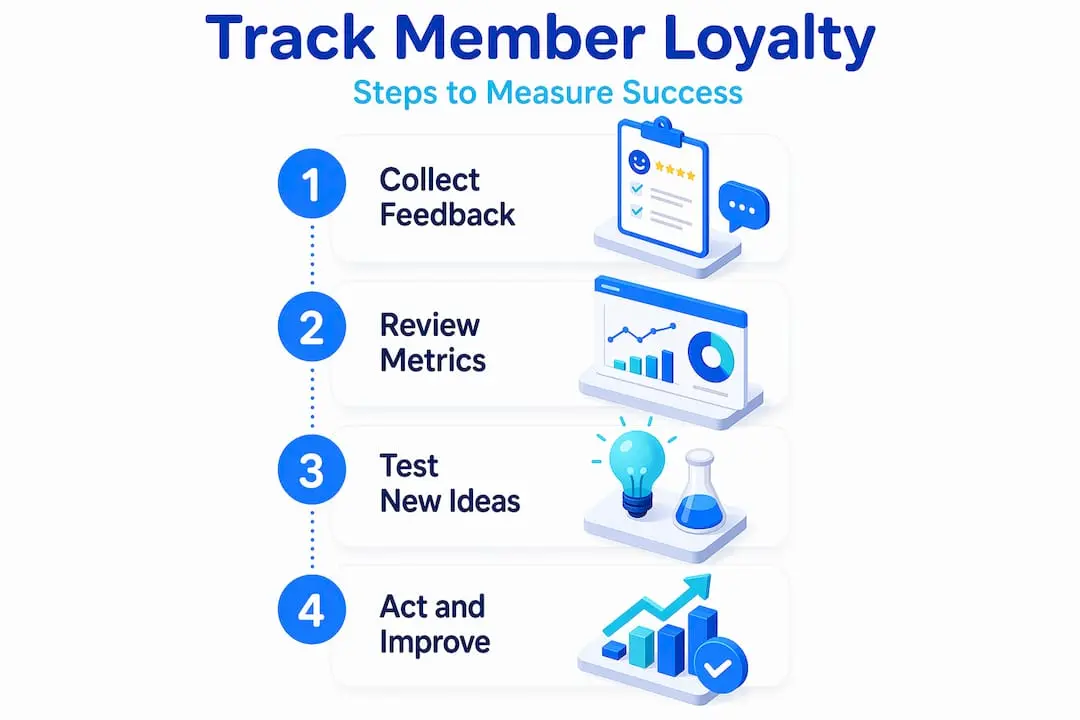
You cannot manage what you do not measure. The organisations that sustain high member loyalty over years are the ones that treat measurement as an ongoing discipline, not a quarterly box-ticking exercise.
The key metrics to track are:
- Renewal and retention rate. Your primary indicator of loyalty health, tracked monthly and by member segment.
- Active engagement rate. The proportion of members participating in events, consuming content, or interacting with your community platform within a defined period.
- Member satisfaction score. Gathered through regular surveys, this metric surfaces dissatisfaction before it becomes churn.
- Net Promoter Score. How likely are your members to recommend your organisation? This is a direct proxy for emotional loyalty.
- Reward redemption rate. Low redemption in a loyalty programme signals confusion or disengagement with the programme itself.
Feedback is an early warning system, not just a satisfaction measure. When members raise the same concern repeatedly through surveys, event feedback, or direct messages, treat it as a signal requiring a visible response. Transparency in acting on feedback is one of the most consistent loyalty builders across sectors. Members want to know their input shaped something real.
Pro Tip: When a loyalty initiative does not perform as expected, share what you learnt with your members. Transparency about failure builds credibility far more than silence does.
Regular data reviews, quarterly at minimum, allow you to spot declining segments early and test targeted re-engagement campaigns before those members lapse entirely. Pair your quantitative data with qualitative insights from member focus groups or advisory panels, and you will develop a loyalty improvement process that genuinely improves over time.
My honest take on what actually drives loyalty
I have observed enough membership organisations to know that the ones with the highest retention are rarely the ones with the most sophisticated loyalty programmes. They are the ones where members genuinely feel they belong.
What I have seen fail repeatedly is the approach of layering a points programme on top of an organisation that has not done the harder work of community building. Members see through transactional loyalty instantly. If the underlying experience is weak, no reward structure will compensate for it.
What actually works is treating every touchpoint as a relationship moment. The email that arrives at the right time with genuinely useful content. The event where a member meets a peer who becomes a collaborator. The moment leadership publicly acknowledges member feedback and says, “You told us this was not working, so we changed it.” These are the interactions that create the emotional investment no loyalty programme can manufacture on its own.
Technology absolutely has a role to play. AI personalisation, automated engagement tracking, and integrated CRM systems make it possible to deliver personal experiences at scale in ways that were simply not feasible five years ago. But technology enables the relationship. It does not replace it. The organisations that will lead in member engagement over the next decade will be the ones that combine smart data use with genuine human connection.
Experiment boldly, measure honestly, and put your members at the centre of every decision. That is the approach that compounds.
— Rob
How Colossus can support your loyalty strategy
If the strategies in this article resonate with you, the practical challenge is putting the right infrastructure in place to execute them consistently. That is precisely where Colossus comes in.
Our platform brings together membership management tools, CRM, event management, email marketing, and advanced analytics in one place. This means your team can segment members with precision, personalise communications at scale, track engagement signals in real time, and manage loyalty programme activity without juggling multiple disconnected systems. For organisations serious about improving member satisfaction, having all your data and tools connected makes the difference between reactive firefighting and proactive relationship management.
Our event management software also helps you create the in-person and virtual experiences that deepen the emotional connections underpinning genuine loyalty. If you are ready to see how Colossus supports membership organisations like yours, get in touch and request a personalised demo.
FAQ
What is the most effective way to boost member loyalty?
Building genuine community and emotional connection consistently outperforms transactional rewards. Combine personalised communication, regular feedback loops, and progression-based benefits to increase member retention sustainably.
How do member loyalty programmes increase retention?
Effective programmes use tiered progression, earned access, and meaningful rewards to motivate ongoing engagement. Behaviour-change focused programmes outperform simple discount or coupon models by creating aspiration and a sense of progress.
What metrics should I track to measure member loyalty?
Track renewal rates, active engagement rates, member satisfaction scores, and Net Promoter Scores. Low reward redemption rates are also a strong early indicator that your loyalty programme needs simplification or updating.
Why do most member loyalty programmes fail?
Most programmes fail because they are layered on top of a weak member experience rather than built on a foundation of genuine value and community. Complexity, irrelevant rewards, and poor redemption processes compound disengagement over time.
How does personalisation improve member satisfaction?
Personalised communications and rewards make members feel recognised as individuals rather than account numbers. Research shows that younger members readily share data in exchange for personalised experiences, demonstrating how strongly this approach influences satisfaction and loyalty.