Hosting inclusive events: your practical 2026 guide

TL;DR:
- Hosting inclusive events requires proactive planning, integrated venue design, and ongoing feedback to ensure full participation for all attendees. Implementing early decisions, comprehensive accessibility measures, and staff training creates a welcoming environment that reflects organizational values. Post-event evaluations help identify gaps and strengthen future inclusivity efforts, turning accessibility into a strategic advantage.
Hosting inclusive events means designing experiences where every attendee, regardless of ability, background, or identity, can participate fully and without barriers. The University of British Columbia’s Equity and Inclusion Office defines proactive accessibility planning as anticipating diverse needs before attendees even register, covering vision, hearing, mobility, chronic health conditions, and sensory sensitivities. For event planners and organisational leaders, this is not a compliance exercise. It is the difference between an event that builds genuine community trust and one that quietly excludes a significant portion of your audience. Getting it right requires early decisions, the right tools, and a clear operational framework.
What does hosting inclusive events actually require?
Inclusive event planning, also referred to in professional practice as accessible event design, is the discipline of removing physical, communicative, and social barriers from every stage of an event. The standard industry term is universal design applied to events, a principle that Museums Galleries Scotland’s Accessible Events Standard describes as integrating accessibility from the start rather than retrofitting it as an afterthought. This distinction matters enormously in practice. Retrofitting costs more, signals lower priority, and produces a worse attendee experience.
The University of Auckland’s 2026 guidance recommends treating accessible restrooms, signage, seating, and microphone access as a single integrated accessibility system rather than a checklist of separate tasks. That framing changes how you plan. Instead of ticking boxes, you are designing a continuous attendee journey from car park to closing remarks. Organisations that adopt this approach report fewer last-minute accommodation requests and stronger post-event satisfaction scores.
What are the essential prerequisites for planning accessible events?
The single most common planning failure is underestimating lead times. Event information shared at least 4 weeks in advance gives attendees time to arrange personal assistants, transportation, and support services, all of which can take one to three weeks to organise. Sending invitations two weeks out effectively excludes attendees who rely on those services.
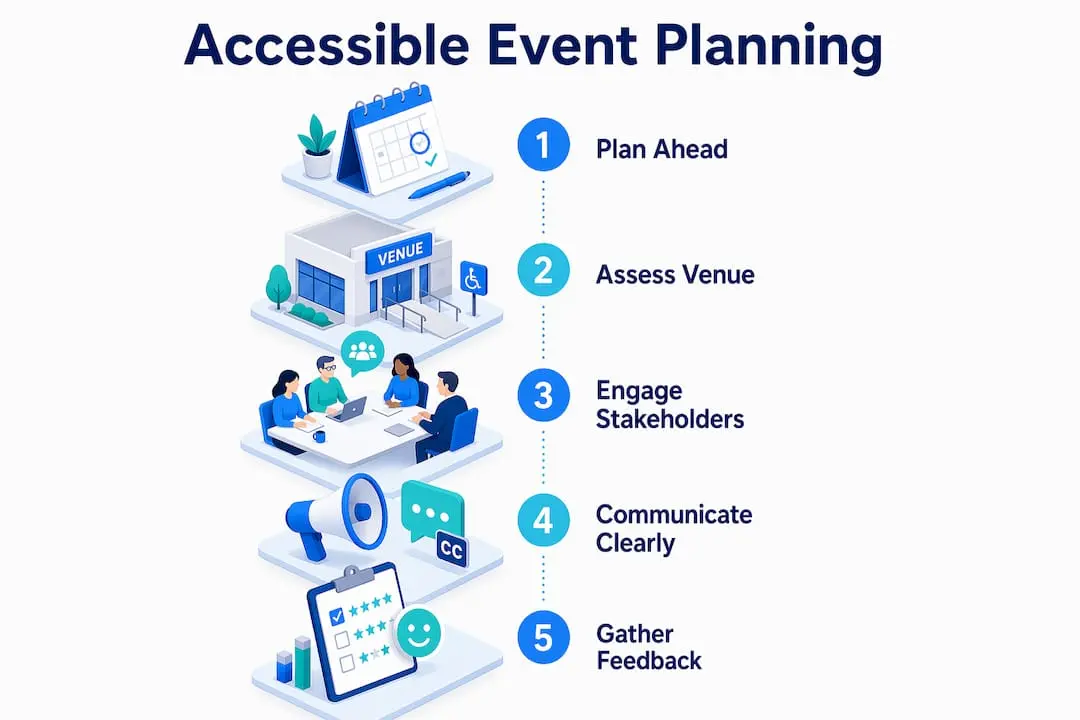
Budget is the second area where plans collapse. The UBC guide recommends booking CART captioning two to four weeks in advance, with costs running from £125 to £160 per hour. ASL or BSL interpretation carries similar lead times and fees. These are not optional extras. They are the price of genuine participation for deaf and hard-of-hearing attendees, and they must appear in your initial budget, not as a late addition.
Venue selection drives the rest of your logistics. The University of Auckland’s checklist covers the following non-negotiables:
- Accessible parking with clearly marked bays close to the entrance
- Step-free routes from arrival to every session space
- All-gender toilets with accessible cubicles
- Adjustable or varied seating to accommodate mobility aids and chronic pain needs
- Audio-visual equipment compatible with hearing loops and captioning displays
- Clear, large-print signage at every decision point
Some jurisdictions add a legal dimension. Philadelphia, for example, requires an Accessibility Plan as part of the special event permit application. Failing to submit one risks permit denial. Even where no such requirement exists, drafting a formal plan disciplines your team to address gaps before they become problems on the day.
Pro Tip: Build a standard accessibility budget line into every event template your organisation uses. Treating it as a fixed cost rather than a discretionary one removes the negotiation each time and signals organisational commitment to inclusion.
How should you design registration and communications for inclusivity?
Accessible registration is where many events lose people before they even arrive. Your registration form is the first interaction an attendee has with your event, and it communicates your values immediately. At minimum, the form should offer the following:
- Gender identity options that include male, female, and gender diverse, rather than a binary choice
- Dietary requirement fields with space for complex needs beyond standard options
- Accommodation request fields with a clear deadline and named contact person
- Carer and companion registration so attendees who need support can bring someone without additional cost
- Accessible format options for event materials, including large print, audio, and plain-text versions
Digital accessibility is equally critical. Registration platforms and event websites must work with screen readers such as JAWS and NVDA, and with voice recognition software such as Dragon NaturallySpeaking. This means using properly labelled form fields, sufficient colour contrast, and keyboard-navigable interfaces. Testing your registration flow with an accessibility checker such as WAVE or the axe browser extension takes under an hour and catches the majority of common errors.
Communications beyond the registration form should include a named accessibility contact, a clear description of the venue’s physical features, and a plain-language summary of the programme. Providing this information early, ideally at the point of registration confirmation, reduces the volume of individual queries your team receives and gives attendees confidence that their needs have been considered. For associations and nonprofits managing large member bases, event planning tools for nonprofits can automate much of this communication workflow.
What are the practical steps for inclusive on-site event logistics?
On the day, execution determines whether your planning translates into genuine inclusion. The following sequence covers the core operational priorities:
- Conduct a pre-event walkthrough of the full attendee journey, from the car park entrance to every session room and back. Identify any temporary obstructions, uneven surfaces, or missing signage and resolve them before doors open.
- Brief all staff and volunteers on accessibility features, including the location of accessible toilets, quiet spaces, hearing loop activation, and the process for handling accommodation requests. Staff who cannot answer basic accessibility questions undermine attendee confidence immediately.
- Position interpreters and captioning screens where they are visible without requiring attendees to sit separately from the main audience. Segregated seating for accessibility users is not inclusive design.
- Set up a quiet or low-stimulation space away from the main programme. Neuroinclusion through designed calm spaces and predictable event structures reduces the need for ad-hoc accommodations and supports attendees with sensory sensitivities, autism, or anxiety.
- Arrange food and drink stations at accessible heights with clear allergen labelling, tongs or serving utensils that do not require fine motor control, and seating nearby so attendees do not need to stand while eating.
- Keep pathways clear throughout the event. Networking sessions in particular tend to generate crowd congestion that blocks wheelchair routes. Assign a staff member to monitor and manage this.
“Attendees discern inclusion within the first 10 minutes, based on who is on stage, how staff interact with them, and the operational details they encounter on arrival.” Fast Company, 2026
That observation from Fast Company is worth taking seriously. The physical environment communicates your organisation’s values before a single speaker takes the stage. Visible ramps, clearly labelled quiet rooms, and staff who greet all attendees with equal warmth are not small details. They are the first data points your audience uses to judge whether they belong.
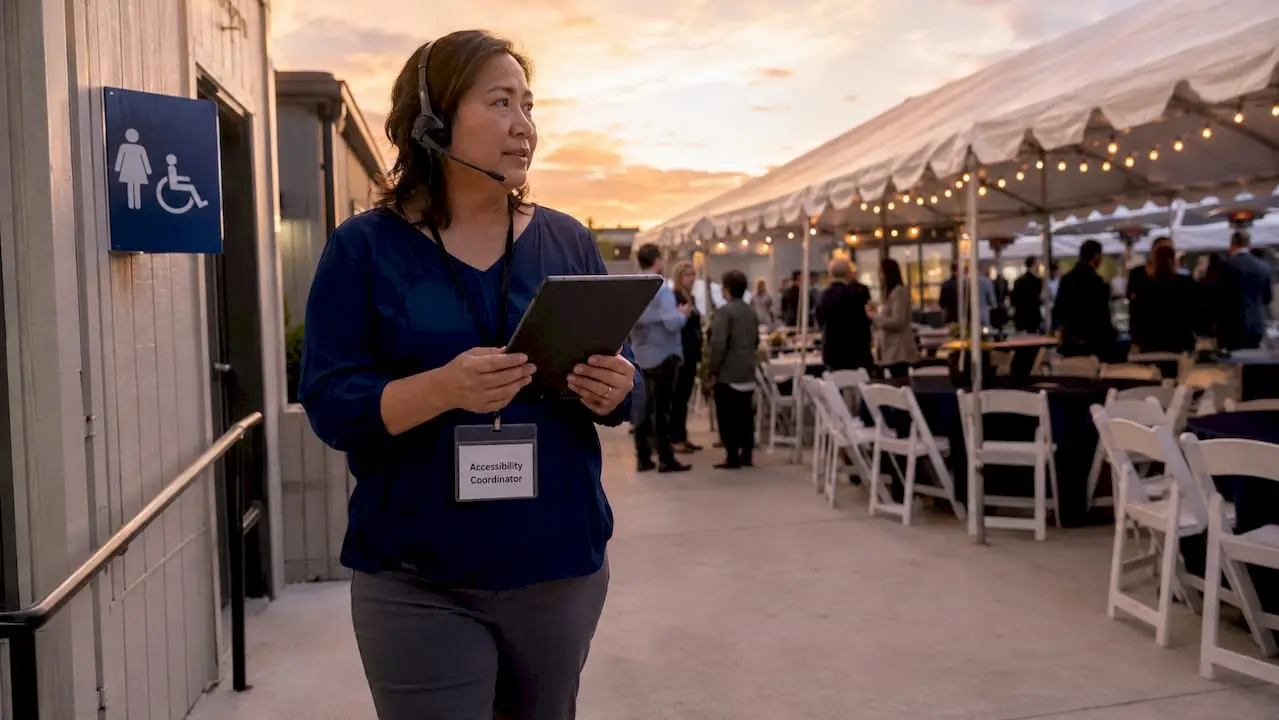
Pro Tip: Assign one named staff member as the on-site accessibility coordinator for every event. This person owns all accommodation queries on the day and has authority to resolve issues without escalation. It prevents attendees from being passed between staff members when they need help.
How do you evaluate and improve inclusivity after an event?
Post-event evaluation is where most organisations leave the most value on the table. Collecting feedback specifically about accessibility and inclusivity, rather than folding it into a general satisfaction survey, produces data you can actually act on.
Your post-event process should include:
- A dedicated accessibility feedback question in your attendee survey, asking whether attendees’ accommodation needs were met and what could have been done better
- A venue accessibility rating completed by your team immediately after the event, while details are fresh, covering parking, signage, toilets, seating, and audio-visual performance
- A lessons-learned log that records which accommodations were requested, which were delivered successfully, and which fell short, along with the reason
- An audit against a recognised standard, such as the Museums Galleries Scotland Accessible Events Standard, to identify structural gaps rather than just individual incidents
The goal is to build an institutional memory of what works for your specific audience. Over time, this data tells you which venues consistently perform well, which accommodation types your members most frequently need, and where your communications process creates friction. Organisations that treat each event as a learning cycle improve faster than those that treat each event as a one-off exercise.
Embedding inclusive practice in your organisation’s culture also means updating your event policies, procurement criteria, and staff training programmes based on what you learn. A single well-run inclusive event is a success. A consistent track record of welcoming gatherings is a competitive advantage for member retention and community reputation.
Key takeaways
Hosting inclusive events requires proactive planning, integrated venue design, and a structured feedback loop to deliver genuine participation for all attendees.
| Point | Details |
|---|---|
| Plan at least 4 weeks ahead | Share event information and open accommodation requests a minimum of 4 weeks before the event date. |
| Budget for accessibility services | Include CART captioning and BSL/ASL interpretation as fixed line items, not optional additions. |
| Treat venue features as a system | Design accessible parking, signage, toilets, seating, and audio-visual as one connected attendee journey. |
| Train staff as inclusion signals | Brief all staff on accessibility features and assign a named on-site accessibility coordinator. |
| Evaluate specifically, not generally | Use dedicated accessibility feedback questions and post-event audits to build institutional knowledge. |
Why inclusion cannot be an afterthought: a planner’s perspective
Having worked across membership organisations and association events for a number of years, the pattern I see most often is this: accessibility gets added to the agenda two weeks before the event, once the venue is booked and the budget is set. At that point, you are managing damage limitation rather than designing inclusion.
The events I have seen done well share one characteristic. The accessibility coordinator was in the room during the initial venue shortlisting conversation, not brought in to review a decision already made. That single shift changes everything. It means the venue with the beautiful atrium but no hearing loop does not make the shortlist. It means the catering brief includes allergen and serving-height requirements from day one.
I also think the industry underestimates the signal that front-line staff send. Inclusion’s emotional tone is shaped not by the keynote speaker but by the volunteer at the registration desk who knows where the quiet room is and offers to walk someone there. Training that person costs almost nothing. The goodwill it generates is disproportionate to the investment.
The other thing worth saying plainly: diverse event teams produce more inclusive events. When the people planning the programme have different lived experiences, they catch gaps that a homogeneous team will not notice. This is not a soft observation. It is a practical quality-control mechanism. If your planning team looks the same every time, your blind spots will too.
— Rob
How Colossus can support your inclusive event planning
Planning welcoming gatherings at scale requires more than good intentions. It requires systems that track accommodation requests, automate accessible communications, and give your team a clear record of what was promised and what was delivered. Colossus’s event management software is built for membership organisations and associations that run events as a core part of their member engagement strategy. Our platform lets you capture accessibility requirements at registration, manage attendee communications with accessible templates, and store a complete record of each event’s accessibility performance for future planning. For organisations looking to build virtual event accessibility into hybrid programmes, Colossus supports that too. Explore how our tools can make your next event genuinely inclusive from the first registration to the final feedback form.
FAQ
What does hosting inclusive events mean in practice?
Hosting inclusive events means designing every stage of an event, from registration to on-site logistics, so that attendees of all abilities, backgrounds, and identities can participate fully. It goes beyond legal compliance to proactively anticipate diverse needs before they are requested.
How far in advance should accessibility planning begin?
Event information should be shared at least 4 weeks before the event date, and services like CART captioning and BSL interpretation should be booked two to four weeks in advance to guarantee availability.
What accessibility features must a venue provide?
A venue should offer accessible parking, step-free routes, all-gender accessible toilets, varied seating, hearing loop compatibility, and clear large-print signage. The University of Auckland recommends testing the full attendee journey from arrival to participation.
How do you collect useful post-event accessibility feedback?
Include a dedicated accessibility question in your post-event survey, complete an internal venue accessibility rating immediately after the event, and audit your performance against a recognised standard such as the Museums Galleries Scotland Accessible Events Standard.
Is an Accessibility Plan legally required for events?
In some jurisdictions, yes. Philadelphia requires submitting an Accessibility Plan with the special event permit application. Even where it is not mandatory, drafting one disciplines your team to address gaps before the event day.