Event marketing schedule: your 2026 planning guide

TL;DR:
- An effective event marketing schedule is a structured timeline covering phases from foundation to urgency, ensuring promotional activities align with event goals. Proper scheduling, channel selection, and KPI tiering are critical to maximize attendance and revenue, with continuous review and adaptation. Most schedules fail due to being viewed as task lists rather than strategic plans driven by data and shared ownership.
An event marketing schedule is a structured timeline that maps every promotional activity required to fill your event and engage your audience from the first planning session to the final registration push. Without one, marketing efforts fragment across teams, budgets get misallocated, and attendance targets are missed. Platforms like Attendir, Tickts, and Bizzabo have each published 2026 benchmarks confirming that phased, timeline-driven promotion consistently outperforms ad hoc campaigns. The difference between a sold-out event and a half-empty room is rarely the quality of the event itself. It is almost always the quality of the promotion plan behind it.
What is an effective event marketing schedule timeline?
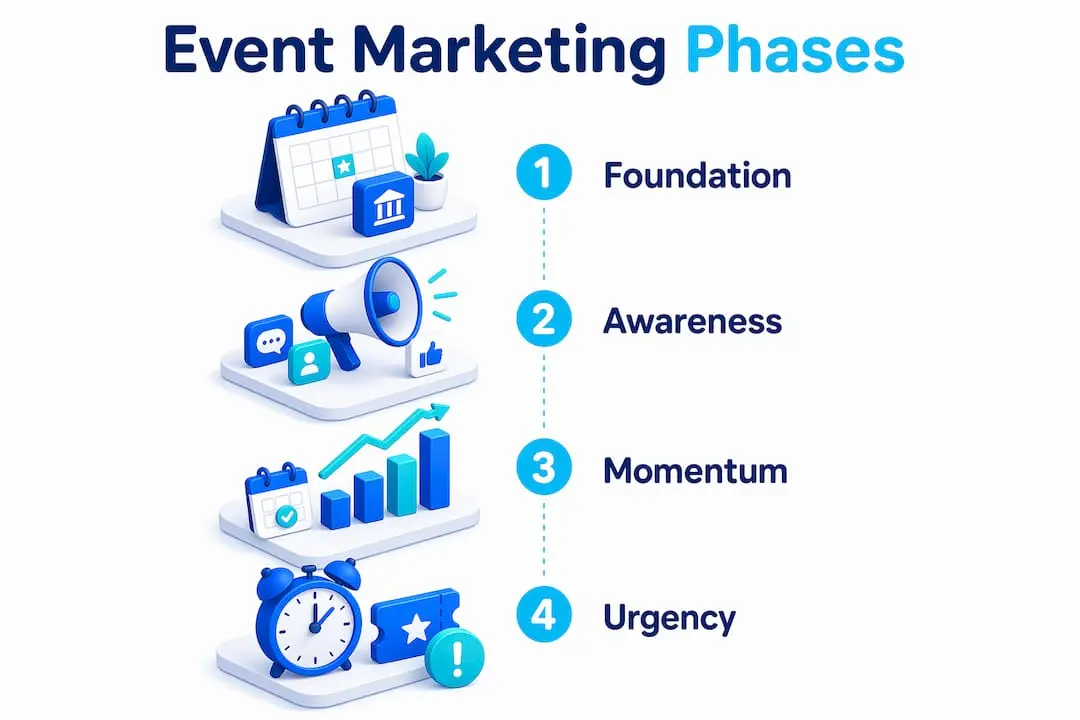
An event marketing schedule, also called an event promotion timeline in industry practice, structures your campaign into four sequential phases: Foundation, Awareness, Momentum, and Urgency. Each phase has distinct goals, activities, and recommended timing relative to your event date.

Lead times vary by event scale: large conferences with 5,000 or more attendees require 16 to 20 weeks of promotion, mid-size corporate events with 500 to 5,000 attendees need roughly 12 weeks, and small workshops or meetups can operate on a 6 to 8 week window. This means a national membership conference should have its marketing calendar active before most planners even finalise the speaker lineup.
The table below summarises the four phases and their core activities:
| Phase | Timing before event | Core activities |
|---|---|---|
| Foundation | 12+ weeks | Goal setting, audience segmentation, landing page build, early-bird offer creation |
| Awareness | 8–12 weeks | Announcement email, organic social launch, PR outreach, SEO content |
| Momentum | 3–8 weeks | Speaker spotlights, paid advertising launch, referral programme activation |
| Urgency | 0–3 weeks | Final push email, countdown posts, last-chance paid retargeting |
The Foundation phase is where most planners underinvest. Defining S.M.A.R.T goals, building your registration landing page, and segmenting your audience before any promotion goes live determines the quality of everything that follows. Skipping this phase and jumping straight to social posts is one of the most common and costly mistakes in event marketing.
Trigger-based scheduling logic maps activities to weeks before the event rather than fixed calendar dates. This approach means your plan scales cleanly whether your event is 16 weeks away or 8 weeks away, without rewriting the entire document.
Pro Tip: Build your event marketing calendar using relative week triggers (e.g. “Week minus 10”) rather than specific dates. When your event date shifts, every activity adjusts automatically.
How should event marketing channels be scheduled and budgeted?
Channel selection and budget allocation are the two decisions that determine whether your event marketing strategy generates registrations or just impressions. The recommended budget split is 50% on organic channels including content, email, and SEO; 30% on paid acquisition; and 20% on creative production and contingency. This framework prioritises channels with compounding returns over those with purely transactional reach.
Email remains the highest-converting channel in event promotion. A well-structured sequence follows three stages:
- Announcement email: Sent at the start of the Awareness phase, this single message accounts for 30 to 50% of email-attributed sales across the entire campaign. It must lead with the clearest possible value proposition and a direct registration link.
- Momentum email: Sent 3 to 4 weeks before the event, this message highlights social proof, speaker announcements, or agenda updates to re-engage contacts who did not convert on the first send.
- Final push email: Sent 5 to 7 days before the event, this message creates urgency through scarcity, deadline framing, or a last-chance offer.
Paid advertising follows a different rhythm. During the Awareness phase, paid channels run broad reach campaigns targeting cold audiences. As the event date approaches, the focus shifts to retargeting warm audiences who visited the registration page but did not convert. Launching paid ads before your landing page is tested and optimised wastes budget at the most critical stage of the funnel.
The channel comparison below provides a practical reference for scheduling decisions:
| Channel | Relative cost | Best phase | Expected outcome |
|---|---|---|---|
| Email sequence | Low | All phases | Highest direct conversions |
| Organic social | Low | Awareness, Momentum | Brand reach, community building |
| Paid social ads | Medium | Momentum, Urgency | Targeted reach, retargeting |
| Referral programme | Low | Momentum | 3 to 5x conversion rate vs cold traffic |
| SEO content | Low | Foundation, Awareness | Long-term discoverability |
Attendee advocacy programmes deserve particular attention. Peer referrals convert at 3 to 5 times the rate of cold paid traffic, yet most organisations treat them as an afterthought. Building a structured referral incentive into your Momentum phase, where existing registrants receive a shareable link and a clear reason to share it, consistently lowers cost per registration. For nonprofit event promotion in particular, peer advocacy is often the single most cost-effective channel available.
What common pitfalls affect event marketing schedules?
The most damaging pitfall is treating event marketing as a support function rather than a core revenue driver. When marketing is positioned as logistics support, it receives insufficient budget, starts too late, and lacks the authority to align stakeholders around shared goals. Events that consistently fill seats treat marketing as a strategic function with direct accountability to pipeline and revenue outcomes.
Beyond that structural issue, the most frequent execution mistakes include:
- Starting promotion too late. Compressing the Awareness phase below four weeks for a mid-size event removes the time needed for organic content to gain traction and for paid campaigns to exit the learning phase.
- Launching paid ads before landing page optimisation. Allow 2 to 3 weeks for landing page testing before activating paid spend. A landing page converting at 15% instead of 30% doubles your cost per registration.
- Focusing on vanity metrics. Social media likes and email open rates are not business outcomes. Quality metrics such as lead-to-meeting conversion rate and attendee seniority reveal whether your event is attracting the right people, not just any people.
- Demographic-only segmentation. Segmenting audiences by job title or industry alone produces generic messaging. Behavioural and intent-based segmentation based on past event attendance, content engagement, or purchase history consistently outperforms demographic labels for targeted outreach.
Pro Tip: Before your campaign launches, define three KPI tiers: primary goals (registrations, revenue), leading indicators (landing page conversion rate, email click-through rate), and quality metrics (attendee seniority, lead-to-meeting conversion). This structure prevents the team from celebrating vanity wins while missing the outcomes that matter.
For event advertising ideas that apply behavioural segmentation in practice, the distinction between who attended your last event and who engaged with your follow-up content is a powerful starting point for building intent-based audience lists.
How to practically build and adjust an event marketing schedule
Building a schedule that holds up under real conditions requires a structured process, not a template you fill in once and forget. Follow these steps to create a plan that is both specific and adaptable:
-
Set S.M.A.R.T goals with tiered KPIs. Define your primary goal (total registrations, revenue target), your leading indicators (email click-through rate, landing page conversion rate), and your quality metrics (ideal customer profile attendance rate, pipeline created). Key metrics to track include registrations versus goal, cost per registration, share-to-registration ratio, and email engagement rates.
-
Map activities to relative week triggers. Assign every task to a week number relative to the event date rather than a fixed calendar date. This preserves the plan’s logic if the event date changes and makes it reusable across future events.
-
Build your landing page first. Before any promotion goes live, your registration page must be live, tested, and tracking conversions. This is the single most important technical prerequisite in the entire schedule.
-
Segment your audience by behaviour and intent. Pull data from your CRM on past attendees, content downloaders, and email engagers. Build separate messaging tracks for warm audiences who already know your organisation and cold audiences who do not. For improving registration rates through segmentation, the difference in conversion between a warm and cold audience can be significant.
-
Activate channels in phase order. Launch organic content and the announcement email first. Add paid advertising only after the landing page has been live for at least two weeks and is converting at an acceptable rate. Activate the referral programme at the start of the Momentum phase.
-
Review and iterate weekly. Set a fixed weekly review cadence to assess leading indicators. If email open rates are below benchmark, test a new subject line. If landing page conversion is low, test a new headline or social proof element. Post-event, document what worked and what did not to inform your next event marketing calendar.
Compressing timelines is sometimes unavoidable. For events with fewer than eight weeks of lead time, prioritise email to your existing audience above all other channels. Your warm list will always convert faster than any paid campaign you can build in a compressed window.
Key takeaways
A well-structured event marketing schedule built on phased timing, trigger-based logic, and tiered KPIs is the primary determinant of whether an event meets its attendance and revenue goals.
| Point | Details |
|---|---|
| Phase your timeline | Use Foundation, Awareness, Momentum, and Urgency phases with activities mapped to relative week triggers. |
| Prioritise email sequencing | An announcement email alone drives 30 to 50% of email-attributed sales; time your sequence deliberately. |
| Allocate budget by channel type | Apply the 50/30/20 split: organic channels first, paid second, creative and contingency last. |
| Avoid vanity metrics | Track lead-to-meeting conversion and attendee seniority, not just likes and open rates. |
| Optimise before you advertise | Test your landing page for at least two weeks before activating paid spend to protect your budget. |
Why most event schedules fail before they start
Most event marketing schedules I have seen fail not because the tactics are wrong, but because the document is treated as a to-do list rather than a strategic plan. The moment a schedule becomes a checklist of tasks assigned to individuals without shared ownership of outcomes, it loses its power. Every activity on the schedule should trace back to a specific goal, and every team member should know which metrics they are responsible for moving.
The other pattern I see repeatedly is planners building their schedule around what they have always done rather than what the data says works. Organisations that ran a successful conference three years ago often replicate that schedule without accounting for changes in their audience, their competitive context, or the platforms where their members now spend time. A schedule built on last year’s assumptions is not a plan. It is a habit.
The most effective approach I have observed is treating the event marketing schedule as a living document with a weekly review cadence built in from day one. When leading indicators signal that a channel is underperforming, the team has the authority and the process to adjust in real time rather than waiting until post-event analysis confirms what everyone already suspected. That responsiveness, more than any single tactic, is what separates consistently high-performing event programmes from those that rely on luck.
— Rob
How Colossus supports your event marketing schedule
Planning a high-performing event requires more than a spreadsheet. Colossus brings together event management software, CRM, and email marketing in a single platform designed specifically for membership organisations, associations, and nonprofits.
With Colossus, you can build your event registration process, automate your email sequences, and track campaign performance from one dashboard. Our platform features include audience segmentation tools, registration analytics, and integrated payment processing, giving your team the data it needs to act on leading indicators rather than waiting for post-event reports. If your organisation runs recurring events and needs a system that connects marketing activity directly to membership outcomes, Colossus is built for exactly that.
FAQ
What is an event marketing schedule?
An event marketing schedule is a structured timeline that maps all promotional activities, from initial announcement to final registration push, to specific phases relative to the event date. It coordinates channels, budgets, and team responsibilities to maximise attendance and engagement.
How far in advance should you start event marketing?
Lead times depend on event scale: large conferences require 16 to 20 weeks, mid-size corporate events need around 12 weeks, and small workshops can work within 6 to 8 weeks. Starting earlier always provides more time for organic content to build traction.
What should a marketing event checklist include?
A marketing event checklist should cover goal setting with tiered KPIs, audience segmentation, landing page build and testing, email sequence creation, paid advertising setup, referral programme activation, and a weekly performance review cadence.
Which email in the event sequence drives the most registrations?
The announcement email drives 30 to 50% of email-attributed sales across the entire campaign, making it the single most important message in the sequence. It should lead with a clear value proposition and a direct call to register.
What metrics matter most for event marketing performance?
The metrics that matter most are registrations versus goal, cost per registration, landing page conversion rate, and quality indicators such as ideal customer profile attendance rate and lead-to-meeting conversion. Social media engagement and email open rates are secondary signals, not primary success measures.