Easiest CRM to Use – Impact on Member Engagement

Managing memberships with multiple spreadsheets and scattered systems often leads to missed opportunities and frustrated teams. For membership managers balancing growing expectations and complex operations, finding a genuinely easy CRM that connects everything can transform daily work. Discover how a user-friendly CRM platform centralises communication, automates routine tasks, and breaks down barriers so your organisation gains clarity, efficiency, and stronger relationships with every member.
Table of Contents
- Defining The Easiest CRM For Memberships
- User-Friendly CRM Features And Benefits
- Comparing Leading Simple CRM Platforms
- CRM Integration And Workflow Streamlining
- Common Pitfalls In CRM Adoption
Key Takeaways
| Point | Details |
|---|---|
| User-Friendly Design | An effective membership CRM should feature an intuitive interface and minimal training requirements, facilitating quick user adoption and enhanced operational efficiency. |
| Integration Capabilities | Seamless integration with existing systems is crucial, allowing for a unified platform that streamlines communication and reduces manual tasks. |
| Holistic Member Engagement | CRMs should enable personalised communication and provide comprehensive tracking of member interactions to foster deeper relationships. |
| Strategic Adoption Planning | Successful implementation requires a clear strategy, adequate user training, and ongoing feedback mechanisms to ensure alignment with organisational goals. |
Defining the Easiest CRM for Memberships
A Customer Relationship Management (CRM) system specifically designed for membership organisations represents far more than just software - it’s a strategic platform for building meaningful connections. Unlike generic business tools, membership CRMs focus exclusively on nurturing relationships throughout an organisation’s entire ecosystem.
In the context of membership management, an effective CRM goes beyond traditional tracking. Centralising communication and engagement becomes paramount, creating a comprehensive system that supports interactions across multiple constituent groups. This holistic approach enables organisations to:
- Track individual member journeys
- Personalise communication strategies
- Automate routine administrative tasks
- Provide 360-degree visibility into member interactions
- Streamline recruitment and retention processes
The most user-friendly membership CRMs distinguish themselves through intuitive design and comprehensive functionality. These systems integrate multiple operational requirements, transforming fragmented communication channels into a unified, intelligent platform. Consolidating disparate systems allows membership organisations to break down departmental barriers and create seamless member experiences.
Key Characteristics of an Easy-to-Use Membership CRM:
- Intuitive user interface
- Minimal training requirements
- Robust integration capabilities
- Customisable dashboards
- Automated reporting features
Practical implementation matters more than theoretical capabilities. An easy CRM should feel like a natural extension of your organisational workflow, reducing complexity while enhancing operational efficiency.
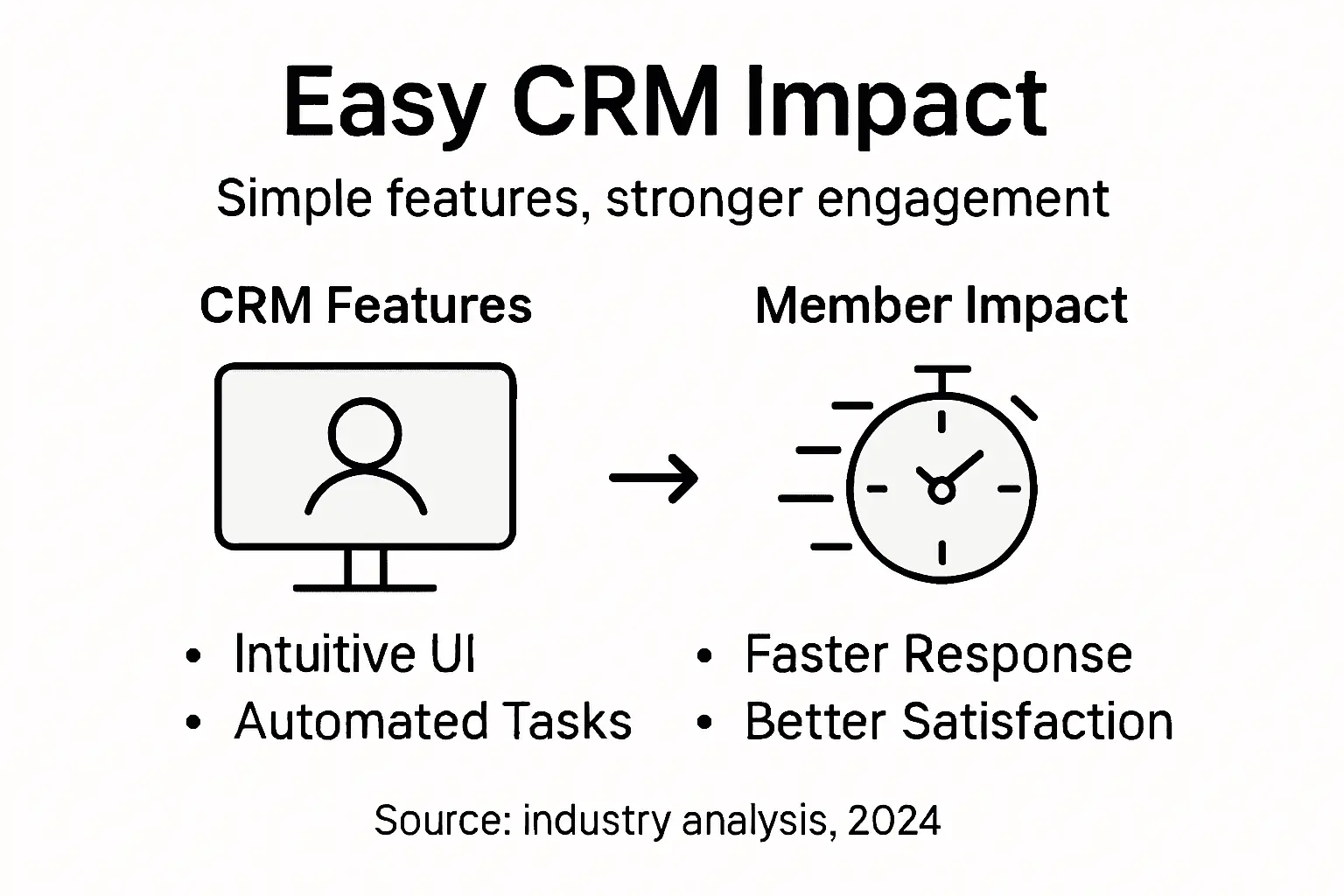
Here’s a comparison of how CRM ease-of-use features impact organisational outcomes:
| CRM Feature | Impact on Teams | Impact on Members |
|---|---|---|
| Intuitive interface | Quicker user adoption | Faster response times |
| Automated tasks | Reduced manual workload | Timely member updates |
| Integration capabilities | Smoother data flow | Fewer communication gaps |
| Custom dashboards | Enhanced team productivity | More tailored services |
| Automated reporting | Improved decision-making | Better service delivery |
Pro tip: Before selecting a membership CRM, request comprehensive demonstration and involve team members from multiple departments in the evaluation process to ensure broad usability and alignment with organisational needs.
User-Friendly CRM Features and Benefits
Modern membership CRMs transform organisational communication through intelligent design and sophisticated technological capabilities. Centralized communication platforms enable seamless interactions across diverse constituent groups, creating more responsive and adaptive membership ecosystems.
Key user-friendly features that distinguish top-tier membership CRMs include:
- Intuitive dashboard interfaces
- Automated task management
- AI-powered analytical insights
- Multi-channel communication capabilities
- Customisable reporting tools
- Seamless data integration
- Real-time member tracking
The most effective CRM systems go beyond basic data management. Holistic interaction tracking allows organisations to develop nuanced understanding of member journeys, transforming raw data into strategic relationship-building opportunities. These platforms break down traditional departmental silos, creating transparent, interconnected communication networks.
Advanced CRM Capabilities:
- Personalised member engagement strategies
- Predictive interaction analytics
- Automated communication workflows
- Comprehensive member lifecycle management
- Integrated communication channels
Technological sophistication means little without genuine user experience. The best CRMs balance complex functionality with intuitive design, ensuring that team members can leverage powerful tools without extensive technical training.

Pro tip: Prioritise CRM solutions offering comprehensive onboarding support and continuous user training to maximise platform adoption and organisational effectiveness.
Comparing Leading Simple CRM Platforms
Navigating the landscape of membership CRM platforms requires careful evaluation of sophisticated yet user-friendly solutions. Comparative analysis reveals nuanced differences between platforms designed to enhance organisational communication and member engagement.
Key considerations when comparing CRM platforms include:
- Ease of implementation
- Customisation capabilities
- Automation features
- Pricing structures
- Scalability potential
- User interface intuitiveness
- Integration capabilities
Top-tier CRM solutions demonstrate remarkable diversity in their approach to member management. Platform comparisons highlight unique strengths across different organisational needs, with some platforms excelling in specific domains such as smaller institutional requirements or large-scale enterprise solutions.
Comparative Platform Evaluation Criteria:
- User experience and interface design
- Data management and integration
- Reporting and analytics capabilities
- Automation and workflow efficiency
- Cost-effectiveness and return on investment
Successful CRM selection transcends technical specifications. The most effective platforms balance sophisticated functionality with genuine user-centricity, ensuring that technological complexity never compromises operational simplicity.
Pro tip: Request comprehensive product demonstrations and conduct thorough user testing across multiple departmental teams before finalising your CRM platform selection.
CRM Integration and Workflow Streamlining
Successful membership management requires seamless technological integration that transforms disparate systems into unified, intelligent platforms. Integrating diverse data sources enables organisations to break down traditional operational silos and create more responsive, interconnected workflows.
Critical integration strategies encompass multiple operational domains:
- Centralising member interaction data
- Automating routine administrative tasks
- Enabling cross-departmental collaboration
- Providing real-time performance insights
- Synchronising communication channels
- Reducing manual data entry
- Enhancing operational transparency
Modern CRM platforms excel at creating comprehensive ecosystems where information flows seamlessly between different organisational functions. Workflow automation reduces administrative burdens by eliminating repetitive tasks and enabling staff to focus on strategic member engagement initiatives.
Key Integration Mechanisms:
- API connections with existing software
- Automated data synchronisation
- Customisable reporting dashboards
- Multi-channel communication tracking
- Intelligent workflow routing
Technological integration is not merely about connecting systems, but creating intelligent, responsive platforms that adapt to organisational needs and transform raw data into actionable insights.
Pro tip: Conduct a comprehensive audit of existing systems and workflows before implementing CRM integration to identify potential compatibility challenges and optimisation opportunities.
Common Pitfalls in CRM Adoption
Successful CRM implementation requires strategic foresight and comprehensive understanding of potential organisational challenges. Identifying critical adoption risks becomes essential for preventing costly technological investments from becoming ineffective organisational burdens.
Common challenges in CRM adoption include:
- Lacking clear strategic objectives
- Insufficient user training
- Neglecting end-user experience
- Overcomplicating system configuration
- Ignoring scalability requirements
- Underestimating change management processes
- Fragmented internal communication
Membership organisations frequently encounter systemic obstacles that undermine technological integration efforts. Implementing incremental deployment strategies helps mitigate risks associated with complex technological transitions.
Primary CRM Adoption Barriers:
- Misaligned technological capabilities
- Resistance to organisational change
- Complex user interfaces
- Limited stakeholder engagement
- Inadequate performance measurement
Successful CRM adoption transcends technological implementation, requiring holistic approaches that prioritise human factors, organisational culture, and strategic alignment.
The following table summarises common CRM adoption pitfalls and practical mitigation strategies:
| Pitfall | Potential Risk | How to Mitigate |
|---|---|---|
| Lack of clear objectives | Misaligned CRM configuration | Set specific outcome goals |
| Insufficient user training | Low platform usage | Provide ongoing training |
| Overcomplicated configuration | User frustration | Adopt a phased implementation |
| Ignoring scalability | Growth bottlenecks | Choose scalable solutions |
| Fragmented communication | Inefficient collaboration | Foster cross-team workshops |
Pro tip: Develop a comprehensive change management plan that includes stakeholder consultation, phased implementation, and continuous user feedback mechanisms.
Simplify Member Engagement with an Easy-to-Use CRM Solution
Struggling with complex CRM systems that slow down your membership engagement and team productivity is a common challenge for many organisations today. The article emphasises the importance of intuitive interfaces, streamlined workflows, and integrated communication channels to enhance member experience and reduce administrative burden. If you seek to centralise your member management, automate tasks, and gain transparent insights into member interactions, then a comprehensive and user-friendly platform is essential.
Colossus Systems offers a highly customisable SaaS platform designed specifically for membership organisations looking to scale efficiently. Our solution combines CRM, event management, targeted marketing, and analytics into a unified platform so you can attract new members, engage audiences with ease, and simplify operational complexity. Features such as tailored communication channels, sales pipelines, and secure payment integrations empower your team to focus on what really matters – building lasting relationships.
Ready to transform your member engagement experience with the easiest CRM to use Discover how Colossus Systems can help you overcome adoption pitfalls and streamline your workflows today Visit our Contact Us page to get in touch with our experts and start your journey towards effortless membership management. Explore how seamless integration and powerful automation can work for your organisation by learning more about our member engagement solutions and take the first step to simplify your CRM experience now.
Frequently Asked Questions
What features should I look for in an easy-to-use membership CRM?
Look for features like an intuitive user interface, minimal training requirements, robust integration capabilities, customisable dashboards, and automated reporting features to ensure effective member engagement.
How can a membership CRM improve member engagement?
A membership CRM can enhance member engagement by centralising communication, personalising strategies, automating administrative tasks, and providing 360-degree visibility into member interactions, leading to improved relationships and satisfaction.
What are some common pitfalls to avoid when adopting a membership CRM?
Common pitfalls include lacking clear strategic objectives, insufficient user training, overcomplicating the system configuration, and ignoring scalability requirements. Addressing these issues is key to successful adoption and effective utilisation.
How does CRM integration affect workflow and member engagement?
CRM integration streamlines workflows by centralising data, automating tasks, and facilitating cross-departmental collaboration, which enhances operational efficiency and allows for more responsive and tailored member interactions.
Recommended
- What Is a CRM System? Guide for Membership Groups 2025|CS
- Customer Service Relationship Management: Enhancing Member Engagement|CS
- Understanding Membership CRM: Key Concepts and Importance|CS
- Integrating Your Website into a Membership CRM to Enhance Engagement |CS
- Drip Marketing: Boosting Conversion for E-commerce - seo analytic