Course of event management: your professional guide

TL;DR:
- Event management courses cover the full event lifecycle, from planning to post-event evaluation, to develop professional skills. They use various formats, from full-time diplomas to online certificates, with costs reflecting depth of content and practical application. Practical skills such as project management, negotiation, and contingency planning are prioritized over creativity alone, ensuring professional readiness.
A course of event management is a formal training programme designed to teach the complete lifecycle of planning, organising, and evaluating successful events. The industry standard credential for this field is the Certified Meeting Professional (CMP), which sets the benchmark for competency across planning, budgeting, risk management, and post-event reporting. Whether you are coordinating a corporate conference, a membership association’s annual summit, or a fundraising gala, formal event management training gives you the structured toolkit that separates professionals from enthusiastic amateurs. This guide explains what these courses cover, how they are delivered, and how to apply what you learn directly to your organisation’s events.
What does a course of event management actually cover?
Core event management courses cover the full event lifecycle, from initial objectives and success metrics through to post-event evaluation and reporting. That scope aligns directly with the CMP credential framework, which treats every phase of an event as a professional discipline in its own right. The curriculum is not simply a checklist of tasks. It is a structured body of knowledge that teaches you to think like a project manager, a negotiator, and a risk analyst simultaneously.
Most programmes address the following subject areas:
- Objectives and success metrics: Defining what the event must achieve and how you will measure it
- Budgeting and financial control: Building realistic budgets, tracking expenditure, and managing contingency funds
- Vendor negotiations: Sourcing, contracting, and managing suppliers including venues, caterers, and audio-visual providers
- Logistics and scheduling: Creating detailed run-of-show documents, staffing plans, and production timelines
- Marketing and communications: Promoting the event, managing registrations, and communicating with attendees
- Risk and safety management: Identifying hazards, securing insurance, obtaining permits, and meeting food safety regulations
- On-site coordination: Managing the event day itself, including briefing teams and handling last-minute changes
- Post-event evaluation: Gathering feedback, producing reports, and documenting lessons learned
Course focus varies by specialisation. Some programmes concentrate on corporate meetings and conferences, others on social or cultural events, and an increasing number address virtual event coordination as a distinct discipline. The best programmes treat all of these as variations on the same professional framework rather than entirely separate fields.
How do course formats and timelines vary?
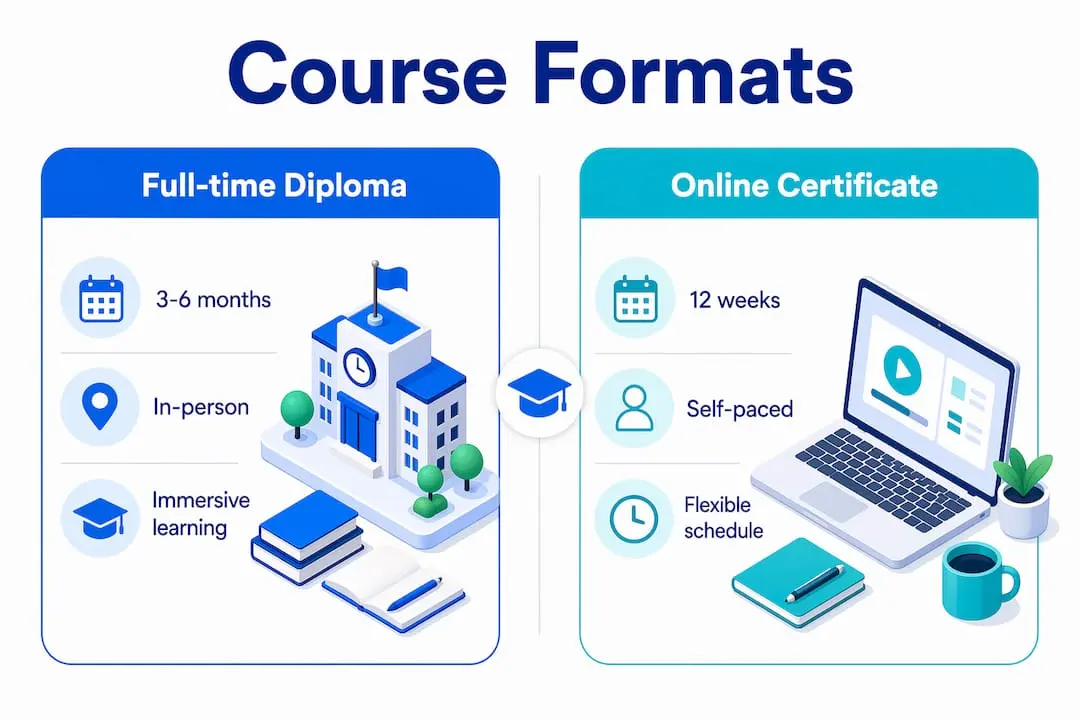
Event management certification timelines range from intensive three-month full-time programmes to flexible, self-paced courses completing between four and 24 weeks depending on learner commitment. That range reflects genuinely different learning outcomes, not just scheduling convenience. A full-time diploma immerses you in the subject and builds professional networks quickly. A self-paced online certificate lets you apply concepts to live events as you study, which has its own practical value.
The table below shows how common formats compare across key dimensions:
| Format | Typical duration | Delivery | Best suited for |
|---|---|---|---|
| Full-time diploma | 3–6 months | In-person or blended | Career changers and recent graduates |
| Part-time certificate | 12–24 weeks | Evening or weekend classes | Working professionals |
| Online self-paced certificate | 4–24 weeks | Fully online | Planners with irregular schedules |
| Short intensive workshop | 1–5 days | In-person | Specific skill gaps or CPD requirements |
Professional training costs differ widely. A 12-week online certificate may cost around £604, with additional certification printing fees of approximately £24.99. Comprehensive advanced diplomas run into several thousand pounds. The cost difference reflects depth of content, tutor access, and the weight of the resulting qualification in the job market.
The trade-off between depth and flexibility is real. A short online module teaches you the vocabulary and frameworks of event management. A full diploma teaches you to apply them under pressure, with feedback from experienced practitioners. Your choice should depend on where you are in your career, not simply on what fits your diary.
What practical skills do effective event management courses prioritise?
Effective event management relies more on structured toolkits and contingency planning than on creativity alone. This is the insight that surprises most new planners. Creativity matters for concept development, but it does not prevent a catering supplier from cancelling 48 hours before your event. Structured processes do.
The practical competencies that distinguish professional planners include:
- Project management: Applying formal project management methods to event timelines, dependencies, and resource allocation
- Negotiation: Securing favourable terms with venues and suppliers without damaging long-term relationships
- Delegation: Assigning tasks clearly so that the lead planner can focus on oversight rather than execution
- Communication: Briefing teams, updating stakeholders, and managing attendee expectations at every stage
- Legal compliance: Understanding insurance, permits, and food safety requirements that distinguish professionals from amateurs
- Risk management: Building contingency plans for weather, technical failure, speaker cancellations, and crowd safety
Successful event managers prioritise delegation and communication over personal execution. Pre-vetted team checklists and clear briefing documents are what allow a planner to handle a crisis on the day without the whole event unravelling. Courses that teach this through live simulations or real event placements produce planners who are genuinely ready for high-pressure environments.
Experiential education moves learners from theory to live adaptation, and that shift is where true mastery develops. Reading about vendor negotiation is useful. Practising it in a role-play scenario with an experienced tutor is transformative.

Pro Tip: Before enrolling, ask the course provider how much of the programme involves live event work, simulations, or industry placements. If the answer is less than 20% of contact hours, the course is primarily theoretical.
Why is post-event evaluation so often neglected?
Post-event evaluation and documentation are critical for proving value and securing future budgets, yet novice planners routinely skip this step. The reason is understandable. After a demanding event, the instinct is to rest and move on. The professional instinct is to document what happened while the detail is still fresh.
A structured post-event review covers four areas. First, attendance and engagement data compared against the original objectives. Second, budget variance analysis showing where actual spend differed from the plan and why. Third, supplier performance notes that inform future procurement decisions. Fourth, a formal lessons-learned report that captures what worked, what failed, and what should change next time.
Pro Tip: Schedule your post-event debrief within 72 hours of the event closing. After that window, team members’ recollections become less precise and the most useful operational detail starts to fade.
Lessons-learned reports serve two audiences. Internally, they build institutional knowledge so that your organisation does not repeat the same mistakes each year. Externally, they give sponsors and senior stakeholders the evidence they need to justify continued investment. Event management training that omits this step is teaching you to run a race without recording your time. You cannot improve what you do not measure.
How can you apply event management training in your professional practice?
Completing an event planning course is the beginning of professional development, not the end of it. The planners who advance fastest are those who treat every event as a live case study and every course module as a framework to test in practice.
-
Match your electives to your career goals. Advanced diploma programmes offer specialist electives and networking opportunities that build credibility beyond standard certificates. If your organisation runs primarily membership events, choose electives in delegate management and sponsorship. If you work in the charity sector, prioritise nonprofit event coordination modules.
-
Build a personal toolkit from day one. Every template, checklist, and risk register you create during training becomes a reusable asset. Adapt these documents for your organisation’s specific events rather than starting from scratch each time.
-
Use certification to build credibility. Credentials like the CMP signal to employers and clients that your knowledge meets a recognised standard. They are particularly valuable when you are pitching for larger budgets or more complex events.
-
Network deliberately during your course. Your fellow students are future colleagues, suppliers, and referrers. Treat every group project and industry visit as a professional relationship in development.
-
Apply the post-event review process to every event you run, regardless of scale. A 30-person team meeting deserves the same structured debrief as a 500-person conference. The habit builds faster than the scale does.
-
Pursue continuous learning through specialist short courses. Online event management courses in specific areas such as event design, time management, or digital marketing keep your skills current as the industry evolves.
Key takeaways
A course of event management is most valuable when it combines structured process training with real-world application, covering the full event lifecycle from objectives through to documented post-event evaluation.
| Point | Details |
|---|---|
| Full lifecycle coverage | Effective courses teach every phase, from budgeting and vendor management to post-event reporting. |
| Format affects depth | Full-time diplomas build networks and applied skills; self-paced online courses suit working planners. |
| Process beats creativity | Structured toolkits, checklists, and contingency plans determine professional outcomes more than creative flair. |
| Post-event review is non-negotiable | Lessons-learned reports prove value to stakeholders and drive continuous improvement across future events. |
| Certification builds credibility | Credentials like the CMP signal competency to employers and clients, supporting career progression. |
Why formal training changed how I think about events
The most common mistake I see experienced planners make is treating formal training as something for beginners. They assume that years of on-the-job experience have already taught them everything a course could offer. In my view, that assumption is precisely why so many experienced planners keep repeating the same operational errors year after year.
What formal training actually does is give you a shared language and a tested framework. Before I worked through a structured event management programme, I had good instincts. Afterwards, I had processes I could hand to a team member and trust them to execute without my constant supervision. That shift from instinct to system is what makes you genuinely scalable as a professional.
The industry is also changing faster than informal experience can track. Virtual and hybrid events have introduced technical and logistical demands that simply did not exist a decade ago. The CMP credential and programmes aligned with it are updating their curricula to reflect this. Planners who rely solely on past experience are working from an increasingly outdated map.
My honest advice: choose a programme with a strong experiential component, commit to the post-event review process from your very first event, and treat your course network as a long-term professional asset. The return on that investment compounds over a career in ways that are genuinely difficult to replicate through experience alone.
— Rob
How Colossus supports what you learn in event management training
Completing an event planning course gives you the frameworks. Colossus gives you the platform to put them into practice at scale.

Colossus is built for membership organisations, associations, and nonprofits that run events as a core part of their member engagement strategy. Our event management software handles registration, attendee communications, payment processing, and post-event reporting within a single platform. That means the budgeting, vendor coordination, and evaluation processes you learn in training map directly onto tools you can use from day one. You can also connect event data to our CRM to track attendee relationships over time, giving your organisation the reporting depth that sponsors and boards expect. If you are ready to see how the platform supports your team’s event workflows, explore our full feature set to find the right fit.
FAQ
What is a course of event management?
A course of event management is a formal training programme covering the full lifecycle of planning, organising, and evaluating events. Curricula typically include budgeting, vendor management, risk management, logistics, and post-event reporting.
How long does an event management course take to complete?
Completion times range from 120 hours to six months, depending on whether you choose a full-time diploma, a part-time certificate, or a self-paced online programme.
What is the CMP certification in event management?
The Certified Meeting Professional (CMP) is the leading industry credential for event planners. It validates competency across the full event lifecycle and is recognised by employers internationally.
What practical skills does event management training develop?
Training develops project management, negotiation, delegation, legal compliance, and risk management skills. Experiential learning components are particularly effective at building the applied competencies that classroom study alone cannot replicate.
Is online event management training as effective as in-person study?
Online event management training delivers strong theoretical grounding and is well suited to working professionals. In-person and blended programmes provide additional value through live simulations, industry placements, and professional networking that online formats find harder to replicate.