Association management software pricing: Budget £300–£2,500+ for teams

Most associations should budget £300 to £700 a month for entry to mid-tier platforms, £1,000 to £3,000 a month for mid-sized organisations with events and integrations, and £2,500 or more monthly plus a significant implementation project for enterprise-scale associations. The pricing model matters as much as the number: per-member pricing punishes growth, flat-rate pricing rewards it. Before signing anything, request a tailored total-cost estimate covering three years, not just year one.
TL;DR:
- Per-member pricing can significantly increase costs as membership grows, especially beyond initial projections, making flat-rate plans more predictable for scaling associations.
- Implementation, custom integrations, and data migration costs often represent the largest portion of the total budget, frequently exceeding the initial subscription fee in the first year.
- Vendors often include platform updates and minor feature releases within the subscription, but major upgrades or new modules might incur extra charges, so clarification is essential upfront.
- Negotiating phased rollouts, clear scope definitions, and asking for pilot periods can secure better terms and reduce risks associated with large multiyear commitments.
- A three-year cost projection, including subscriptions, implementation, transaction fees, and support, is crucial to accurately compare vendors and plan for future growth.
Table of Contents
- Breaking down association management software pricing line by line
- Which pricing model fits your association?
- What do associations actually pay, by size?
- What hidden costs should you confirm before signing?
- How to build a total cost of ownership and ROI case
- How to negotiate discounts and better terms
- Do software updates and version upgrades cost extra?
- Colossus Systems: how our plans map to the buyer job and simplify budgeting
- What negotiation actually gets you better terms
- Sources
- FAQ
Breaking down association management software pricing line by line
Vendor quotes rarely arrive in a format you can compare side by side. One proposal bundles support into the licence; another itemises it separately. Understanding the individual cost components is the only way to see what you are actually paying for.
The core subscription licence is the baseline: access to the platform itself, usually billed monthly or annually. Some vendors charge this as a flat fee regardless of membership size; others scale it against member count, contact records, or admin seats. This single decision shapes everything else in your contract.
Module and feature add-ons explain most of the price divergence you will see between quotes for what looks like the same product. Event management, a learning management system for virtual training, advanced analytics, and e-commerce capability are frequently priced as separate tiers or bolt-ons rather than included by default.
Payment gateway and transaction fees sit outside the subscription in almost every case. Vendor category pages routinely note that gateway providers such as Stripe or PayPal charge per-transaction fees on top of whatever the AMS platform charges, and some vendors add their own markup on top of the raw gateway rate. Ask explicitly who absorbs that cost, and whether it is passed through to members at checkout.
Implementation costs cover data migration, integrations with existing tools (accounting software, a separate CRM, a website), and any custom development. This is the line item most likely to be quoted vaguely, and vague implementation scope is consistently the biggest source of quote-to-quote variance according to Capterra’s AMS vendor listings.
Support tiers and SLAs affect your recurring cost more than most buyers expect. A basic support tier might mean email-only, 48-hour response times; a premium tier with a dedicated account manager and same-day response typically carries its own monthly premium.
- Core subscription licence (flat, per-member, or per-seat)
- Module add-ons (events, LMS, analytics, e-commerce)
- Payment gateway and transaction fees
- Implementation (migration, integrations, custom work)
- Support tier and SLA premium
Which pricing model fits your association?
The pricing structure you choose determines how your costs behave as your association grows, and getting this wrong is expensive in ways that don’t show up until year two or three.
Per-member or per-contact pricing suits associations expecting flat or slow-growing membership. It becomes a liability the moment recruitment succeeds. An association that doubles its membership base doubles a chunk of its software bill overnight, often without a corresponding jump in staff capacity to justify it.
Per-admin or per-user licences matter most when your team is small and centralised. Seat limits rarely bite until you bring on seasonal event staff or regional chapter coordinators, at which point you discover the licence only covers five named users.
Tiered plans with bundled features are the most common structure and the hardest to compare, because “Growth” from one vendor and “Growth” from another can include entirely different feature sets. Read the fine print on what triggers an upgrade to the next tier: member count, transaction volume, or feature access are all common triggers.
Flat-rate and per-unit models suit smaller, volunteer-run associations that want budget certainty above all else. You know the number in January and it doesn’t move in July because membership grew by 200 people.
- Per-member: good for stable membership, risky for growth
- Per-seat: good for small teams, risky for seasonal scaling
- Tiered/bundled: common but requires careful feature comparison
- Flat-rate: best for budget certainty, less common at scale
If the second number shocks you, the pricing model is wrong for your growth plans, not just the price.*
What do associations actually pay, by size?
Category pages and vendor directories converge on a rough three-tier pattern, though every association’s actual bill depends heavily on module choices and transaction volume.
Small and volunteer-run associations typically see entry-level pricing from low tens to low hundreds of pounds monthly, or a modest per-member fee according to pricing patterns tracked across AMS category pages. The caveat: these quotes often assume minimal customisation and self-service onboarding. Add a data migration from a legacy spreadsheet system and the number moves.
Mid-sized organisations commonly land in the several-hundred-pounds-per-month range, sometimes structured as a per-thousand-members fee. Expect a genuine one-off implementation cost here too, covering integrations with an accounting platform or existing event ticketing tool, on top of the recurring subscription.
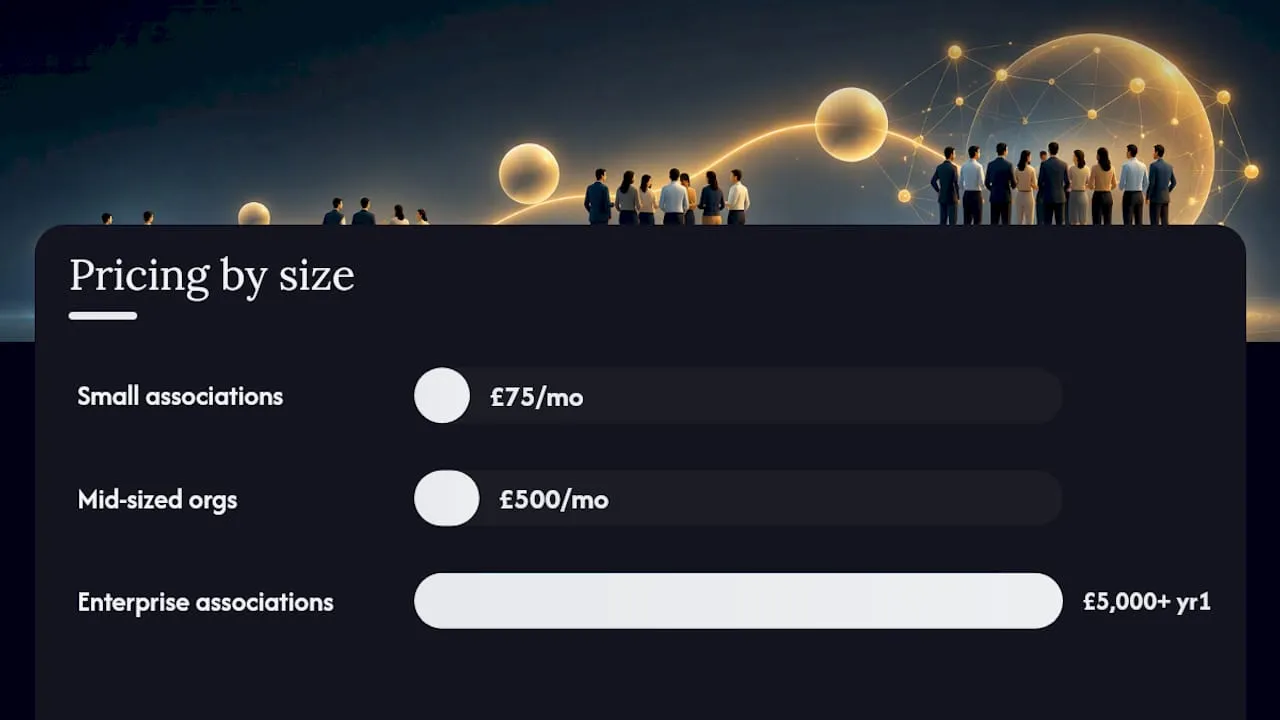
Enterprise-level associations frequently see the subscription cost become the smaller line item. Implementation, custom development, and multi-system integration work often dominate the first-year invoice, with projects running into the thousands of pounds before the platform has processed a single renewal.
A handful of specific things reliably push a quote into the next price band:
- Multiple membership tiers requiring different renewal logic and pricing rules
- High event volume with complex registration workflows (waitlists, group bookings, multi-session tracking)
- A requirement to migrate years of historical transaction and engagement data
- Integration with finance systems, marketing automation, or a separate LMS
- Custom reporting beyond what the platform ships with by default
Digital budgets tend to rise as associations scale their member-facing platforms rather than staying flat year over year, a pattern the 2024 Nonprofit Digital Investments Report documents clearly. Budget for that trajectory rather than assuming your first-year quote is your permanent number.
What hidden costs should you confirm before signing?
The signed contract is where good intentions meet fine print. Confirm each of the following before you commit budget to a multi-year deal.
- Data migration and cleansing scope. Ask whether migration is priced as a fixed fee or hourly, and get a written definition of what counts as “clean” data versus what triggers additional charges.
- Custom integrations. Fixed-scope quotes protect you from cost creep; hourly rates for developer time can run well past initial estimates once real-world edge cases appear.
- Training and documentation. Nonprofit technology benchmarking suggests organisations routinely under-budget for training and post-launch adjustment, adding 10 to 20% to first-year costs beyond the initial quote.
- Renewal escalators and minimum terms. Check whether year two carries an automatic price increase, and what the minimum contract length is before you can exit without penalty.
- Exit and data export fees. Some vendors charge to export your own member data if you leave. Get this in writing now, not when you’re already trying to leave.
- Support response times, in writing. A verbal promise of “fast support” means nothing. Get the actual SLA hours and confirm whether faster response times cost extra.
Vendor directories are useful for a first market scan, but they routinely omit exactly these implementation and customisation fees, which is precisely why a full worked TCO example from your shortlisted vendors matters more than any published price list.
How to build a total cost of ownership and ROI case
A defensible budget needs a formula, not a gut feeling. The simplest version that holds up in a board meeting: subscription costs + implementation + transaction fees + support, projected across three years.
- Gather your inputs first. Current and projected member counts, expected annual transaction volume (renewals, event tickets, donations), and the exact module list you need. Vendors cannot quote accurately without these.
- Request the three-year projection, not the year-one number. Ask each vendor to show how their price moves if your membership grows by 25% and 50%. This is where per-member models often reveal their real cost.
- Commit to measurable KPIs before you buy. Staff time saved on manual renewal processing, improvement in renewal rate, and incremental event revenue from better registration workflows are all trackable and give the board something concrete to measure against the spend.
- Build your RFP around inclusions, not just price. Ask explicitly what’s bundled: data migration hours, training sessions, custom report builds, and support tier. A clear statement of inclusions is the single most effective lever for reducing quote variance between competing vendors.
Pro Tip: Model your TCO over three years even if you’re only allowed to sign a one-year contract. Vendors know most buyers only look at year one, and that’s exactly where the real cost gets hidden.
How to negotiate discounts and better terms
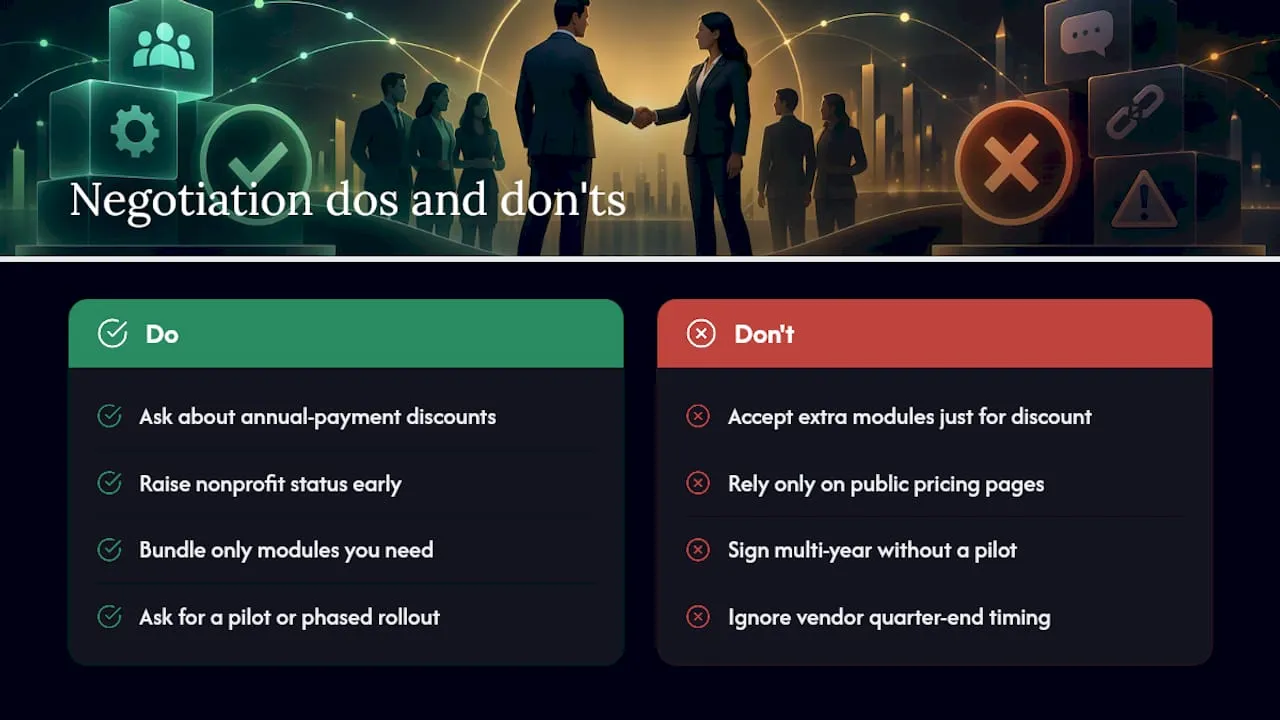
Vendors have more flexibility on price than published pricing pages suggest, particularly for annual commitments and multi-year deals. Paying annually instead of monthly commonly unlocks a discount worth asking about directly, even when it isn’t advertised.
Nonprofit status is worth raising explicitly and early. Many vendors maintain unpublished nonprofit or charity discount tiers that never appear on a public pricing page, so ask the question even if the sales page shows no such option.
Bundling matters too. A vendor is generally more willing to discount when you commit to multiple modules (events plus CRM plus e-commerce) in one deal rather than negotiating each separately later. That said, never let bundle discounts push you into modules you don’t actually need. Timing plays a role as well: vendors often have more room to move near the end of their financial quarter, so a purchase decision timed to that window can yield a better rate than the same conversation a month later.
Always ask for a pilot period or phased rollout before committing to a full multi-year term. A vendor confident in their platform will generally agree to prove value on a smaller scope first, and that willingness itself tells you something about how the relationship will go once you’re a locked-in customer rather than a prospect.
Do software updates and version upgrades cost extra?
This depends entirely on how the vendor structures its subscription, and it’s a question worth asking before you sign rather than after an invoice surprises you.
Most modern SaaS-based association management platforms include ongoing updates and feature releases within the subscription fee, since the vendor hosts and maintains a single version for all customers rather than shipping discrete “versions” you buy separately. This is one of the genuine advantages of cloud-based AMS platforms over older, on-premise systems that charged separately for major version upgrades.
The cost risk shows up in a different place: major feature releases that get positioned as a new tier rather than an included update. Ask vendors directly whether new capabilities added to the platform over your contract term will be included in your existing plan or offered as a paid upgrade. Also confirm what happens to custom integrations or reports when the underlying platform updates. Poorly managed updates can occasionally break a custom integration built against an older version of the platform’s interface, and fixing that is a cost that should sit with the vendor’s implementation team, not yours, if it was their update that caused it.
Colossus Systems: how our plans map to the buyer job and simplify budgeting
Colossus offers multiple plans designed to support associations at different growth stages, including plans targeting smaller associations, those scaling events and marketing, mid-sized associations, and complex, multi-chapter organisations. Additional licence options are available to extend access without a full seat.
Because member management, event registration, CRM, and payment processing live on one platform rather than four bolted-together tools, you remove a whole category of integration cost and the hidden fees that come with keeping separate systems talking to each other. That’s the real saving compared with piecing together point solutions, and it’s worth checking our feature breakdown to see exactly what sits in each tier before you commit.
On a first call with Colossus, ask three things directly: what our migration approach looks like for your existing data, what our support SLA actually guarantees in hours, and which pricing inclusions (training, custom reports, integrations) come standard versus billed separately. Head to our membership software pricing page to request a tailored quote built around your member count and event volume.
What negotiation actually gets you better terms
Phased rollouts are the single most underused lever in AMS procurement. Committing to a full platform migration in one go hands the vendor all the leverage; agreeing to start with member management and add events six months later keeps you in a position to renegotiate before the big spend lands.
Reference commitments are genuine currency. If you’re willing to be a case study or reference call for prospective customers, that’s worth asking a discount for directly. It costs you nothing and vendors value it more than buyers assume.
On concessions, three are worth insisting on in writing: a defined, capped scope for data migration (not open-ended hourly billing), a documented data export process at no charge if you leave, and a pilot period before the full contract term starts. Structure payments against milestones, tying the final implementation instalment to acceptance testing rather than a calendar date. It keeps the incentive where it belongs, on delivery.
— Rob
Sources
- Association Management Software
- 2024 Nonprofit Digital Investments Report
- Association Management Software
FAQ
What Is the Best Association Management Software?
There’s no single best platform. It depends on your member count, event volume, and whether you need integrated CRM and payments in one system. Colossus offers an integrated option across four plans built around that combination.
Is AMS Software Free?
Genuinely free, full-featured AMS platforms are rare, since ongoing hosting, support, and payment processing all carry real costs for the vendor. Free tiers that do exist are typically limited to a small member cap or restricted feature set designed to get you onto a paid plan.
How Much Does Association Management Software Cost?
Small associations typically pay from the low hundreds of pounds monthly, mid-sized organisations often move into the several-hundred-to-low-thousands range, and enterprise associations frequently see significant implementation costs on top of a subscription starting from £2,500 a month. Colossus’s plans run from £349 monthly for Core up to Enterprise pricing from £2,500 monthly, available on the pricing page.
What’s the Difference Between AMS and CRM Software?
A CRM tracks relationships and communication history with contacts; an AMS builds on that foundation with membership renewals, event registration, and association-specific workflows. Many modern platforms, Colossus included, combine both rather than requiring two separate systems.