Sustainable event management: your 2026 best practice guide

TL;DR:
- Effective sustainable event management involves setting measurable targets like waste diversion and carbon reduction, backed by recognized standards such as ISO 20121 and EIC. Operational strategies include choosing green-certified venues, managing waste properly, and integrating sustainability into budgeting and reporting. Accurate data collection through digital tools enables credible reporting and continuous improvement to meet sponsor expectations.
Sustainable event management is the structured practice of designing and executing events to minimise environmental harm, ensure social responsibility, and promote economic sustainability across the full event lifecycle. Also known formally as sustainable event planning, it operates on the triple bottom line: people, planet, and profit. Standards such as ISO 20121 and the Events Industry Council’s Sustainable Event Standards now define the baseline for credible practice. Corporate sponsors increasingly require documented sustainability policies, and events that lack them risk losing sponsorship outright. This guide gives you the frameworks, benchmarks, and operational tools to meet that expectation.
What measurable goals should you set for sustainable event management?
Vague commitments produce vague results. Specific, measurable targets such as diverting at least 80% of waste from landfill or reducing per-attendee carbon emissions by 25% year on year are the foundation of effective green event management. Without a number attached, “we aim to be greener” tells sponsors and attendees nothing they can verify.
Set your goals across three categories:
- Waste diversion. Target a minimum 80% diversion rate from landfill. Measure it by weight, not by bin count.
- Carbon emissions. Set a per-attendee carbon budget. Track travel, energy, and catering separately so you know where reductions are achievable.
- Local sourcing radius. Define a kilometre threshold for food and materials procurement. A 160-kilometre radius is a common industry benchmark for catering suppliers.
- Energy consumption. Conduct a load assessment before the event and procure renewable energy where possible to reduce your carbon footprint.
- Single-use plastic elimination. Set a target of zero single-use plastic items at catering points, not just a reduction.
Statistic callout: Diverting 80% of waste from landfill is cited as a 2026 industry benchmark for events targeting credible sustainability credentials. That figure gives sponsors a concrete metric to include in their own ESG reports.
Align your targets with your sponsors’ ESG reporting cycles. If a corporate sponsor reports quarterly, your post-event data needs to be available within that window. Build the reporting deadline into your planning timeline from day one.
Pro Tip: Ask each corporate sponsor for a copy of their ESG reporting framework before you finalise your sustainability goals. Their metrics become your metrics, and that alignment makes your event indispensable to their reporting.
How do ISO 20121 and EIC Sustainable Event Standards guide green event management?
Two frameworks dominate credible eco-friendly event planning: ISO 20121 and the Events Industry Council (EIC) Sustainable Event Standards. Understanding both helps you choose the right level of rigour for your organisation.
ISO 20121: a management system, not a checklist
ISO 20121 is a management system standard that covers the full event lifecycle, from procurement and supply chain mapping through to post-event reporting and continuous improvement. The key distinction is that it requires you to build sustainability into your organisation’s processes, not bolt it on at the end. A certified hotel applying ISO 20121 achieved a 9.4% reduction in electricity consumption, 5.03% less water usage, and 25% fewer plastic bottles used year on year. Those are not aspirational figures. They are the result of a structured management approach applied consistently.
ISO 20121 also mandates stakeholder engagement. You must identify who is affected by your event, consult them, and document how their concerns shaped your decisions. That process alone produces better supplier relationships and more accurate data.
EIC Sustainable Event Standards: eight categories of practice
The EIC Sustainable Event Standards cover eight core categories: venue, accommodations, food and beverage, audio-visual, exhibits, ground transport, destinations, and event organisers themselves. Each category contains specific criteria for reducing waste, energy use, and environmental impact. The standards are designed for certification, meaning an independent body verifies your claims. That verification matters enormously when sponsors need auditable proof rather than self-reported estimates.
The two frameworks complement each other. ISO 20121 gives you the management system; EIC gives you the category-specific criteria to populate it.
Pro Tip: If full ISO 20121 certification is outside your budget this year, use the EIC Sustainable Event Standards as your operational checklist. They cover the same ground at a lower administrative cost and still give sponsors a recognised framework to reference.
What operational strategies improve sustainable conference management?
Sound strategy on paper means nothing without execution. The operational layer of sustainable conference management is where most events either succeed or fall short.

Venue selection
Choose venues with recognised green certifications such as BREEAM or LEED. Confirm that the venue has onsite composting, waste sorting infrastructure, and access to renewable energy. A venue that lacks these facilities forces you to import solutions at significant cost and complexity.
Waste management on the ground
- Install clearly labelled waste sorting stations at every catering and networking point.
- Brief trained volunteers to stand at stations during peak periods and guide attendees.
- Eliminate single-use plastics entirely from catering. Replace them with refillable water stations and compostable serviceware.
- Collect waste by category at the end of each day and weigh each stream. Daily data is far more accurate than a single end-of-event estimate.
Digital-first communications and registration
Switch all delegate communications to digital channels. Use on-demand badge printing at check-in rather than pre-printing full runs. Hybrid event models reduce travel emissions significantly by allowing remote attendance for sessions that do not require physical presence.
Supply chain and vendor selection
Map your supply chain before contracting any supplier. Ask vendors for their own sustainability documentation as a condition of tender. A sustainable event organisation checklist can structure this process and ensure no category is overlooked.
Pro Tip: Build a supplier sustainability scorecard with five to ten criteria and use it at every tender stage. Suppliers who cannot meet a minimum score do not progress. This removes subjectivity and gives you a defensible audit trail.
How can you integrate sustainability into budgeting and stakeholder communication?
Sustainability initiatives get cut when they are treated as optional extras. Embedding sustainability in your budget from the outset, with a dedicated line item, prevents that from happening. A dedicated fund line also signals to your team and suppliers that green event strategies are non-negotiable, not aspirational.
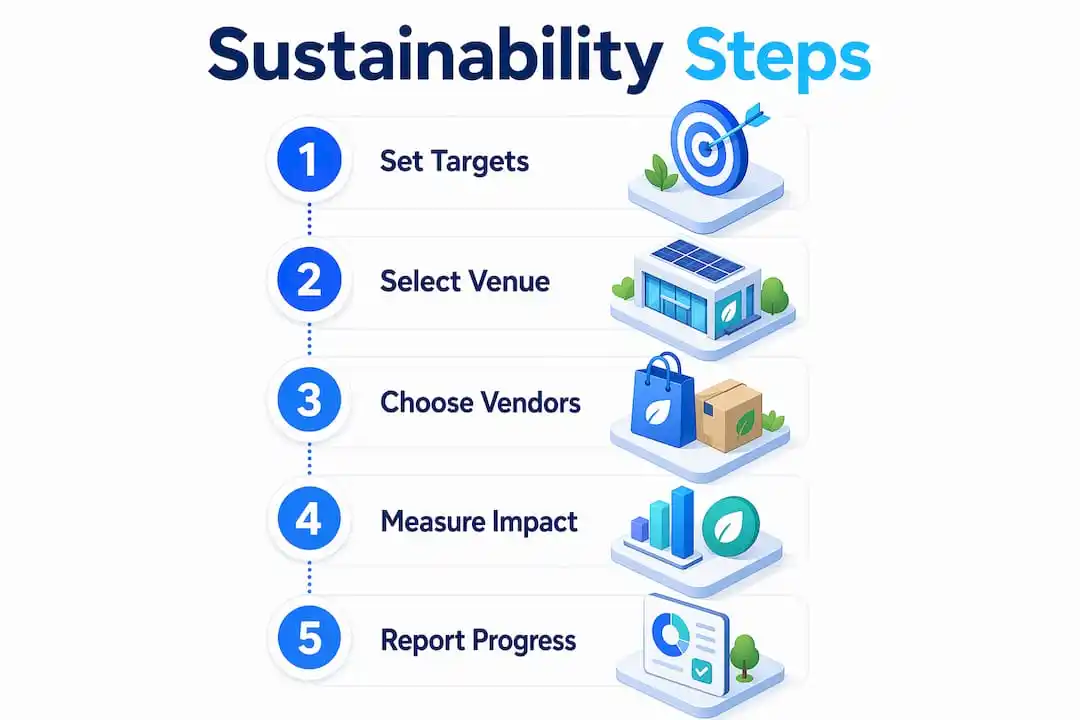
Follow these steps to build sustainability into your financial and communication planning:
- Create a dedicated sustainability budget line. Separate it from general operations so it cannot be absorbed by cost overruns elsewhere.
- Mandate supplier documentation early. Require sustainability credentials from all suppliers at the tender stage, not after contracts are signed.
- Communicate objectives to all stakeholders. Send a sustainability brief to exhibitors, sponsors, and attendees at least eight weeks before the event. Include specific guidelines on travel, materials, and waste.
- Include carbon offset costs in ticket pricing or sponsorship packages. Offset costs are predictable and modest. Building them in from the start avoids awkward conversations later.
- Publish a post-event sustainability report. Share verified metrics with sponsors within four weeks of the event. Transparency builds credibility and makes renewal conversations easier.
Pro Tip: Frame your sustainability report as a sponsor asset, not just an internal document. Sponsors can use verified event sustainability data in their own ESG disclosures. That utility increases your event’s value to them beyond the event itself.
How do you measure, report, and improve sustainable event practices over time?
Measurement is where most events fall short. Estimates and approximations do not satisfy ESG-driven sponsors who need granular, verified data broken down by emission source category. Accurate reporting requires capturing hard data on attendee travel, energy consumption, catering waste, and water use through digital tools integrated into your event management system.
The Net Zero Carbon Events initiative provides frameworks and AI-based tools to help organisers measure, reduce, and report carbon emissions across all event categories. Using a recognised framework means your methodology is defensible and comparable year on year.
“Operationalising sustainability with accurate data collection and integration into event management systems produces better outcomes than treating sustainability as a communications-only exercise.”
Avoid the three most common measurement pitfalls:
- Estimating travel emissions from delegate postcodes rather than capturing actual travel modes at registration.
- Aggregating waste data into a single figure rather than separating landfill, recycling, composting, and food waste streams.
- Omitting catering metrics such as food waste by weight and the carbon intensity of menu choices.
Digital platforms capturing real-time data across check-in, resource use, and attendee travel enable accurate carbon footprint measurement and credible reporting. After each event, publish a transparency report with your metrics, what worked, what did not, and your targets for next time. That continuous improvement cycle is what ISO 20121 mandates and what sponsors increasingly expect.
Pro Tip: Add a travel mode question to your registration form. A single dropdown asking delegates how they plan to travel gives you actual data rather than estimates, and it costs nothing to implement.
Key takeaways
Effective sustainable event management requires measurable goals, recognised standards, accurate data, and sustainability embedded in the budget from day one.
| Point | Details |
|---|---|
| Set specific targets | Use benchmarks such as 80% waste diversion and 25% per-attendee carbon reduction, not vague commitments. |
| Apply recognised standards | ISO 20121 and EIC Sustainable Event Standards give sponsors auditable frameworks to reference. |
| Embed sustainability in the budget | A dedicated line item prevents green initiatives from being cut when costs rise. |
| Capture hard data | Use digital tools to record actual travel, waste, and energy figures rather than estimates. |
| Publish post-event reports | Transparent, verified sustainability reports build sponsor trust and support event renewal. |
Why sustainability must be operational, not aspirational
The events I have seen fail at sustainability share one trait: they treated it as a communications exercise rather than an operational discipline. A beautifully written sustainability policy means nothing if the waste contractor has no composting facility and the catering team ordered 3,000 single-use plastic cups.
The shift I find most significant in 2026 is the sponsor pressure point. Corporate sponsors now arrive at contract negotiations with ESG checklists. They want verified waste diversion rates, carbon metrics broken down by source, and evidence of continuous improvement. “We aim to be sustainable” no longer passes that test. Events that cannot produce granular post-event data are losing renewal conversations.
What actually works is treating sustainability the same way you treat financial management: with a budget, a reporting cycle, and accountability. The event management and sustainability practices that deliver results are the ones built into the planning process from the first budget meeting, not added in the final six weeks.
The most promising development I see is the application of circular economy principles to event materials. Furniture hire, modular exhibition stands, and shared décor pools can maintain event quality while dramatically reducing waste. The UNDP’s work on circular MICE (Meetings, Incentives, Conferences, and Exhibitions) events shows this is not theoretical. It is operational and scalable for associations and nonprofits right now.
My honest advice: pick one standard, ISO 20121 or EIC, and commit to it fully for your next event. Partial compliance with both produces neither certification nor credibility.
— Rob
How Colossus supports your sustainability goals
Event planners managing sustainability commitments need more than good intentions. They need systems that capture data accurately, connect registration to reporting, and give sponsors the verified metrics they require.

Colossus’s event management software integrates registration, check-in, and attendee data into a single platform, giving you the real-time operational data that credible sustainability reporting depends on. You can capture travel mode at registration, track attendance patterns, and connect that data directly to your post-event sustainability report. Our platform features also support vendor management workflows, making it straightforward to document supplier sustainability credentials and maintain your audit trail. For associations and nonprofits with corporate sponsors demanding ESG compliance, Colossus gives you the operational backbone to meet that expectation with confidence.
FAQ
What is sustainable event management?
Sustainable event management is the practice of planning and executing events to minimise environmental harm, ensure social responsibility, and promote economic sustainability across the full event lifecycle, guided by frameworks such as ISO 20121.
What is ISO 20121 and why does it matter for event planners?
ISO 20121 is an international management system standard covering the full event lifecycle, from procurement to post-event reporting. Applying it has produced verified gains including a 9.4% reduction in electricity consumption in certified organisations.
How do I set measurable sustainability goals for my event?
Set specific targets such as diverting 80% of waste from landfill and reducing per-attendee carbon emissions by 25% year on year. Align those targets with your corporate sponsors’ ESG reporting frameworks for maximum relevance.
What data do I need to produce a credible sustainability report?
Capture actual figures for attendee travel modes, energy consumption, waste by stream (landfill, recycling, composting), and catering waste by weight. Avoid estimates; sponsors require granular, verified data broken down by emission source category.
How does a digital event management platform support sustainability?
Digital platforms capture real-time data across registration, check-in, and resource use, enabling accurate carbon footprint measurement. That operational data integration supports ESG compliance and continuous improvement year on year.