Student Ambassador Programmes: Driving Engagement

Nearly every North American campus today looks for new strategies to recruit and engage students, but not everyone realizes that british institutions, like the University of Westminster, set a global standard with their ambassador programmes. With up to 60 percent of successful outreach driven by peer-led initiatives, effective student ambassadors can transform institutional impact. This guide explores practical ways to design ambassador models that build trust, drive participation, and develop campus leaders.
Table of Contents
- Student Ambassador Programmes Defined
- Types And Models Of Ambassador Programmes
- Core Roles, Responsibilities And Skills
- Training, Support And Best Practices
- Risks, Safeguarding And Legal Compliance
- Common Mistakes And Effective Solutions
Key Takeaways
| Point | Details |
|---|---|
| Student Ambassador Programmes Enhance Engagement | These initiatives provide mutual benefits, offering students practical experience while organisations gain credible youth representation. |
| Diverse Roles Maximise Effectiveness | Integrating various ambassador roles, such as Marketing and Peer Support, creates a dynamic and effective programme structure. |
| Structured Training is Essential | Comprehensive training equips ambassadors with critical skills and ensures they effectively communicate institutional values. |
| Legal Compliance is Crucial | Implementing thorough background checks and safeguarding protocols protects both students and institutions, fostering a safe environment. |
Student ambassador programmes defined
Student ambassador programmes are strategic initiatives designed to leverage student networks and enthusiasm to represent and promote institutional objectives within academic environments. These programmes transform motivated students into dynamic brand representatives who bridge communication between organisations and their target audiences.
Typically, student ambassadors serve as voluntary representatives who engage peers through multiple channels. The United Nations Development Programme demonstrates a robust model where students actively advocate for sustainable development missions, connecting institutional goals with campus communities. Ambassadors often receive structured training to develop critical professional skills like public speaking, networking, and strategic communication.
The core responsibilities of student ambassadors generally include:
- Organising campus events
- Creating social media content
- Conducting peer-to-peer recruitment
- Representing institutional values
- Facilitating information sessions
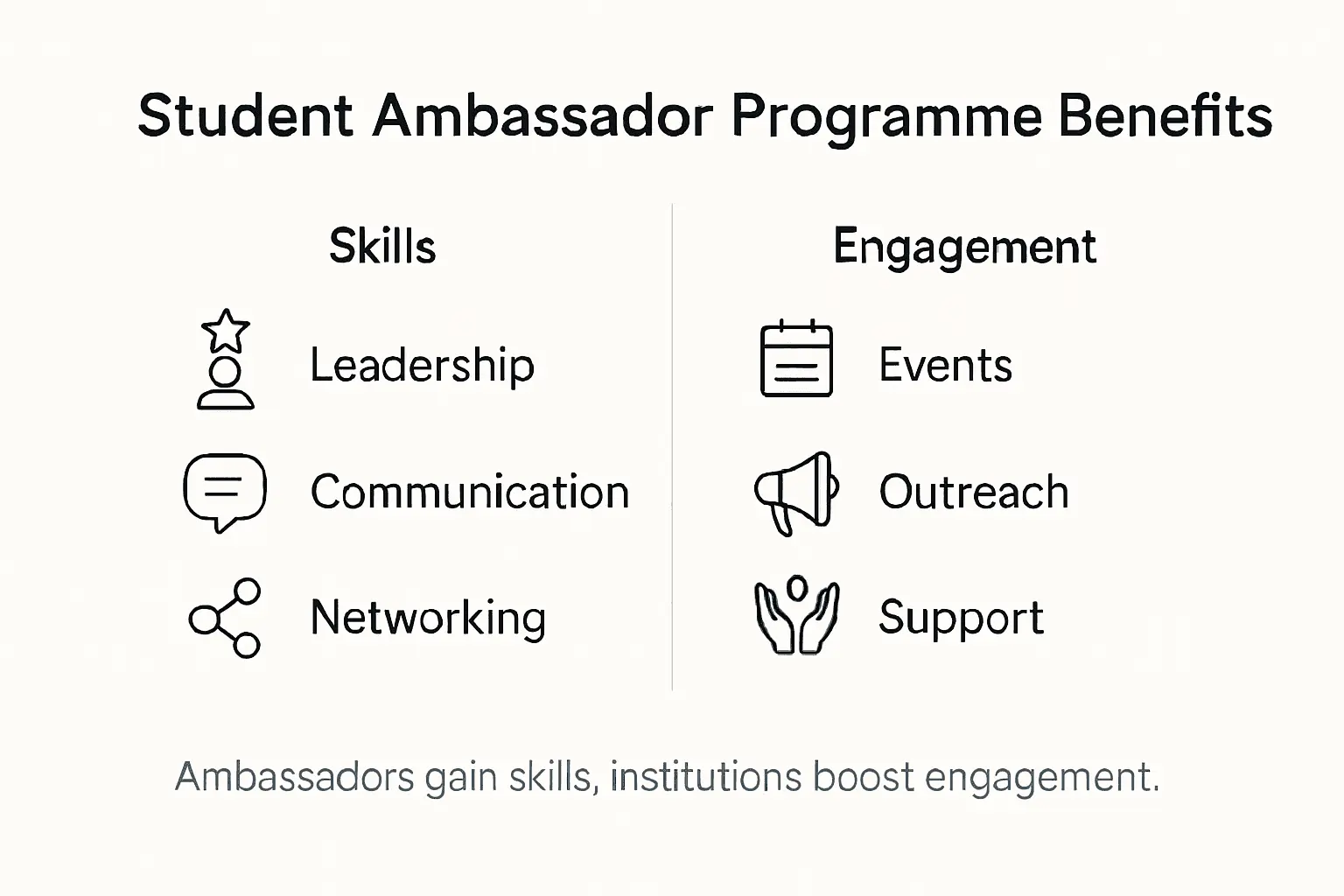
These programmes offer significant mutual benefits. Students gain practical experience, leadership skills, and potential career development opportunities, while organisations expand their reach and credibility through authentic, youth-driven engagement. Student ambassadors for EU Careers showcase how targeted representation can effectively communicate institutional opportunities.
Pro tip: Select student ambassadors who demonstrate natural communication skills, genuine institutional passion, and strong peer networks for maximum programme effectiveness.
Types and models of ambassador programmes
Ambassador programmes vary widely across educational institutions, reflecting diverse strategic approaches to student engagement and institutional representation. These models range from highly structured corporate-style initiatives to more flexible, student-driven platforms that adapt to specific institutional needs and objectives.
The University of Amsterdam illustrates a comprehensive ambassador model that encompasses multiple engagement channels. Their programme includes diverse roles such as:
- Virtual chat platform support
- Webinar facilitation
- Campus tour coordination
- Digital content creation
International university networks have developed particularly sophisticated ambassador models. EU-CONEXUS demonstrates a robust approach to student representation that emphasises cross-institutional collaboration, social media engagement, and strategic recruitment support. These programmes typically categorise ambassador roles into several key types:
- Marketing Ambassadors: Focus on promotional activities and institutional branding
- Recruitment Ambassadors: Specialise in prospective student outreach
- Digital Engagement Ambassadors: Manage online communication channels
- International Relations Ambassadors: Support cross-cultural communication
- Peer Support Ambassadors: Provide academic and social guidance
The most effective programmes integrate multiple role types, creating a dynamic ecosystem of student representation that serves institutional objectives while providing valuable professional development opportunities for participants.
Here’s a summary of major student ambassador roles and how each contributes to institutional aims:
| Ambassador Role | Strategic Purpose | Typical Impact on Institution |
|---|---|---|
| Marketing Ambassador | Enhance brand visibility | Boosts public perception |
| Recruitment Ambassador | Attract prospective students | Grows student community |
| Digital Engagement Ambassador | Manage online communication | Increases digital reach and engagement |
| International Relations Amb. | Support cross-cultural dialogue | Strengthens global network |
| Peer Support Ambassador | Provide academic/social guidance | Improves campus wellbeing |
Pro tip: Design ambassador programmes with clear role descriptions and flexible engagement options to attract diverse student talent and maintain high motivation levels.
Core roles, responsibilities and skills
Student ambassadors play a crucial role in bridging communication between educational institutions and their broader community. Effective ambassadors serve as authentic institutional representatives, sharing personal experiences through multiple engagement channels, including campus tours, social media platforms, and live events.
The core responsibilities of student ambassadors typically encompass a comprehensive range of strategic communication and outreach activities:
- Conducting campus tours for prospective students
- Creating engaging social media content
- Representing institutional values and culture
- Participating in recruitment events
- Providing peer-to-peer information and support
Successful ambassadors must develop a robust skill set that combines interpersonal communication, digital literacy, and strategic thinking. Key competencies include:
- Public Speaking: Delivering compelling presentations
- Digital Marketing: Creating and managing social media content
- Storytelling: Sharing authentic institutional narratives
- Leadership: Motivating and guiding peer groups
- Cross-cultural Communication: Engaging diverse student populations
Most institutions provide targeted training programmes to help ambassadors develop these critical skills, ensuring they can effectively represent the organisation’s mission and values while gaining valuable professional experience.

Pro tip: Select ambassador candidates who demonstrate natural communication skills, genuine institutional passion, and a proven ability to connect with diverse peer groups.
Training, support and best practices
Training programmes are the cornerstone of successful student ambassador initiatives, providing critical preparation and ongoing professional development. The United Nations Development Programme exemplifies comprehensive training approaches, offering structured workshops that equip ambassadors with essential knowledge about sustainable development, communication strategies, and career pathways.
Effective ambassador training typically encompasses several key elements:
- Initial comprehensive onboarding
- Targeted skills development workshops
- Ongoing mentorship programmes
- Regular performance feedback
- Access to institutional resources
Institutional guidelines, such as those from the University of Westminster, highlight the importance of structured training protocols. Best practices for ambassador training include:
- Comprehensive Induction: Detailed orientation covering institutional expectations
- Safety Training: Protocols for managing diverse engagement scenarios
- Communication Skills Development: Workshops on effective presentation and interaction
- Digital Literacy: Training in social media management and digital communication
- Continuous Learning: Regular opportunities for skill enhancement and reflection
Successful programmes recognise that training is an ongoing process, not a one-time event. They create supportive ecosystems that nurture ambassador potential, provide clear guidance, and offer multiple channels for professional growth and institutional contribution.
Review this quick reference of best practices for ambassador programme training and performance:
| Best Practice | Description | Benefit to Ambassadors |
|---|---|---|
| Comprehensive Induction | Structured onboarding for clear roles | Ensures confidence and readiness |
| Ongoing Mentorship | Regular guidance from experienced staff | Accelerates skill development |
| Performance Feedback | Constructive reviews and goal setting | Drives professional growth |
| Flexible Learning Paths | Customised training modules | Boosts engagement and motivation |
Pro tip: Design ambassador training programmes with flexibility, allowing personalised learning paths that align with individual strengths and institutional objectives.
Risks, safeguarding and legal compliance
Legal compliance is a critical foundation for student ambassador programmes, requiring meticulous attention to organisational and participant protection. The University of Westminster demonstrates comprehensive safeguarding protocols, emphasising crucial elements like Disclosure and Barring Service (DBS) checks and robust protection policies.
Key legal and safeguarding considerations include:
- Comprehensive background screening
- Clear conduct guidelines
- Confidentiality protocols
- Risk management strategies
- Vulnerability awareness training
Effective risk management strategies involve establishing clear operational boundaries, particularly when addressing sensitive topics. Critical compliance elements require institutions to:
- Implement Rigorous Screening: Conduct thorough background checks
- Develop Clear Communication Protocols: Establish boundaries for ambassador interactions
- Provide Comprehensive Training: Educate ambassadors on legal responsibilities
- Create Reporting Mechanisms: Design transparent incident reporting systems
- Maintain Ongoing Oversight: Regularly review and update safeguarding practices
Successful programmes integrate legal compliance as a fundamental design principle, recognising that proactive risk management protects both institutional reputation and student participants. This approach transforms potential vulnerabilities into opportunities for structured, responsible engagement.
Pro tip: Develop a comprehensive legal compliance checklist that ambassadors must review and acknowledge before commencing their roles.
Common mistakes and effective solutions
Student ambassador programmes often encounter significant challenges that can undermine their effectiveness and institutional impact. Higher education marketing research reveals that many programmes struggle with fundamental design and implementation issues, creating systemic barriers to successful engagement.
Common mistakes in student ambassador initiatives include:
- Undefined role expectations
- Insufficient initial and ongoing training
- Limited performance recognition
- Inadequate communication frameworks
- Minimal institutional support
Effective messaging control represents a critical challenge for many organisations, requiring strategic management approaches. Recommended solutions involve:
- Comprehensive Role Definition: Establish clear, detailed ambassador responsibilities
- Structured Training Programmes: Develop multilayered skill development pathways
- Consistent Communication Guidelines: Create flexible yet controlled messaging protocols
- Performance Recognition Systems: Implement meaningful reward mechanisms
- Regular Programme Evaluation: Conduct ongoing assessments and adaptations
Successful programmes balance institutional objectives with ambassador creativity, creating environments where student representatives can authentically represent organisational values while maintaining professional standards.
Pro tip: Implement quarterly review sessions with ambassadors to continuously refine programme strategies and address emerging challenges.
Elevate Your Student Ambassador Programme with Colossus Systems
Building a dynamic student ambassador programme demands clear role definitions, seamless communication, and engaging event management. If your institution struggles with training organisation, messaging control or tracking ambassador activities, Colossus Systems offers an all-in-one SaaS platform designed to streamline member management, event coordination and digital engagement. Our platform supports multiple ambassador roles — from recruitment to marketing — empowering your team to deliver authentic, strategic outreach while maintaining rigorous compliance and safeguarding protocols.

Transform your student ambassador initiatives with tools that enable virtual training, peer communication, targeted campaigns and secure payment processing. Start scaling your engagement effectively today by visiting Contact Us to explore tailored solutions. Discover how Colossus Systems helps you overcome common programme challenges and drives measurable growth with precision and ease.
Frequently Asked Questions
What are student ambassador programmes?
Student ambassador programmes are initiatives that empower students to represent and promote institutional objectives by engaging with their peers. Ambassadors typically organise events, create content, and facilitate communication between the institution and its target audiences.
What roles do student ambassadors typically have?
Student ambassadors can assume various roles including marketing, recruitment, digital engagement, international relations, and peer support. Each role contributes to strengthening institutional representation and enhancing student engagement.
How do training and support for student ambassadors work?
Training for student ambassadors usually includes comprehensive onboarding, skills development workshops, ongoing mentorship, and regular feedback sessions. This preparation is essential for ensuring they effectively represent the institution and gain valuable professional experience.
What are the main benefits of being a student ambassador?
Being a student ambassador offers numerous benefits, including the development of leadership skills, professional experience, networking opportunities, and the chance to contribute to their institution’s community and outreach efforts.