School event marketing tips that drive real results

TL;DR:
- Effective school event marketing requires early, consistent promotion, tailored messaging, and active community engagement. Organizing content across multiple platforms and leveraging ambassadors enhances reach, trust, and registration, while operational readiness ensures a positive attendee experience. Post-event follow-up builds relationships and drives continued participation, supported by integrated tools like Colossus for streamlined management.
Posting a flyer in the school corridor and sending one email to parents is not a marketing strategy. Yet that is how many school events are still promoted, and coordinators are left puzzled when attendance disappoints. Effective school event marketing tips go well beyond announcements. They involve structured timelines, the right digital channels, community advocates, and operational thinking that ties promotion directly to the attendee experience. Whether you are organising a PTA fundraiser, a sports day, or an open evening, this guide gives you the practical framework to fill seats and build momentum.
Table of Contents
- Key takeaways
- School event marketing tips: start with a clear foundation
- Building your phased marketing timeline
- Choosing the right digital platforms
- Activating community ambassadors
- Operations and marketing: the hidden connection
- My take on what actually works
- How Colossus supports your school event marketing
- FAQ
Key takeaways
| Point | Details |
|---|---|
| Start promotion six to eight weeks out | Beginning early is the single biggest factor in driving registrations and avoiding last-minute panic. |
| Define your event goal before promoting | Your “why” shapes your messaging, channels, and audience targeting from the very first post. |
| Use phased, platform-specific content | Different audiences live on different platforms; tailor your content format to each channel for best results. |
| Activate community ambassadors | Students, parents, and staff sharing personal posts reach audiences no official school page can access. |
| Treat registration as part of marketing | Friction at sign-up kills conversions; QR codes, simple links, and multiple payment options are non-negotiable. |
School event marketing tips: start with a clear foundation
Before you design a single graphic or schedule a single post, you need to answer one question: what is this event actually for? Defining a clear event goal before booking vendors or printing materials is critical, because it shapes every audience targeting and messaging decision that follows. A fundraising gala needs different language, different channels, and a different call to action than a science fair open to the whole community.
School events typically serve one of several distinct goals: driving attendance numbers, raising funds, building community engagement, or showcasing the school to prospective families. Each goal produces a different set of key performance indicators. For a fundraiser, you track donations and ticket sales. For an open evening, you track registrations from new families. Knowing which numbers matter helps you stop measuring the wrong things and start focusing your energy where it counts.
Your audience is also more fragmented than it might appear. Consider the four groups most school events need to reach:
- Parents and carers who respond well to email, WhatsApp groups, and Facebook community pages
- Students who are most reachable via Instagram, TikTok, and peer-to-peer word of mouth
- Staff and governors who need direct internal communications via staff briefings or intranets
- Wider community members including alumni, local businesses, and prospective families, who respond to LinkedIn, local press, and Google
Specialist school communications guidance from organisations like the NSPRA consistently reinforces that school event promotion requires tailored strategies distinct from generic consumer marketing. Generic approaches produce generic results. Segment your audience, match your message to their motivations, and your response rates will improve considerably.
Building your phased marketing timeline
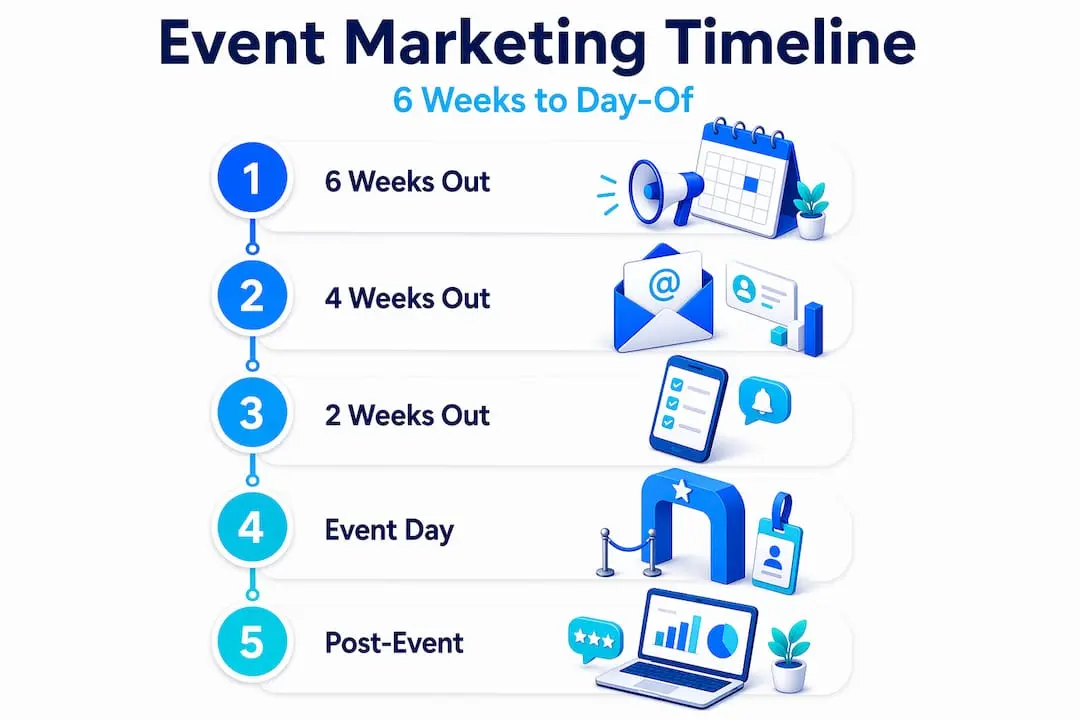
The most common and costly error in school event marketing is starting promotion too late, with the highest conversion rates coming from a minimum six-week promotion window. A phased timeline takes the guesswork out of what to do and when.
Here is a framework you can adapt for most school events:
- Six to eight weeks before: Announce the event date and lock in your core details. Create the registration link, set up your unique event hashtag, and publish the event on your school website and Facebook page. Send the first email to your list with a save-the-date.
- Four to five weeks before: Publish full event details across all channels. Share visuals, speaker or performer previews, and any early-bird ticket offers. Ask staff and parent ambassadors to start sharing on their personal accounts.
- Two to three weeks before: Ramp up content frequency. Post testimonials or highlights from past events. Use countdown stickers on Instagram Stories and send a second email reminder to those who have not yet registered.
- One week before: Increase social media posting to once or twice daily. Share behind-the-scenes content, practical logistics like parking and timings, and a clear, urgent call to action. Send a final email reminder.
- Day of the event: Post real-time updates, live stories, and photos. Remind followers where to find you and what to expect.
- Within 48 hours after: Send a thank-you email, share photo highlights, and include a short attendee survey. Add new contacts to your CRM for future event communications.
A phased marketing approach also includes day-of live stories and a post-event recap with follow-up emails, turning a single event into a continuous engagement cycle rather than a one-off push.
Pro Tip: Prepare your registration link and QR code at the six-week mark, not the week before. Embedding them in every piece of content from day one removes friction and gives late deciders an instant path to sign up.
Choosing the right digital platforms
Not every platform deserves equal effort. Different social platforms suit different purposes: Instagram works for visual storytelling, TikTok drives engagement with short-form video, LinkedIn reaches alumni and local businesses, and YouTube supports virtual school tours or event previews. Spreading yourself across all of them equally is a fast path to burnout with mediocre results everywhere.
Here is how to make each platform work specifically for school events:
- Facebook: Create a dedicated event page and post in local community groups. Facebook Events allow you to send automatic reminders to people who have clicked “interested,” which costs nothing and keeps your event visible.
- Instagram: Use Reels to show behind-the-scenes preparation, countdown Stories with sticker links to your registration page, and carousels to outline event highlights or schedules.
- TikTok: Short videos from student volunteers or staff showing event setup, rehearsals, or a “reasons you should come” format perform well with student audiences.
- LinkedIn: Useful for alumni outreach, business sponsorship requests, and promoting professional development events connected to the school.
- WhatsApp and school apps: Do not underestimate direct messaging. Parent groups on WhatsApp and dedicated school communication apps often outperform social media for parent attendance conversion.
Effective event promotion blends owned channels like email and social media with partner and speaker co-promotion before investing in paid advertising. Paid reach has its place, particularly in the final week, but your owned channels and advocate networks should always be activated first.
Pro Tip: Your most powerful social media accounts are not the official school page. They are the personal accounts of your most enthusiastic parents, teachers, and students. Give them ready-made share copy and graphics so posting takes them thirty seconds.
Activating community ambassadors
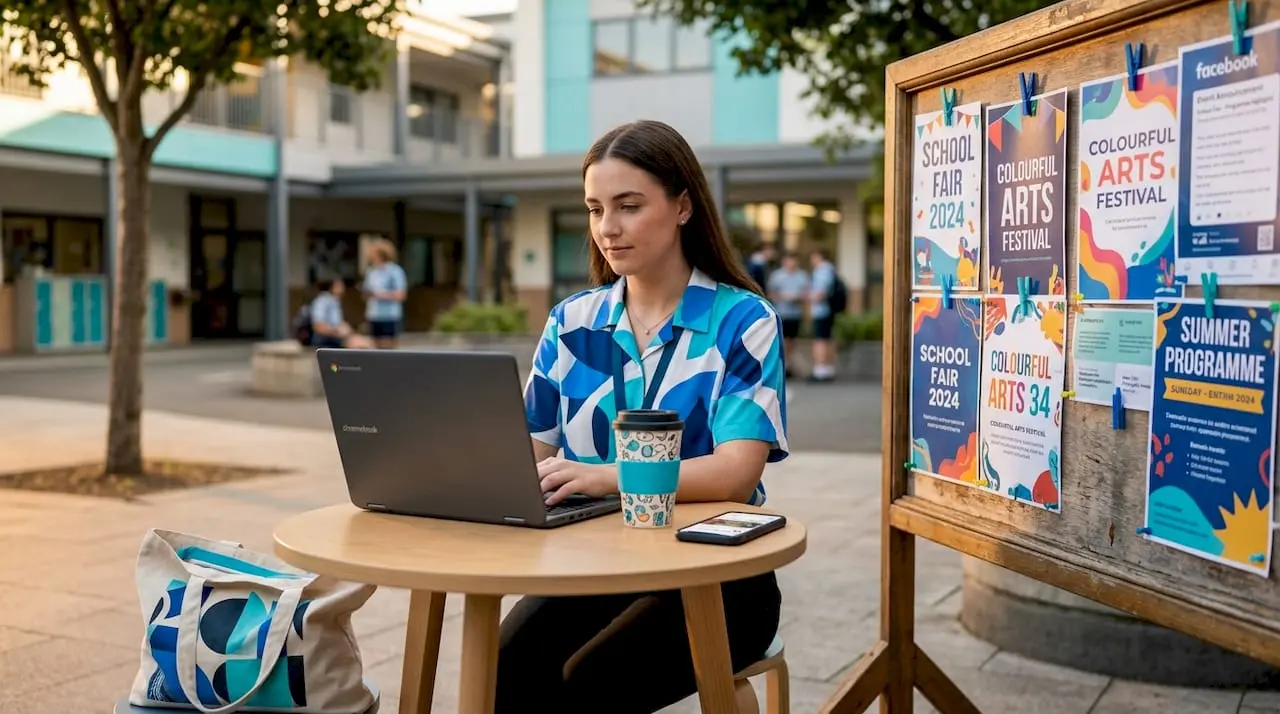
Your school community is your most under-used marketing asset. Training student and parent ambassadors and creating shareable, visually appealing moments dramatically increases both reach and the quality of the attendee experience. A parent posting “So excited for Saturday’s fundraiser, see you there!” reaches their network of 300 local contacts in a way no school newsletter can replicate.
Here is how to build an effective ambassador programme for your events:
- Identify natural advocates early. Look for parents who already share school news, students involved in the event programme, and staff members with engaged personal followings.
- Give them a brief. Ambassadors should know the event date, key messages, your hashtag, and what you want them to share. Keep it to one page.
- Create content they can actually use. Provide branded graphics, a short caption template, and a direct registration link. Remove every barrier between willingness and action.
- Build in photo opportunities. Curated Instagrammable moments at the event itself, such as a branded photo wall, a prize display, or a decorated entrance, encourage attendees to post during and after the event, generating organic reach at no extra cost.
- Follow up within 48 hours. Thank your ambassadors personally, share the best attendee content, and survey participants. This closes the loop and builds goodwill for your next event.
A unique event hashtag ties all of this together. Short, easy-to-remember hashtags improve content aggregation and act as a living photo archive for your school community. Use it consistently across every channel from day one, and ask everyone involved to use it too.
Operations and marketing: the hidden connection
Here is what many school event planning guides miss entirely: your marketing makes a promise, and your event operations either keep or break it. If you promote a slick, well-run evening and attendees arrive to find a queue snaking around the building, no signage, and a sound system that was not tested, you have damaged trust that takes multiple future events to rebuild.
Operational details like equipment checks and signage preparation the day before an event are critical for smooth execution. Arriving 60 to 90 minutes early for setup and beginning concessions or welcome activities 30 minutes before the official start prevents the bottlenecks that sour first impressions.
The operational elements that most directly affect your marketing outcomes include:
- Registration and payment flow. Integrating registration links, QR codes, and multiple payment options into your marketing from the start reduces drop-off at the conversion point. Test every link before you publish it.
- Signage and wayfinding. Attendees who cannot find the entrance or car park will not return next year. Clear, professional signage is an extension of your brand promise.
- Volunteer briefing. Volunteers who know their roles, timings, and where to direct questions are your on-the-ground ambassadors. A poorly briefed volunteer team creates confusion that no amount of good digital marketing can offset.
- Post-event data capture. Every name and email collected at registration is a future marketing asset. Make capturing this data part of your operational process from the outset.
“The gap between a well-marketed event and a well-run event is where community trust is won or lost. Brilliant promotion brings people once. A brilliant experience brings them back.”
My take on what actually works
I have spent years watching school events succeed or quietly disappoint, and the pattern is almost always the same. The events that fill up are not necessarily the most exciting ones. They are the ones that were promoted early, promoted consistently, and felt personal rather than institutional.
The single change that makes the biggest difference in my experience is starting six weeks out and not stopping. Most coordinators do a burst of activity in the first week and then go quiet until three days before. By then, the audience has mentally moved on. Consistent, low-effort touchpoints, such as a quick Instagram Story, a brief email update, or a parent ambassador post, keep the event present in people’s minds without requiring enormous effort each week.
I also believe that owned channels and community advocacy deliver better return than any paid campaign for a school event context. Parents trust other parents. Students trust their friends. A short video from a student who went last year beats a polished school graphic every time. Authenticity is your strongest asset and it costs nothing.
The other thing I would push back on is treating post-event work as optional. Following up within 48 hours, thanking attendees, sharing photos, and sending a quick survey is not just good manners. It builds the audience for your next event. Every person who had a good experience is a potential ambassador, and the follow-up is where that relationship either grows or fades.
— Rob
How Colossus supports your school event marketing
Managing the moving parts of school event promotion across email, registration, social scheduling, and attendee follow-up is genuinely complex. Colossus is built for exactly this kind of challenge.
Our event management software brings registration, communication, and attendee management into one place, so you spend less time switching between tools and more time building the community engagement that fills events. From custom registration pages with integrated payment options to automated email reminders and post-event surveys, every step of the promotion cycle is covered. Our CRM tools mean every attendee contact is captured and ready to use for your next event, turning one-off attendees into a loyal, engaged community. If you are ready to take your school event marketing further, explore what Colossus can do for your organisation.
FAQ
How early should you start promoting a school event?
Start promoting at least six to eight weeks before the event date. This window gives you time to build awareness, drive registrations, and send multiple reminders without relying on last-minute urgency alone.
What are the most effective channels for school event promotion?
Email and Facebook remain the strongest channels for reaching parents, while Instagram and TikTok work best for students. WhatsApp parent groups often convert better than social media for direct attendance confirmation.
How do you use ambassadors to promote school events?
Recruit engaged parents, students, and staff early, provide them with ready-made graphics and captions, and ask them to share across their personal accounts. Personal posts consistently outperform official school channels for organic reach.
What should you do after a school event to support future marketing?
Send a thank-you email within 48 hours, share photo highlights, and include a short attendee survey. Capturing this feedback and adding contacts to a CRM builds the audience and credibility for your next event.
Why does registration matter for school event marketing?
A complicated or broken registration process is where conversions are lost, regardless of how strong your promotion is. Simple links, QR codes, and multiple payment options must be tested and embedded into all marketing content from the start.