Multi-channel engagement tactics for membership marketers

TL;DR:
- Effective member engagement requires coordinated multi-channel strategies that build on each other rather than simply increasing communication volume.
- Using targeted data, defined audiences, and appropriate timing across channels enhances retention and ROI in membership organizations.
Most membership organisations assume that adding more communication channels automatically improves member engagement. It does not. Without coordinated multi-channel engagement tactics, you end up sending the same renewal reminder via email, SMS, and push notification on the same day, irritating members rather than retaining them. The real discipline lies in knowing which channel to use, when to use it, and how each touchpoint builds on the last. This article gives you the frameworks, channel strategies, and measurement approaches to make multi-channel marketing genuinely work for your membership organisation.
Table of Contents
- Key takeaways
- Multi-channel vs cross-channel vs omnichannel engagement
- The D3 framework for audience-led channel selection
- Channel strengths, timing, and coordination
- Measuring and optimising multi-channel performance
- Automating member journeys with coordinated campaigns
- What I’ve observed in membership marketing practice
- How Colossus supports your multi-channel engagement strategy
- FAQ
Key takeaways
| Point | Details |
|---|---|
| Coordination beats volume | Using more channels without strategic coordination creates noise, not engagement. |
| The D3 framework guides targeting | Decode data, define your audience, and determine channels before launching any campaign. |
| Channel timing is critical | Sending the right message at the wrong time via the wrong channel is as harmful as no message at all. |
| Multi-touch attribution reveals true ROI | Last-click models hide the contribution of mid-funnel channels that drive renewal and retention decisions. |
| Automation reduces churn | Scheduled, trigger-based multi-channel sequences for renewals and onboarding consistently outperform manual outreach. |
Multi-channel vs cross-channel vs omnichannel engagement
Before building your strategy, you need clarity on what these three terms actually mean. They are frequently used interchangeably, but they describe meaningfully different approaches, and confusing them leads to wasted budget and unfocused campaigns.
Multi-channel engagement means communicating with members across several independent channels: email, SMS, social media, and push notifications, for instance. Each channel tends to operate in isolation, with its own messaging, timing, and metrics. There is no deliberate coordination between them. Many membership organisations start here.
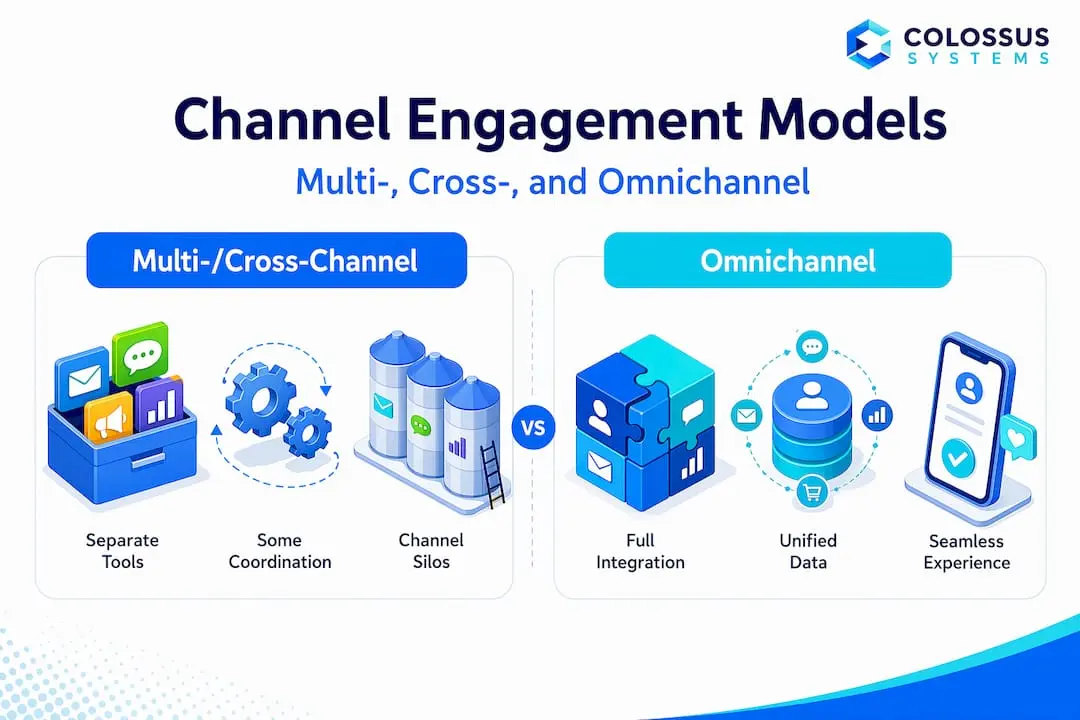
Cross-channel marketing strategies go further. The channels are coordinated so that messaging is consistent and each touchpoint is aware of what the member has already received. If a member opened your renewal email but did not click, a follow-up SMS a few days later makes sense. 75% of consumers think about a purchase or decision multiple times per week, which means your members are encountering multiple digital signals constantly. Cross-channel strategies take advantage of that by presenting a coherent experience across touchpoints.
Omni-channel customer engagement takes integration to its fullest expression. Rather than simply coordinating messages, it unifies the entire member journey so that channels form a single coherent experience regardless of where the member interacts. The member portal, event communications, renewal sequences, and community interactions all feed into one central picture of the member.
For most membership organisations, the practical priority is moving from multi-channel to cross-channel. Here is how those approaches compare:
| Approach | Channel coordination | Data integration | Best for |
|---|---|---|---|
| Multi-channel | None | Siloed | Starting out, limited resource |
| Cross-channel | Coordinated messaging | Partial integration | Growth-stage organisations |
| Omnichannel | Fully unified journey | Full integration | Mature, data-rich organisations |
The D3 framework for audience-led channel selection
Adobe’s framework for multi-channel lifecycle engagement offers a practical starting point for membership marketers who want to move beyond ad hoc channel decisions. The three steps are Decode Data, Define Audience, and Determine Channels.
-
Decode data. Start by analysing your member behavioural data: which emails are opened, which events are attended, which members have not logged into your portal in 90 days. These signals tell you far more about intent than demographic profiles alone. In a membership context, behavioural data includes renewal history, content downloads, and event participation patterns.
-
Define your audience. Not all members are at the same point in their lifecycle. A first-year member needs onboarding content. A five-year member approaching renewal needs a different conversation entirely. Customers do not follow linear journeys, and your segmentation should reflect that. Group members by engagement level, tenure, and renewal risk rather than treating them as a single list.
-
Determine channels. Only once you know who you are targeting and what behaviour you want to influence should you decide which channels to use. Channel choice should be based on members’ actual behaviour and device contexts, not on what is easiest to send. If your data shows that 70% of a particular segment ignores emails but responds to push notifications, that is your channel decision made.
The results of applying this framework are significant. Organisations that extended beyond email to include additional channels saw a 123% increase in conversions over eight months, alongside a 420% increase in sessions.
Pro Tip: Before adding a new channel to your stack, run a 30-day pilot with a single audience segment. Measure both engagement rate and unsubscribe rate. A channel that lifts clicks but spikes opt-outs is creating long-term damage to your list quality.
Channel strengths, timing, and coordination
Each channel in your toolkit has a specific role. Using every channel for every message is one of the most common mistakes in multi-channel marketing, and it leads to the channel cannibalisation and message conflict that erodes member trust over time.
Here is how to think about the primary channels in a membership context:
- Email works well for detailed, low-urgency communications: event announcements, newsletters, benefit summaries, and renewal notices sent several weeks in advance. Members expect to find this content in their inbox and can engage with it at their convenience.
- SMS and WhatsApp are high-visibility, high-urgency channels. Open rates for SMS consistently exceed 90%, making them well-suited for expiry reminders, last-chance event registrations, and time-sensitive announcements. Do not use them for content that can wait a week.
- Push notifications perform best for members who actively use your app or portal. They are context-sensitive: sending a push notification to a member who has not opened your app in six months will not achieve much.
- In-app messages are reserved for members who are actively engaged. Use them to surface relevant actions during a session, such as prompting an event registration while a member is already browsing your events catalogue.
- Social media builds community and awareness but should not carry transactional messaging. It works at the top of your engagement funnel, not at the renewal stage.
Timing and sequencing matter as much as channel choice. Real-time and streaming data allow you to trigger messages based on member behaviour rather than fixed calendar dates. A member who viewed the renewal page twice this week without completing the process is telling you something. A triggered SMS at that point is far more effective than a batch renewal email sent to your entire list on the 1st of the month.
Pro Tip: Map out your member journey as a series of decision points rather than a timeline. At each decision point, ask: which channel is the member most likely to see right now, and what single action do you want them to take? That question prevents you from loading a single touchpoint with too many competing messages.
Measuring and optimising multi-channel performance
Measurement is where most membership marketers lose the thread. When you run campaigns across multiple channels simultaneously, last-click attribution gives credit to whichever channel happened to be the final one before conversion. That tells you almost nothing useful about what actually drove the decision.

The average B2B buying journey involves over ten touchpoints, and membership renewal decisions are rarely different. A member might receive a renewal email, see a social post about member benefits, receive a WhatsApp reminder, and then click through to renew. Last-click attribution credits WhatsApp. Multi-touch attribution shows you the full picture.
A practical starting point when full data integration is not yet in place is a 2/2 model: allocate 50% of credit to the last-click channel and 50% to all assisted channels. This produces a more honest picture of which channels are warming members up before conversion. It also prevents the common mistake of cutting mid-funnel channels because they appear not to be converting, when in fact they are doing the essential work of keeping members engaged.
| Attribution model | How credit is assigned | Best use case |
|---|---|---|
| Last-click | 100% to final channel | Simple, single-channel campaigns |
| First-click | 100% to first touchpoint | Awareness-focused campaigns |
| Linear | Equal split across all touchpoints | Long membership lifecycle campaigns |
| 2/2 model | 50% last-click, 50% assisted | Practical hybrid when data is limited |
Pro Tip: Track proxy metrics alongside conversion rates. If you cannot yet measure the full member journey, monitor assisted conversions, time-to-renew, and session frequency per channel. These signals will tell you which channels are influencing decisions even when the final click lands elsewhere.
Automating member journeys with coordinated campaigns
The practical application of everything above is automation. Once you have defined your audience segments, mapped your channel preferences, and established your sequencing logic, the campaigns themselves should run with minimal manual intervention. This is where automating member renewals becomes a genuine retention tool rather than an administrative task.
A renewal sequence for a membership organisation might look like this:
- Six months before expiry: Email summarising the member’s activity and benefits used over the past year. This is a value reminder, not a sales message.
- Three months before expiry: Email with renewal call to action, supported by a targeted social media retargeting campaign for members who did not open the email.
- One month before expiry: SMS or WhatsApp message with a direct renewal link, triggered only for members who have not yet renewed.
- Day of expiry: Push notification (for active app users) or a final email with an easy one-click renewal option.
- Day after expiry: A non-email channel message, such as WhatsApp, for members who still have not acted. Non-email channels consistently outperform email in these high-urgency, time-sensitive situations.
The logic for each step should be driven by CRM data: if a member renews at any point in the sequence, the remaining steps should stop immediately. Sending a “don’t forget to renew” message to a member who renewed yesterday is the kind of error that damages the member relationship more than it helps. Integration between your CRM, email platform, and communication tools is what prevents these failures. Organisations using engagement software built for memberships find that centralising member data is the single most important step towards making multi-channel automation work reliably.
What I’ve observed in membership marketing practice
I’ve worked with enough membership organisations to recognise a recurring pattern. The ones that struggle with engagement are almost always suffering from channel sprawl without coordination. They have an email platform, a separate SMS tool, a social media scheduler, and a CRM that does not talk to any of them. Each team member manages a different channel, and nobody has a complete picture of what a member has received in the past 30 days.
The shift that transforms results is not adding more channels. It is reducing the number of channels to those that your members actually use, and then coordinating those channels so that every message builds on the last. I’ve seen organisations cut their active channel count from six to three and watch renewal rates climb because the remaining three channels were used with precision and good timing.
The other thing I’d emphasise is that personalisation does not require sophisticated technology to start. Even basic segmentation by tenure and renewal date, combined with a disciplined sequencing approach, produces measurably better outcomes than a single-list broadcast strategy. You do not need to solve omnichannel on day one. You need to make your current channels work together coherently, and then build from there.
— Rob
How Colossus supports your multi-channel engagement strategy
Putting these tactics into practice requires tools that work together, not separate platforms competing for data.
Colossus brings together the capabilities membership organisations need to execute coordinated, data-driven engagement in one place. Our membership management platform supports automated workflows, CRM-driven segmentation, and multi-channel communication sequencing so your renewal campaigns, onboarding journeys, and event communications all operate from a single source of member data. Our event management software integrates directly with member communication tools, so event reminders, follow-ups, and registration confirmations become part of your wider engagement strategy rather than isolated messages. And our CRM tools give you the behavioural data and segmentation capabilities to make channel decisions based on actual member activity. If you are ready to move beyond broadcast emails and build genuine multi-channel member journeys, Colossus is built to support exactly that.
FAQ
What are multi-channel engagement tactics for membership organisations?
Multi-channel engagement tactics are coordinated communication strategies that use several channels, such as email, SMS, push notifications, and social media, to interact with members at relevant points in their lifecycle. The goal is not simply to use multiple channels, but to use them in a sequenced, data-informed way that reinforces each touchpoint.
How is cross-channel different from multi-channel marketing?
Multi-channel marketing uses several channels independently, whilst cross-channel marketing strategies coordinate those channels so messaging is consistent and each touchpoint is informed by what the member has already seen or done. Cross-channel approaches produce better engagement because they treat the member journey as a connected experience rather than a series of isolated messages.
Which channels work best for membership renewal campaigns?
Email works well for early-stage renewal reminders sent weeks in advance, whilst SMS and WhatsApp are more effective for urgent, last-chance messages close to or after the expiry date. Targeted multi-channel renewal sequences timed at six months, three months, one month, and expiry day consistently improve retention rates.
How should membership marketers measure multi-channel campaign success?
Avoid relying solely on last-click attribution, which undervalues the channels that build engagement before conversion. A multi-touch model, or at minimum a 2/2 split between last-click and assisted conversions, gives a more accurate view of channel synergy across touchpoints and prevents you from cutting channels that are doing essential mid-funnel work.
How do I improve channel engagement without overwhelming members?
Start by auditing how many messages a member receives across all channels in a given month. Reduce channel overlap, establish clear rules about which channel carries which type of message, and use CRM data to suppress messages for members who have already taken the desired action. Quality and relevance always outperform frequency.