Importance of Extracurricular Activities for Member Engagement

Membership managers often face questions about which activities truly inspire deeper connections and long-term commitment across diverse global groups. The challenge lies in defining exactly what counts as an extracurricular activity when offerings stretch far beyond standard responsibilities. Clarifying this concept helps distinguish between routine obligations and voluntary enrichment experiences that spark engagement, skill development, and community spirit. This overview sheds light on how a precise definition can shape your member engagement strategy for retention and growth.
Table of Contents
- Defining Extracurricular Activities For Membership Organisations
- Types Of Extracurricular Activities And Formats
- How Activities Foster Member Retention And Growth
- Skill Development And Broader Member Benefits
- Challenges And Best Practices For Activity Success
Key Takeaways
| Point | Details |
|---|---|
| Extracurricular Activities | These activities are crucial for transforming members into engaged community contributors, enhancing personal development and professional networking. |
| Flexibility and Variety | Tailoring activities to diverse member interests and learning styles is essential for improving engagement and participation. |
| Retention through Engagement | Active participation fosters a sense of belonging, leading to higher retention rates and advocacy for the organisation. |
| Overcoming Barriers | Address challenges like socioeconomic disparities and geographic limitations by offering diverse formats and inclusive options for all members. |
Defining extracurricular activities for membership organisations
Extracurricular activities for membership organisations refer to structured events, programmes, and initiatives that members participate in beyond their core professional or standard obligations. Unlike formal membership responsibilities, these activities exist to foster personal development, build stronger interpersonal connections, and create a vibrant community around your organisation. The terminology itself has caused some confusion across the membership sector. Academic research notes that extracurricular activities lack universal definitions but are generally understood as voluntary pursuits outside formal structures that develop skills relevant to career success and personal growth.
For your membership organisation specifically, think of extracurricular activities as the experiences that transform members from passive participants into engaged community members. These might include professional networking events, skill-building workshops, mentorship circles, social gatherings, volunteer opportunities, or special interest groups. The key distinction is that members choose to participate based on interest rather than obligation. These activities complement formal membership roles by providing enrichment opportunities and creating meaningful touchpoints beyond transactional interactions. Research shows that extracurricular activities promote holistic development, social interaction, and skill-building, whilst simultaneously strengthening the sense of community within your organisation.
What makes extracurricular activities particularly valuable for membership organisations is their flexibility. Unlike fixed membership dues or mandatory training, these programmes can be tailored to different interests, learning styles, and schedules. A property management association might offer advanced negotiation workshops alongside social events for newer members. A healthcare professional body could facilitate mentorship between experienced practitioners and early-career members. The activities you choose should reflect your members’ genuine needs whilst reinforcing your organisation’s mission and values.
Understanding this definition is crucial because it shapes how you design, promote, and measure these programmes. When your team recognises extracurricular activities as distinct from core membership services, you create intentional space for deeper engagement. This clarity also helps you communicate the value proposition to prospective members and allocate resources more effectively.
Professional tip Map your existing member interactions to identify which are formal obligations and which are optional enrichment opportunities, then deliberately expand the extracurricular activities where engagement gaps exist.
Types of extracurricular activities and formats
Membership organisations typically offer a diverse range of extracurricular activities, each serving different member interests and engagement styles. The breadth of options available matters because members have varying preferences, time commitments, and learning styles. Common types include professional development workshops, networking events, volunteer initiatives, sports or wellness groups, arts and creative pursuits, academic or technical clubs, and social gatherings. Some organisations also facilitate mentorship programmes, peer learning circles, and special interest groups centred on specific topics or industries. This variety ensures that whether a member prefers competitive environments, collaborative projects, or independent skill-building, there’s something that resonates with them.
Formats for these activities vary considerably depending on your organisation’s resources and member preferences. Extracurricular activities range from regular weekly meetings to seasonal competitions and intensive workshops, allowing flexibility in how engagement happens. Some formats work best for building ongoing community, whilst others create short, high-impact experiences. Consider the practical differences: a weekly professional development group builds consistent relationships and accountability, whilst a quarterly conference-style event creates a concentrated moment for networking and learning. Casual social activities might happen monthly or on-demand, whereas formal competitions or certifications might occur annually. The key is matching the format to the activity’s purpose and your members’ capacity to participate.
Geographic and resource considerations shape what your organisation can realistically offer. Research shows that activity diversity and availability are influenced by socioeconomic factors and geographic location, which affects participation rates globally. A large metropolitan association might sustain in-person monthly events, whilst a geographically dispersed membership may rely more heavily on virtual workshops and online communities. Some organisations blend formats, combining in-person annual conferences with hybrid workshops and asynchronous online learning modules. This hybrid approach maximises accessibility without stretching your team’s capacity.
When designing your activity portfolio, think about creating a mix. Offer some activities that build ongoing relationships through regular participation, others that provide quick value for busy members, and some that are explicitly competitive or milestone-based. This variety keeps your engagement calendar fresh and ensures you’re reaching members at different life and career stages.
The following table summarises how common extracurricular activity formats suit different member needs:
| Format Type | Ideal For | Typical Frequency |
|---|---|---|
| Workshops | Skill acquisition seekers | Monthly or quarterly |
| Networking Events | Relationship builders | Quarterly or annually |
| Online Communities | Geographically dispersed | Ongoing/asynchronous |
| Mentorship Circles | Career development focus | Bi-monthly or ongoing |
| Social Gatherings | Informal social connection | Monthly or as arranged |
Professional tip Audit your current activity offerings against member demographics and feedback to identify gaps, then prioritise adding formats that address underserved segments rather than replicating what already exists.
How activities foster member retention and growth
When members participate in extracurricular activities, something shifts in their relationship with your organisation. They move from passive consumers of services to active contributors in a living community. This transformation directly impacts retention because engagement through activities fosters a sense of belonging and builds soft skills like teamwork and leadership. Members who attend a workshop, join a special interest group, or volunteer for an initiative develop genuine connections with other members. Those connections create accountability and mutual support that extends far beyond a single event. A member who attends only annual conferences might renew out of habit. A member who participates in monthly workshops, quarterly networking dinners, and serves on a committee has woven themselves into the organisational fabric. They’re far more likely to renew, upgrade their membership tier, and recruit others.

The growth dimension operates through a similar mechanism, though with a different emphasis. Active members become organisational advocates and leaders. When someone develops confidence through public speaking at a workshop or builds a professional network through structured mentoring, they experience tangible value from membership. These positive personal experiences translate into word-of-mouth recommendations that attract new members. Furthermore, members who actively participate in extracurricular activities tend to exhibit greater loyalty and contribute to organisational growth by becoming leaders and advocates. Your most engaged members often become committee volunteers, event speakers, and informal ambassadors. This creates a virtuous cycle where growth attracts more engaged members, who then drive further growth.
The retention and growth equation also works through skill development and confidence-building. Members gain capabilities they couldn’t access elsewhere, whether that’s advanced technical training, leadership coaching, or professional networking. These skills enhance their career prospects, making membership feel essential rather than optional. A finance professional who gains expertise in emerging compliance standards through your workshops becomes more valuable in their field. They’re unlikely to drop membership because they’ve integrated your offerings into their professional development strategy. Growth follows naturally because they recommend membership to colleagues facing similar development needs.
However, access matters critically here. If your activities are only available to members in major cities or during business hours, you’ll retain and grow only a subset of your base. Organisations that intentionally design inclusive activities, including virtual formats and flexible scheduling, capture higher engagement and broader growth.
Professional tip Track which activity types show highest attendance-to-retention correlation for your membership segments, then invest deeper in those formats whilst iterating on lower-performing ones.
Skill development and broader member benefits
The most tangible benefit of extracurricular activities lies in the skills members develop. Unlike formal training programmes that focus narrowly on job-specific competencies, these activities build a broader toolkit. Extracurricular activities develop communication, leadership, problem-solving, and teamwork skills that apply across professional and personal contexts. A member attending a debate club develops persuasion and critical thinking. Someone volunteering on an event committee learns project management and coordination. A participant in a peer mentoring circle builds coaching abilities and emotional intelligence. These aren’t abstract gains either. Members can immediately apply what they learn in their day jobs, making membership feel directly relevant to career progression.
Beyond the obvious skill acquisition, research shows that participation in extracurricular activities supports development of competencies such as interpersonal skills, leadership, and time management, with benefits extending to improved social networks and enhanced motivation. This matters because your members aren’t just seeking credentials or certificates. They’re seeking transformation. A member who joins your organisation purely to access technical content might leave when they find similar content elsewhere. A member who develops meaningful relationships, gains confidence through active participation, and builds capabilities they can’t access alone becomes genuinely invested. The social dimension amplifies the skill development. Learning leadership theory in isolation feels abstract. Learning leadership by actually leading a committee, receiving feedback from peers, and seeing impact creates internalized capability.
The broader member benefits extend even further. When members feel more capable and connected, they experience enhanced wellbeing and social inclusion. This creates a ripple effect through their professional communities. A member who gains confidence through your workshops becomes more visible in their field, potentially advancing their career. Their success reflects positively on your organisation. They become ambassadors not out of obligation but because membership genuinely improved their life. They recommend joining to colleagues, speak about their experience at industry events, and remain loyal even if they could technically access similar content elsewhere.
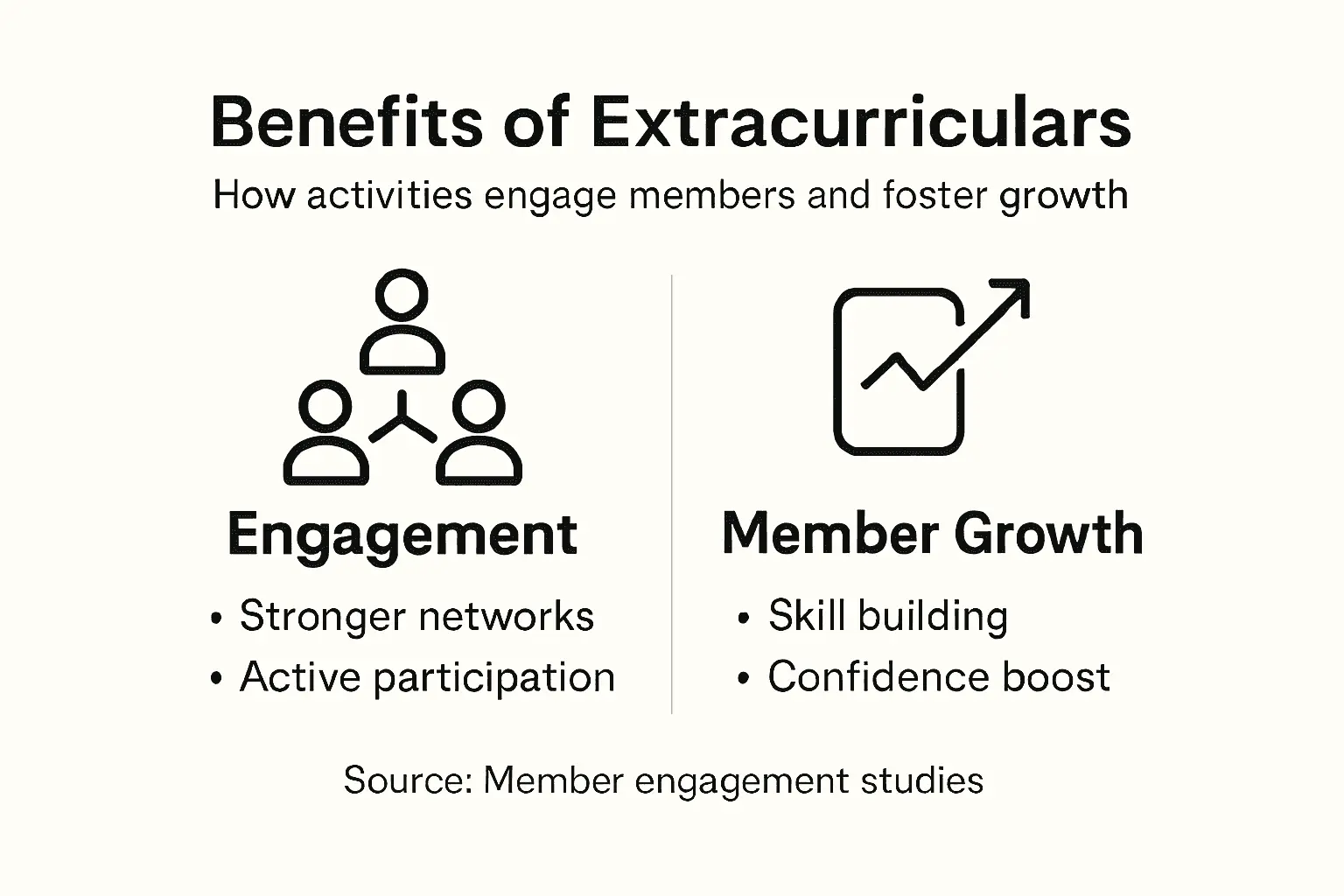
For your organisation, this translates into members who are empowered, engaged, and contributing. These members serve on committees, mentor newer members, present at your events, and help shape your community. They’re not passive consumers waiting for you to provide value. They’re active creators of value.
Professional tip Survey members after activities specifically about skill gains and confidence growth rather than just satisfaction ratings, as these correlate more strongly to renewal and advocacy behaviour.
Challenges and best practices for activity success
Running extracurricular activities sounds straightforward until you actually try it. The reality involves navigating genuine obstacles that can undermine even well-intentioned programmes. The primary challenge is access. Unequal access due to socioeconomic barriers, geographic disparities, and perceived exclusivity prevents full member participation, reducing engagement effectiveness. A workshop scheduled during working hours excludes members in time-zone disparities or with inflexible employment. A premium-priced networking dinner filters out budget-conscious members. In-person-only events disadvantage geographically scattered members. Financial constraints and lack of awareness compound these issues. Members simply don’t know activities exist, or they know but can’t afford participation or attendance.
The best-practice response to these challenges requires intentional design. Start by offering a genuine mix of formats. Include free and paid options. Provide virtual alternatives to in-person events. Schedule some activities outside standard business hours. Create tiered pricing so cost isn’t an absolute barrier. Clear planning, regular evaluation, and alignment with members’ interests ensures activity success. This means actually surveying members about what interests them rather than assuming. It means tracking attendance patterns to see who’s showing up and who’s absent. It means evaluating not just whether events happen, but whether they deliver the intended engagement outcomes.
Leadership quality matters more than you might expect. A poorly-run workshop creates frustration rather than learning. An unskilled volunteer committee coordinator can collapse a promising initiative. Invest in training your activity leaders and volunteer coordinators. Build partnerships with external experts or community organisations if your internal capacity is limited. Sustained engagement requires variety, which prevents boredom and reaches different member interests. Offering only networking events excludes members who learn better through hands-on workshops or prefer one-on-one mentoring. Variety also means you’re not exhausting your volunteer pool by relying on the same people repeatedly.
Culture matters fundamentally. Members need to feel genuinely welcome, not like outsiders crashing an exclusive club. New members particularly feel this. Best practice means deliberately welcoming newcomers, actively inviting quieter members to participate, and creating pathways for people to step into leadership roles gradually rather than demanding immediate commitment.
The table below compares key challenges and best practices for running successful extracurricular activities:
| Challenge | Impact on Members | Best Practice Response |
|---|---|---|
| Socioeconomic barriers | Reduced participation | Offer tiered/free options |
| Geographic disparities | Exclusion of remote members | Include virtual activities |
| Poor communication | Low awareness | Regular targeted promotion |
| Repetitive formats | Decreased engagement | Diversify activity offerings |
Professional tip Start every activity planning meeting by identifying which member segments would be excluded by your current format, then make one concrete change to improve access rather than accepting limitations as fixed.
Enhance Member Engagement with Tailored Extracurricular Activity Management
Many membership organisations struggle to transform passive members into active community participants through extracurricular activities. The article highlights critical challenges such as limited access, lack of diverse engagement formats, and the need for inclusive, flexible programming to boost retention and growth. Your organisation can overcome these hurdles by leveraging technology that unifies member management, event planning, and communication tools — all designed to foster a vibrant, connected membership experience.
Colossus Systems offers a comprehensive platform that enables you to easily manage varied extracurricular activities including workshops, networking events, virtual training, and mentorship programmes. Our solution supports customised event registration, seamless integration with online payment gateways, and targeted email marketing to ensure every member is informed and empowered to participate. Streamline your operations while cultivating deeper relationships that increase loyalty and encourage advocacy.
Ready to elevate your member engagement strategy with flexible, scalable tools crafted for membership organisations? Discover how our platform can help you offer inclusive and impactful extracurricular activities by contacting us today at Colossus Systems Contact. Transform your member experiences and grow your community with solutions that work.
Frequently Asked Questions
What are extracurricular activities in membership organisations?
Extracurricular activities in membership organisations are structured events, programmes, and initiatives that members engage in beyond their formal obligations, aiming to enhance personal development and foster community connections.
How do extracurricular activities contribute to member retention?
Extracurricular activities help transform members from passive participants to active contributors, fostering a sense of belonging that increases their likelihood of renewing membership and engaging further with the organisation.
What types of extracurricular activities can membership organisations offer?
Membership organisations can offer a variety of extracurricular activities, including professional development workshops, networking events, volunteer initiatives, mentorship programmes, social gatherings, and special interest groups.
Why is access important for extracurricular activities?
Access is crucial as unequal access due to socioeconomic barriers and geographic disparities can limit participation. Designing inclusive activities, such as offering virtual options and tiered pricing, ensures broader engagement among all members.
Recommended
- What Is Membership Engagement? Complete Overview | Colossus Systems
- Improving Member Engagement: Proven Strategies for 2025|CS
- Engagement Metrics Explained: Complete Guide for Organizations|CS
- How to Boost Member Engagement and Why use Engagement Software|CS
- 7 Community Involvement Ideas for Moving Homeowners - Onyx Removals