Hybrid event management for associations: 2026 guide

TL;DR:
- Hybrid event management involves designing equal experiences for in-person and virtual audiences from the start. It requires significant technology investment, dedicated roles, and tailored content to maintain engagement and measure success accurately. Proper planning and execution expand membership reach and improve overall satisfaction.
Hybrid event management is the process of planning and executing events that deliver equal value to both in-person and virtual attendees simultaneously. For event planners in membership organisations, associations, and nonprofits, this model has moved from a contingency option to a core delivery format. 83% of organisers report higher total attendance with hybrid formats. That figure signals real opportunity, but it comes with a significant challenge: keeping remote attendees genuinely engaged beyond the first hour. The technology investment alone is substantial, with 35–40% of the total event budget typically allocated to AV and streaming infrastructure, compared to just 10–15% for standard in-person events.
What does effective hybrid event management actually require?
Effective blended event management starts with a single principle: your virtual attendees are participants, not spectators. Treating the virtual audience as an afterthought is the most common planning failure, and it produces a predictably poor remote experience. The fix is not technical. It is a design decision made at the very start of planning.

Successful hybrid events are designed from day one to serve both audiences equally, with synchronised content formats, appropriate session lengths, and networking opportunities built for each environment. That means your planning timeline must account for two parallel but complementary experiences, not one event with a livestream bolted on.
Audience equity is the central design challenge. In-person and virtual attendees require unique yet complementary experiences rather than identical ones. A 90-minute panel session works well in a conference room. Online, attention drops sharply after 45 minutes without structured interaction. Designing for both means adjusting format, pacing, and interaction points for each group without making either feel like a second-class experience.
Here is what that looks like in practice:
- Content format: Break long sessions into shorter segments with clear transitions. Virtual attendees benefit from tighter, more visual presentations.
- Interaction design: Schedule a live poll, Q&A prompt, or chat activity every 10–15 minutes for virtual participants. This maintains attention and creates data you can act on.
- Networking: Provide virtual lounges, matchmaking tools, or facilitated video meetings alongside in-person networking breaks. Do not leave remote attendees staring at a holding screen.
- Moderation teams: Assign separate moderation roles for the room and the online audience. One person cannot effectively manage both.
Pro Tip: Build your run-of-show document with two columns: one for the in-person timeline and one for the virtual timeline. Where they diverge, note the specific action required from each team.
What technology infrastructure do hybrid events need?
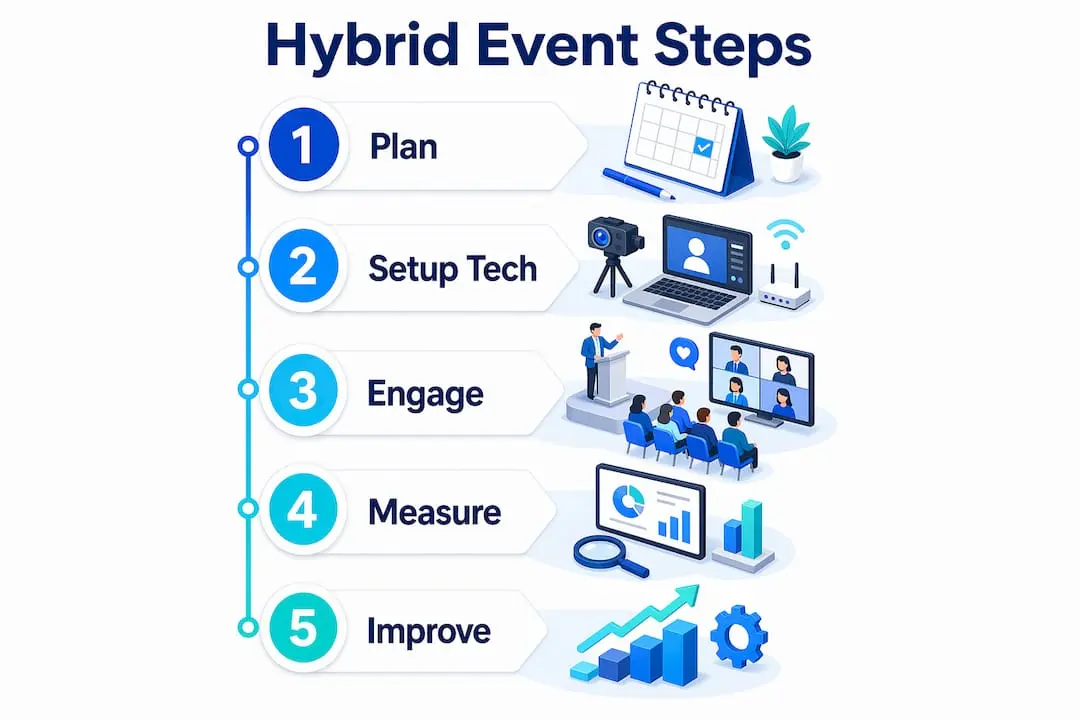
Technology is where hybrid event planning budgets are most frequently underestimated. Technology costs for hybrid events require significantly higher allocation than standard events, driven by professional-grade equipment and platform requirements. Planners who have only managed in-person events are often surprised by the scope.
The core infrastructure requirements fall into four categories:
- Audio-visual hardware: Professional cameras, directional microphones, encoding hardware, and video switching equipment. Consumer-grade webcams produce a noticeably inferior experience that reflects poorly on your organisation.
- Connectivity: A dedicated, high-bandwidth internet connection at the venue with a backup mobile connection. A single point of failure here ends your virtual event.
- Streaming and engagement platform: A platform that handles live broadcasting, registration, attendee engagement, and session recording in one environment. Stitching together separate tools creates data gaps and technical risk.
- Operational hub: A central system that unifies registration, attendance tracking, communications, and analytics. Planners who integrate these functions into a single hub reduce workflow complexity and produce cleaner post-event data.
Pro Tip: Book a full technical rehearsal at least 48 hours before your event. Test every camera angle, microphone, and streaming connection with a live audience of internal staff playing the role of virtual attendees.
The table below summarises the key technology categories and their primary function:
| Technology category | Primary function |
|---|---|
| AV hardware | Captures and transmits high-quality audio and video to remote viewers |
| Dedicated internet connection | Maintains stable streaming without interruption |
| Integrated event platform | Manages registration, engagement, broadcasting, and data in one system |
| CRM and analytics integration | Tracks attendee behaviour and produces ROI reporting for sponsors and leadership |
Centralised registration and tracking systems are not optional extras. They are the mechanism by which you prove event value to your board and sponsors. Without unified data, you are reporting on two separate events rather than one.
How do you keep virtual attendees engaged throughout?
Remote disengagement is the defining risk of any hybrid format. Physical presence creates natural social pressure to stay attentive. Virtual attendance removes that pressure entirely. Without deliberate intervention, drop-off accelerates sharply after the first session.
Interactive features like live polls, breakout rooms, gamification, and digital whiteboards keep virtual audiences invested, but only when they align with session objectives. Interaction for its own sake feels hollow and actually increases disengagement. Every engagement tool you deploy should have a clear purpose tied to the session content.
The most effective virtual event strategies share a common structure:
- Dedicated virtual host: This person focuses solely on the online audience. They moderate the chat, surface questions to speakers, flag technical issues, and keep the energy up between segments. A dedicated virtual host is vital to advocate for online attendees in real time.
- Scheduled interaction points: Plan a structured engagement moment every 10–15 minutes. This could be a poll, a chat prompt, a breakout discussion, or a Q&A window.
- Gamification: Award points for session attendance, poll responses, and networking activity. Display a leaderboard visible to both audiences to create shared competition.
- Digital networking tools: Virtual lounges and video meeting tools give remote attendees a genuine networking experience. Pair them with a matchmaking function based on professional interests for best results.
For practical guidance on engaging your audience effectively, the principles above apply whether your event runs for two hours or two days. The frequency of interaction points simply scales with session length.
Pro Tip: Send virtual attendees a pre-event communication that explains exactly how to participate: how to ask questions, access breakout rooms, and join networking sessions. Attendees who know what to expect engage more actively.
How do you measure hybrid event performance accurately?
Measuring a hybrid event accurately requires separate tracking for each audience segment before you combine the data. Averaging satisfaction scores across in-person and virtual attendees produces a misleading number that serves neither group well.
The metrics worth tracking for each audience are different by design:
- In-person: Session attendance, room capacity utilisation, networking participation, and post-event survey scores.
- Virtual: Live attendance numbers, session dwell time, poll response rates, chat activity volume, and drop-off points by session.
Centralised data architecture enables you to unify these metrics into a single reporting view while preserving the segment-level detail. That combination gives leadership and sponsors a clear picture of total event reach alongside the quality of each audience’s experience.
Survey design matters as much as the data you collect. Send separate post-event surveys to in-person and virtual attendees, with questions matched to their specific experience. Asking a virtual attendee about the quality of the venue catering wastes their time and skews your data.
| Metric | In-person audience | Virtual audience |
|---|---|---|
| Attendance | Room headcount by session | Live viewer count by session |
| Engagement | Networking participation | Poll responses, chat volume |
| Satisfaction | Post-event survey score | Post-event survey score (separate) |
| Drop-off | Early departures | Session exit timestamps |
Use your CRM integration to connect event engagement data with member profiles. This tells you which members attended which sessions, how engaged they were, and how that correlates with renewal behaviour or future event registration. That level of insight is what separates a well-managed hybrid event from a well-attended one. For more on hybrid event best practices, applying consistent measurement frameworks across events builds the longitudinal data your organisation needs.
Key takeaways
Effective hybrid event management requires equal design investment in both in-person and virtual experiences from the very first planning session, not as an afterthought.
| Point | Details |
|---|---|
| Budget for technology early | Allocate 35–40% of your total event budget to AV, streaming, and platform costs. |
| Design for audience equity | Build separate but complementary content timelines for in-person and virtual attendees. |
| Appoint a dedicated virtual host | One person must focus solely on the online audience to maintain engagement and resolve issues. |
| Measure each audience separately | Track in-person and virtual metrics independently before combining them for overall reporting. |
| Centralise your data | Use an integrated platform to unify registration, engagement, and analytics into one reporting view. |
What I have learned from running hybrid events in membership organisations
The biggest mistake I see association event planners make is deciding to “add a virtual option” two weeks before the event. By that point, the programme is locked, the room layout is fixed, and the speaker briefings are done. Retrofitting a virtual experience onto an in-person event produces exactly the kind of second-rate remote experience that drives down satisfaction scores and reduces future registration.
The technology budget reality also catches planners off guard. Tripling your AV spend compared to a standard event feels extreme until you experience a streaming failure in front of 400 remote attendees. Professional encoding hardware, a backup internet connection, and a dedicated technical operator are not luxuries. They are the minimum viable infrastructure for a credible hybrid event.
What I have found genuinely works is treating the virtual host role with the same seriousness as the main stage MC. Give that person a full briefing, a dedicated communication channel with the technical team, and the authority to pause proceedings if the online experience breaks down. That single staffing decision improves remote satisfaction scores more than any engagement tool I have tested.
The hybrid model does expand your reach in ways that a purely in-person event cannot match. Members who cannot travel, those with caring responsibilities, and those in different time zones can all participate meaningfully. That is a real membership benefit worth protecting with proper planning. For planners looking to build on these foundations, hybrid event planning resources that address the specific context of associations and nonprofits are worth reviewing before your next event cycle.
— Rob
How Colossus supports your hybrid event delivery
Managing a hybrid event across two audiences, multiple data streams, and a complex technology stack is demanding. Colossus brings registration, CRM, communications, and event analytics into a single platform built for membership organisations and nonprofits.
With Colossus, you can manage ticket types for in-person and virtual attendees separately, track engagement data from both audiences in one place, and produce sponsor and leadership reports without manually combining spreadsheets. The event management software handles the operational complexity so your team can focus on delivering a great experience for every attendee. Explore the full range of platform features to see how Colossus fits your organisation’s event workflow.
FAQ
What is a hybrid event?
A hybrid event combines a live in-person gathering with a simultaneous virtual experience for remote attendees. Both audiences participate in the same programme through coordinated content delivery and shared engagement tools.
How much should I budget for hybrid event technology?
Allocate 35–40% of your total event budget to technology for a hybrid event. This covers professional AV equipment, streaming infrastructure, and an integrated event platform.
How do I keep virtual attendees engaged during a hybrid event?
Schedule a structured interaction point every 10–15 minutes, appoint a dedicated virtual host, and use tools such as live polls, moderated Q&A, and breakout rooms. Interactive features must align with session objectives to be effective.
Should I send separate surveys to in-person and virtual attendees?
Yes. Separate surveys matched to each audience’s experience produce accurate satisfaction data. Combining responses into a single average obscures the quality of each group’s experience and makes improvement harder to target.
What is the role of a virtual host at a hybrid event?
A virtual host focuses exclusively on the online audience, moderating chat, surfacing questions to speakers, and resolving technical issues in real time. This dedicated role is the single most effective staffing decision for improving remote attendee satisfaction.