How to set membership fees that retain members

TL;DR:
- Setting membership dues involves aligning fees with perceived value, using audits, survey insights, and competitor benchmarks. Choosing the appropriate fee structure and streamlining billing processes are essential for retention and financial sustainability. Regularly reviewing costs, communicating purpose, and utilizing effective tools like automated billing support growth and member satisfaction.
Membership dues pricing is the strategic process of aligning what members pay with the genuine value your organisation delivers. Getting it wrong costs you in two directions: price too low and you undermine financial sustainability; price too high and you drive members away. Knowing how to set membership fees requires a structured approach covering value audits, fee structure selection, and billing mechanics. This guide draws on frameworks used by organisations including the American Medical Association and Exponent Philanthropy to give you a practical, repeatable method for determining membership prices that work.
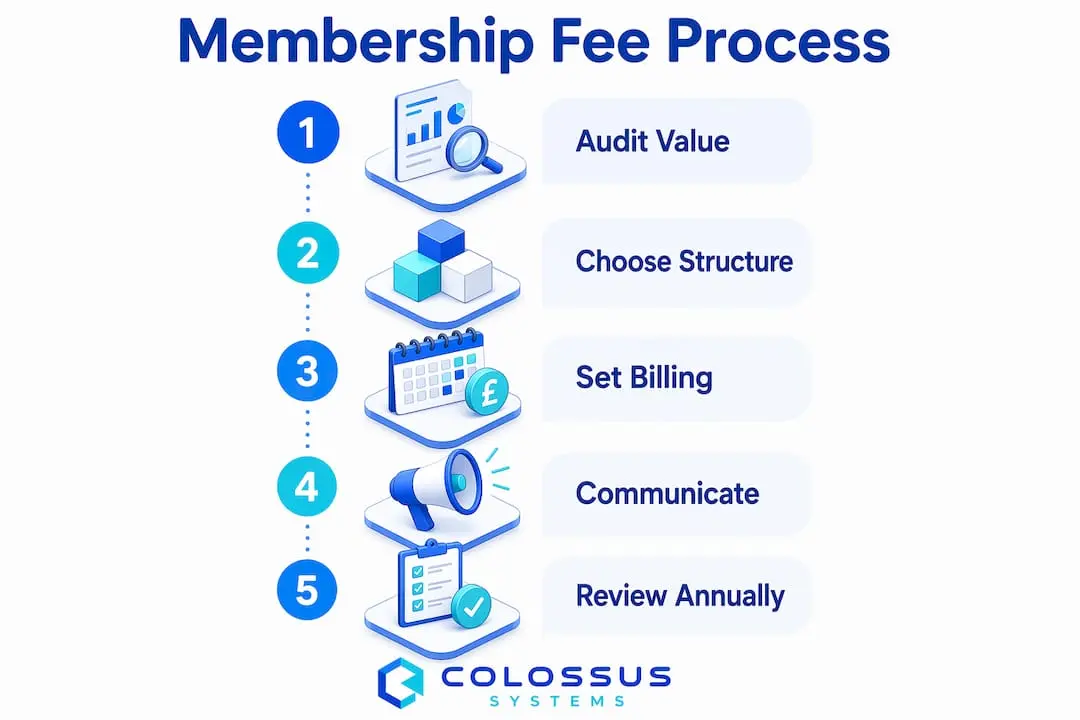
How to set membership fees: start with a value audit
The most reliable starting point for any pricing decision is understanding what your members actually believe they receive. Annual pricing audits using member data identify gaps between perceived value and current price, keeping dues relevant and fair. Without this step, you are essentially guessing.
A value audit has three components: usage analytics, direct member surveys, and competitor benchmarking. Usage analytics tell you which benefits members actually use, not just which ones you think they value. If your online resource library gets 12% engagement but your networking events fill within 48 hours, that data should directly inform where you invest and what you charge. Direct surveys ask members to rate the importance of each benefit they receive. The answers often surprise leadership teams.
Peer benchmarking is strategic for value positioning, not for copying competitor prices. The goal is to understand where your offering sits relative to alternatives, then justify your fee on the basis of differentiation. If your mentoring programme, accreditation support, or exclusive research access has no equivalent elsewhere, that is a pricing argument in your favour.
- Usage analytics: Pull data on logins, event attendance, resource downloads, and support requests quarterly.
- Member surveys: Ask members to score each benefit from 1 to 5 on importance and satisfaction separately.
- Competitor benchmarking: Map three to five comparable organisations by sector, size, and geography.
- Gap analysis: Where satisfaction scores fall below importance scores, you have a value delivery problem, not a pricing problem.
Pro Tip: Run your value audit at least 60 days before your annual renewal cycle opens. This gives you time to act on findings before members decide whether to renew.
Conduct this audit annually. Member expectations shift as your sector evolves, and a fee that felt fair three years ago may feel arbitrary today. Regular pricing audits build member trust by aligning fees transparently with perceived value and organisational costs.
Which membership fee structure fits your organisation?
Once you understand what members value, you need to choose the right fee structure. The three primary models are flat-rate, tiered, and hybrid. Each carries distinct trade-offs in terms of administrative complexity, revenue predictability, and member accessibility.

| Structure | Best For | Key Advantage | Key Risk |
|---|---|---|---|
| Flat-rate | Small, homogeneous membership | Simple to administer | Alienates members with very different budgets |
| Tiered | Diverse membership segments | Matches price to capacity | Overlapping benefits cause confusion and churn |
| Hybrid | Large, mixed organisations | Flexibility across segments | Higher administrative overhead |
Flat-rate dues work well for tightly defined communities where members share similar resources and needs. A local trade association with 200 small business owners of comparable size is a reasonable candidate. The moment your membership spans sole traders and large corporates, flat-rate pricing becomes a liability.
Tiered structures are the most widely adopted model in professional associations. Tiered fee structures with explicit member segment targets balance revenue with fairness and retention risk. Exponent Philanthropy’s asset-based dues model illustrates this well: approximately 75% of members pay £2,000 or less, 19% see no increase under the revised model, and the top tier is capped at £10,000. That cap matters because it signals fairness to your highest-paying members and removes the fear of open-ended escalation.
The most common mistake with tiered pricing is creating tiers with overlapping benefits. Unclear benefit differentiation between tiers causes cancellations even when average revenue improves. Each tier must offer something the tier below cannot access. If a mid-tier member looks at the top tier and cannot identify a concrete additional benefit, they will not upgrade and may question whether their current tier is worth it.
Pro Tip: Name your tiers after outcomes or identities your members aspire to, not generic labels like Bronze, Silver, and Gold. “Associate,” “Fellow,” and “Senior Fellow” carry professional meaning that reinforces the value of moving up.
On billing frequency, monthly billing lowers access barriers while annual billing improves organisational cash flow. A hybrid approach, offering a modest discount for annual payment, captures both benefits. Many associations find that 60–70% of members choose annual billing when offered a 10–15% saving, which significantly improves revenue predictability.
How does billing process affect member retention?
Administrative mechanics are the least glamorous part of membership pricing, and the most frequently neglected. Billing schedules and renewal timing directly affect member retention and payment success rates. Poor billing design creates friction that causes otherwise satisfied members to lapse.
The American Medical Association’s dues structure offers a useful reference point. The AMA operates tiered rates by member status, with both annual and monthly billing cycles and defined cancellation deadlines. That level of specificity is not bureaucratic excess. It removes ambiguity for members and reduces the volume of administrative queries your team handles.
Follow these steps to build a billing process that reduces lapse rates:
- Set a consistent renewal date. A single annual renewal date simplifies your team’s workload and makes it easier to run coordinated renewal campaigns. Rolling renewals by join date create administrative complexity that scales badly.
- Send a minimum of three renewal reminders. The first should arrive 60 days before expiry, the second 30 days out, and the third seven days before the deadline. Each reminder should include a clear statement of what the member receives for their dues.
- Offer instalment plans for higher-tier members. Quarterly or monthly instalments reduce the financial barrier for members at premium tiers. The AMA’s monthly instalment option is a direct response to this need.
- Automate renewal processing. Automating member renewals removes human error from the collection process and ensures no member lapses due to an administrative oversight.
- Define a grace period and communicate it clearly. A 30-day grace period after expiry, with access maintained, gives members time to resolve payment issues without feeling penalised.
- Record and act on failed payments promptly. A failed payment is not a lapsed member. Reach out within 48 hours with an alternative payment method or instalment offer before treating the membership as cancelled.
The goal is to make renewal feel like a non-event for members who intend to stay. Friction at renewal is a decision point. Remove the friction and you remove the opportunity for doubt.
What budget and legal factors shape your fee decisions?
Fee setting must begin with your annual organisational budget, not with a competitor’s price list. Starting from a realistic annual budget simplifies justification to boards and members and prevents chronic underpricing. The budget tells you what dues must cover; the value audit tells you what members will accept.
Build your fee calculation from the following budget components:
- Direct operating costs: Staff salaries, technology subscriptions, office costs, and event delivery expenses that exist solely to serve members.
- Programme delivery costs: The cost of producing each benefit your members receive, from publications to CPD events to online resources.
- Reserves contribution: A target percentage, typically 10–20% of annual expenditure, set aside for financial resilience.
- Ancillary income offset: Revenue from non-dues sources such as sponsorship, event ticket sales, and training fees should reduce the dues burden, not be treated as a bonus.
Separating reserves and ancillary income from core dues calculations keeps your pricing transparent and defensible. When a member asks why dues increased, you can point to a specific cost driver rather than a general shortfall.
For organisations operating as charities or nonprofits, the legal treatment of dues adds another layer of consideration. Nonprofit 501©(3) organisations can charge membership dues if structured correctly to avoid tax complications and maintain deductibility. The key distinction is whether dues constitute a contribution or a payment for services received. If members receive benefits of material value in return for their dues, those dues are not fully deductible as charitable contributions. UK charitable organisations face analogous considerations under HMRC guidance on membership subscriptions and Gift Aid eligibility.
Clear communication about how dues are used is both a legal best practice and a retention tool. Members who understand where their money goes are significantly less likely to question a fee increase.
Key takeaways
Setting membership fees effectively requires aligning dues with member-perceived value, choosing a fee structure suited to your membership segments, and building billing processes that remove renewal friction.
| Point | Details |
|---|---|
| Conduct annual value audits | Use usage data and member surveys to identify gaps between perceived value and current price. |
| Match structure to your membership | Choose flat-rate, tiered, or hybrid models based on the diversity of your member segments. |
| Differentiate tier benefits clearly | Each pricing tier must offer distinct benefits; overlapping tiers drive cancellations regardless of revenue gains. |
| Base fees on your annual budget | Calculate dues from actual operating costs and reserves, not competitor pricing alone. |
| Automate billing and renewals | Structured reminders, instalment options, and automated processing reduce lapse rates significantly. |
Why most organisations underprice their membership
The single most common mistake I see membership organisations make is setting fees based on what feels politically safe rather than what the data supports. Leadership teams worry about member backlash, so they hold fees flat for years. Then, when costs force an increase, the jump feels sudden and unjustified to members who have had no visibility into the organisation’s finances.
The organisations that handle pricing most confidently are those that treat their value audit as a standing agenda item, not an emergency measure. When members see that you review fees annually, communicate the rationale clearly, and tie any increase to a specific improvement in what they receive, the conversation changes entirely. I have seen associations increase dues by 15% with near-zero churn because the communication was transparent and the timing was right.
Tiered pricing is genuinely powerful, but only when the tiers are built around member identity and aspiration, not just price points. The Exponent Philanthropy model works because it is asset-based. Members at different financial scales pay proportionally, which feels fair. Generic Bronze, Silver, Gold tiers without meaningful benefit differentiation do not carry that logic, and members notice.
My strongest recommendation is this: before you touch your pricing, spend 30 days listening to your members. Run a short survey, review your usage data, and talk to five members at each tier. The answers will tell you more than any benchmarking exercise. Pricing decisions made from member insight are far easier to defend, and far more likely to stick.
For organisations managing sustainable membership growth, the fee structure is one piece of a larger retention picture. Get the pricing right, then build the engagement around it.
— Rob
How Colossus supports your membership pricing strategy
Setting the right fee structure is only half the work. Executing it without the right tools creates the administrative burden that erodes the gains you have made.
Colossus is built specifically for membership organisations that need to manage customised fee structures, automate billing cycles, and track member engagement in one place. Our platform supports tiered dues configuration, scheduled renewal reminders, instalment payment processing, and integrated CRM tools that give you the member data you need to run your next value audit with confidence. You can explore the full range of membership management features to see how Colossus fits your organisation’s pricing and retention goals. Managing dues manually is a task of the past. Let Colossus handle the mechanics so your team can focus on member value.
FAQ
What is the best way to determine membership prices?
Start from your annual organisational budget to establish the minimum dues required, then conduct a member value audit using usage data and surveys to confirm what members will accept. Benchmarking comparable organisations helps you position your pricing, but should not replace internal cost analysis.
How many tiers should a membership fee structure have?
Most organisations perform best with two to four tiers. Each tier must offer clearly distinct benefits. Overlapping benefit levels cause member dissatisfaction and higher churn, so fewer well-defined tiers outperform many loosely differentiated ones.
Can a nonprofit charity charge membership dues?
Yes. Nonprofit organisations can charge membership dues provided the structure is designed correctly to manage tax treatment. In the UK, HMRC guidance on charitable subscriptions determines whether dues qualify for Gift Aid, depending on the benefits members receive in return.
How often should membership fees be reviewed?
Fees should be reviewed annually. Annual pricing audits using member data keep dues aligned with evolving member expectations and organisational costs, and make incremental increases far easier to justify than infrequent large adjustments.
What billing frequency works best for member retention?
Offering both annual and monthly billing options serves the widest range of members. Monthly billing reduces financial barriers for new or lower-income members, while annual billing with a modest discount improves cash flow and reduces administrative overhead for your organisation.