Event venue marketing plan: your 2026 guide

TL;DR:
- An event venue marketing plan focuses on targeted audiences, resource allocation, and measurable strategies to ensure consistent bookings. Effective planning combines audience segmentation, channel mix, phased timelines, and rapid inquiry responses to outperform competitors. Building systems for quick follow-up, optimized listings, and off-peak targeting enhances booking rates and revenue.
An event venue marketing plan is the structured approach to promoting your venue by targeting the right audiences, allocating resources effectively, and ensuring a reliable booking pipeline through measurable strategies. Without a formal plan, venues rely on word of mouth and sporadic campaigns that produce inconsistent results. The most effective venue promotion strategy combines audience segmentation, a balanced channel mix, phased timelines, and disciplined follow-up systems. Adding LocalBusiness, Event, and FAQ structured data to your venue website can increase click-through rates by 20–40%. That single technical step illustrates a broader truth: the venues filling their calendars are not outspending competitors. They are out-planning them.
What are the key components of an event venue marketing plan?
A venue marketing plan is built on five interdependent components. Miss one and the whole system underperforms.
Audience segmentation is the starting point. Corporate event planners, nonprofit coordinators, and social event organisers each have different priorities, budgets, and decision timelines. A conference venue targeting all three with identical messaging wastes budget and dilutes impact. Segment your audiences first, then build separate messaging tracks for each.
Clear, measurable goals anchor every decision that follows. Goals should map directly to venue KPIs: inquiry volume, conversion rate, average booking value, and repeat booking rate. Vague goals like “increase awareness” produce vague results.
Channel selection determines where your budget goes. The core channels for most venues are paid digital advertising, organic SEO content, listing platforms, email marketing, and referral programmes. Each serves a different stage of the planner’s decision process.
Here is a recommended budget allocation based on 2026 industry benchmarks:
| Channel | Budget allocation | Primary purpose |
|---|---|---|
| Paid digital (Google, LinkedIn, Meta) | 30–35% | Immediate demand capture |
| Organic SEO and content | 10–15% | Long-term trust and pipeline |
| Email marketing | 10–15% | Nurturing and retention |
| Creative assets and production | 10–15% | Conversion rate improvement |
| Listing platform management | 10–15% | Inquiry volume and quality |
| Contingency | 5–10% | Reallocation to top performers |
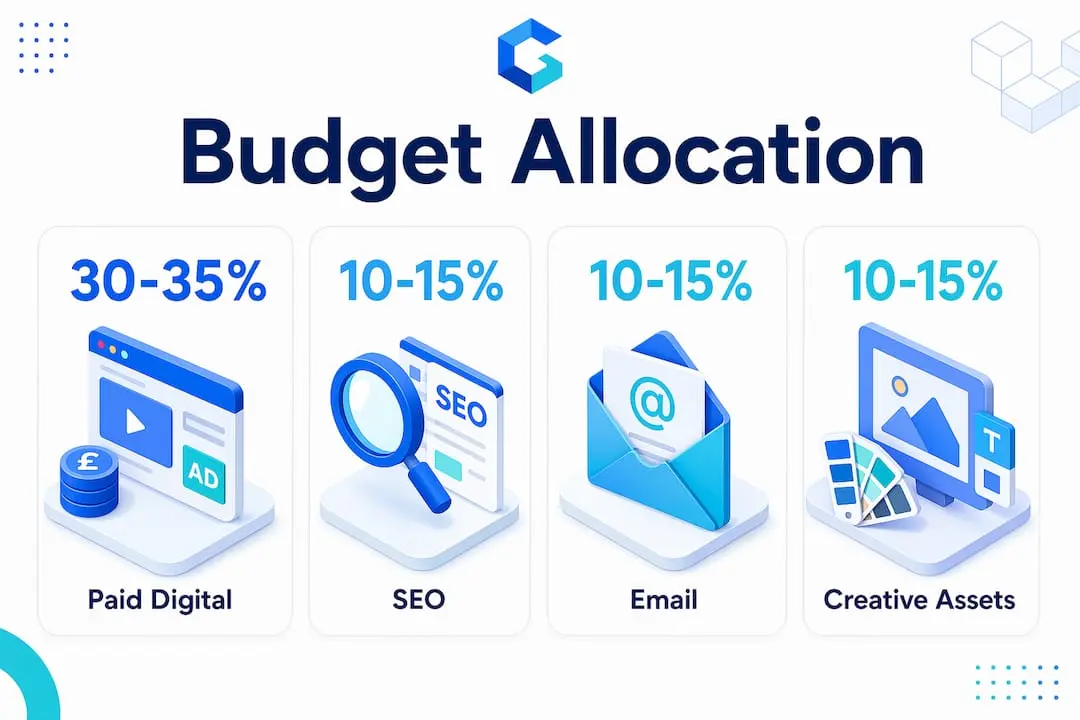
This budget allocation framework reflects a balance between immediate lead capture and sustainable organic growth. The contingency budget is not a safety net. It is a planned reallocation tool for mid-campaign performance data.
Creative assets are frequently underfunded. High-quality photography, video walkthroughs, and floor plan visuals directly affect how planners shortlist venues. Treating creative as an afterthought produces listing pages that planners scroll past.
Inquiry response protocols close the loop. A plan without a defined follow-up process loses bookings at the final stage. Define who responds, how quickly, and what the follow-up sequence looks like before you launch any campaign.
Pro Tip: Build your audience segments into your CRM from day one. Tagging contacts by event type and organisation size lets you personalise outreach at scale without manual effort.
How do you build a timeline and budget for your venue marketing plan?
Phased timelines prevent the common mistake of spending the entire budget in the final weeks before an event. Structured marketing plans divide activity into four phases: foundation, awareness, momentum, and urgency, starting approximately 12 weeks before small to medium events.
- Foundation (weeks 12–10). Audit your existing listings, photography, and website. Set up tracking, confirm your CRM is configured, and finalise your audience segments. No paid spend yet.
- Awareness (weeks 9–7). Launch organic content targeting planner search queries. Activate Google Business Profile updates and listing platform improvements. Begin low-budget paid campaigns to test messaging.
- Momentum (weeks 6–4). Scale paid spend on proven ad sets. Activate email sequences to warm leads. Publish case studies and testimonials to support shortlisting decisions.
- Urgency (weeks 3–1). Retarget engaged audiences. Deploy limited-availability messaging. Accelerate follow-up cadence on open inquiries.
This phased approach mirrors the way planners actually make decisions. Marketing mapped to planner decision timelines covers discovery, shortlisting, decision, and retention stages, each requiring distinct content and contact points. Treating each stage as a separate conversion challenge produces far better pipeline results than running a single undifferentiated campaign.
Pro Tip: Reserve your contingency budget until week 5. By then, you have enough performance data to know which channels are generating qualified inquiries. Move the contingency there, not to underperforming channels.
The booking cycle for corporate events typically runs 6–12 months ahead of the event date. Your timeline planning must account for this. A venue targeting corporate clients in october should be running awareness content in january and paid campaigns from march onwards.
What marketing channels yield the highest ROI for event venues?
Peer referrals and attendee advocacy convert at 3–5 times the rate of cold paid traffic. That makes referral programmes the highest-ROI channel available to most venues, yet they are consistently underfunded. A structured referral incentive, such as a discount on a future booking or a gift to the referring planner, costs a fraction of a paid acquisition.
Paid search captures immediate demand. Google Ads and Performance Max campaigns targeting high-intent venue queries deliver 3–6x return on ad spend for venues with average bookings above £4,000. LinkedIn advertising reaches corporate event planners directly by job title and company size, making it the most precise paid channel for B2B venue marketing.
Effective venue marketing treats paid search as immediate demand capture and SEO content as long-term trust and lead-nurturing elements, integrated within an orchestrated marketing system.
Organic SEO content that answers planner questions about room capacity, AV requirements, and quote briefing builds trust and captures demand 6–12 months ahead of the event. Educational content compounds over time. A well-written guide to planning a corporate away-day at your venue will generate qualified inquiries for years without additional spend.
Listing platforms deserve more attention than most venues give them. Successful venue listings require 60 or more high-quality photos, detailed videos, transparent pricing bands, and consistent verified reviews to maximise conversion. Treat your listing as a conversion rate optimisation project, not a directory entry.
For nonprofit and association event planners, event advertising ideas tailored to their budget constraints and audience expectations produce significantly better results than generic venue promotion. Adapting your messaging to the specific priorities of each segment is not optional. It is the difference between a shortlisted venue and one that never gets considered.
Social media works best when it tells stories rather than broadcasts availability. User-generated content from past events, behind-the-scenes setup footage, and client testimonial videos all outperform static promotional posts. Virtual tours embedded on your website and listing pages reduce the number of site visits required before a booking decision, which shortens the sales cycle.
How can venues build systems to tighten inquiry response and booking conversion?
The single most impactful change most venues can make has nothing to do with advertising. Responding to inquiries within one hour significantly increases booking likelihood. Most venues respond within 24 hours or longer. That gap is where bookings are lost.
A structured follow-up cadence turns warm leads into confirmed bookings:
- Day 1. Respond within one hour with a personalised reply that addresses the specific event type, date, and capacity mentioned in the inquiry. Attach a tailored brochure or proposal template.
- Day 3. Send a follow-up that adds value. Include a relevant case study, a link to a virtual tour, or answers to common questions for that event type.
- Day 7. Make a direct ask. Offer a site visit, a call with your events coordinator, or a provisional hold on the date. Create a reason to respond.
This day 1, day 3, day 7 cadence prevents leads going cold and drives conversions far beyond what delayed responses achieve. A CRM configured to trigger reminders at each stage removes the reliance on individual memory and ensures no inquiry falls through.
Reviews and referral incentives feed the top of the funnel while your follow-up system works the bottom. Ask every confirmed client for a review within 48 hours of their event. The experience is fresh, and the likelihood of a detailed, useful review is highest at that point.
Pro Tip: Connect your listing platform leads directly into your CRM. Manual copy-and-paste between platforms introduces delays and errors. Automated intake keeps your response time within the one-hour window.
For event registration strategies that support your follow-up process, a well-designed registration flow captures the data you need to personalise outreach from the first contact.
What strategies help venues address off-peak periods and different event types?
Off-peak periods are a planning problem, not a demand problem. The demand exists. It is simply directed at different event types or audiences than your primary market.
- Target alternate event categories. A venue that fills its calendar with corporate conferences in autumn and spring can target social events, charity fundraisers, and association dinners in the quieter summer and january periods. Each category has its own booking cycle and decision-maker profile.
- Create off-peak packages. Bundled pricing that includes catering, AV, and staffing at a fixed rate reduces the friction of budget approval for smaller organisations. Nonprofit and association planners in particular respond well to transparent, all-inclusive pricing.
- Build vendor referral networks. Caterers, photographers, AV suppliers, and florists all have clients who need venues. A formal referral arrangement with three or four complementary suppliers produces a steady stream of warm introductions at no media cost.
- Adapt messaging by segment. Corporate planners prioritise reliability, technology, and professional service. Social event organisers prioritise atmosphere, flexibility, and catering quality. Nonprofit coordinators prioritise value, accessibility, and mission alignment. The same venue can speak to all three. The messaging must be distinct.
| Event segment | Primary priority | Most effective channel |
|---|---|---|
| Corporate | Reliability and AV capability | LinkedIn ads, organic SEO |
| Social | Atmosphere and catering | Instagram, listing platforms |
| Nonprofit | Value and accessibility | Referrals, nonprofit event promotion |
| Associations | Member experience | Email, membership event marketing |
Data analysis identifies which segments are underperforming relative to their potential. If your corporate bookings are strong but your nonprofit segment is thin, the gap is not market size. It is messaging, channel selection, or pricing structure. Fix the specific gap rather than increasing overall spend.
Key takeaways
A successful event venue marketing plan requires audience segmentation, phased timelines, channel discipline, and a rapid inquiry response system working together as one integrated approach.
| Point | Details |
|---|---|
| Structured data boosts visibility | Adding LocalBusiness and Event schema can increase click-through rates by 20–40%. |
| Referrals outperform paid traffic | Peer referrals convert at 3–5 times the rate of cold paid traffic, making them the highest-ROI channel. |
| Phased timelines prevent waste | A 12-week plan with foundation, awareness, momentum, and urgency phases allocates budget where it matters most. |
| One-hour response wins bookings | Responding to inquiries within one hour significantly increases the likelihood of conversion. |
| Off-peak needs a separate strategy | Targeting alternate event segments with tailored packages fills calendar gaps without discounting your core offer. |
What most venue marketers get wrong
The venues I see struggling most are not under-spending on advertising. They are over-spending on campaigns while under-investing in the systems that convert interest into bookings. A venue with a well-managed Google Business Profile, 60 or more quality listing photos, and a one-hour inquiry response protocol will consistently outperform a venue spending three times as much on paid ads but responding to inquiries the next morning.
The other pattern I see repeatedly is treating marketing as a series of isolated campaigns rather than an integrated system. A campaign ends, bookings dip, and the team scrambles to launch the next one. The venues with full calendars are running paid, organic, email, and referral channels simultaneously, each feeding the others. Paid ads drive traffic to SEO-optimised pages. Those pages capture email addresses. Email sequences nurture leads until they are ready to book. Satisfied clients feed the referral programme. The system runs continuously.
My honest recommendation: before you increase your advertising budget, audit your inquiry response time, your listing quality, and your follow-up cadence. Fix those first. The return on that investment will exceed almost anything you can buy with additional media spend.
— Rob
How Colossus supports your venue marketing and booking pipeline
Event planners and marketing professionals managing venues for associations, nonprofits, and membership organisations need more than a marketing plan. They need the systems to execute it consistently.
Colossus brings together event management software, CRM tools, email marketing, and member management within a single platform. The CRM tracks every inquiry, automates follow-up reminders at day 1, day 3, and day 7, and keeps your pipeline visible at all times. Event registration, payment processing, and member communications all connect within one system, removing the manual handoffs that slow response times and cost bookings. Explore the full platform features to see how Colossus supports venues at every stage of the marketing and booking process.
FAQ
What is an event venue marketing plan?
An event venue marketing plan is a structured, multi-channel strategy for promoting a venue, targeting the right audiences, and generating a consistent booking pipeline. It covers audience segmentation, channel selection, budget allocation, phased timelines, and inquiry follow-up systems.
How much should a venue spend on marketing?
A 2026 benchmark allocates 30–35% of the marketing budget to paid digital, 10–15% each to SEO, email, and creative, and 5–10% as contingency for reallocation to top-performing channels.
Which marketing channel has the highest ROI for venues?
Peer referrals and attendee advocacy convert at 3–5 times the rate of cold paid traffic, making them the highest-ROI channel. Paid search delivers strong short-term returns for venues with average bookings above £4,000.
How quickly should a venue respond to inquiries?
Venues should respond to every inquiry within one hour. A structured follow-up cadence on days 1, 3, and 7 prevents leads going cold and significantly increases booking conversion rates.
How do venues fill off-peak periods?
Targeting alternate event segments such as nonprofit gatherings, association dinners, or social events with tailored packages and dedicated messaging fills calendar gaps without reducing rates for core corporate bookings.