Event management and sustainability: a 2026 guide

TL;DR:
- Sustainable event management integrates environmental, social, and economic responsibility throughout all phases of an event. It relies on measurable goals, recognised frameworks like ISO 20121, and embedding sustainability into contracts and operations. Verified data and compliance with standards are now essential for securing sponsorships and maintaining reputation in 2026.
Sustainable event management is the practice of integrating environmental, social, and economic responsibility into every phase of an event, from initial planning through to post-event reporting. The discipline has a formal home in standards like ISO 20121 and the EIC Sustainable Event Standards, which give event planners a structured path beyond good intentions. As sponsor expectations shift from voluntary pledges to verified data, understanding sustainable event planning is no longer optional for professionals who want to secure partnerships and protect their organisation’s reputation. Event management and sustainability now sit at the centre of every serious event brief.
What measurable sustainability goals should event planners set?
Vague commitments no longer satisfy sponsors, attendees, or internal stakeholders. Specific, measurable targets such as diverting 80% of waste from landfill, reducing per-attendee carbon emissions by 25%, and sourcing 100% of catering locally give your team clear benchmarks to plan against. Precise targets drive accountability in a way that broad pledges never can.
Setting goals at this level changes how you make operational decisions. A waste diversion target forces you to audit your venue’s recycling infrastructure before signing a contract. A local sourcing commitment shapes your catering brief from day one. These are not aspirational statements. They are design constraints that produce better events.
The shift toward evidence-based goals in 2026 reflects a wider industry maturity. Sponsors and certification bodies now ask for proof, not promises. Your sustainability goals must be specific enough to measure, report on, and defend in a post-event debrief.
- Waste diversion rate: Target a minimum percentage of total waste diverted from landfill, tracked by weight.
- Carbon emissions per attendee: Set a reduction target against a baseline from a previous comparable event.
- Local sourcing percentage: Define “local” by distance (for example, within 80 kilometres) and apply it to catering contracts.
- Water usage: Track consumption per attendee for indoor events where metering is possible.
- Digital versus print ratio: Commit to a specific reduction in printed materials compared to your last event.
Pro Tip: Set your sustainability targets before you issue any supplier briefs. Suppliers who receive a brief with embedded sustainability requirements will price and plan accordingly, rather than retrofitting green options at extra cost.
How do recognised frameworks help manage sustainability in events?
Frameworks give event planners a systematic method rather than a checklist of individual actions. ISO 20121:2024 is the globally recognised standard that helps organisations manage the environmental, social, and economic impacts of events. Applying it moves your programme from inconsistent good-faith efforts to measurable progress and continuous improvement.
The EIC Sustainable Event Standards, updated in mid-2026, provide a certification framework covering eight sustainability areas. These include venue selection, food and beverage, exhibition services, and attendee transport. The standards give both planners and suppliers a shared language and a clear path to certification.
| Framework | Scope | Primary benefit |
|---|---|---|
| ISO 20121:2024 | Global, all event types | Systematic management and continuous improvement |
| EIC Sustainable Event Standards | North American focus, eight key areas | Certification and supplier alignment |
Both frameworks share a core principle: sustainability must be managed, not just intended. Certification under either standard signals to sponsors and attendees that your claims are independently verified. That credibility is increasingly the deciding factor in competitive bid processes.
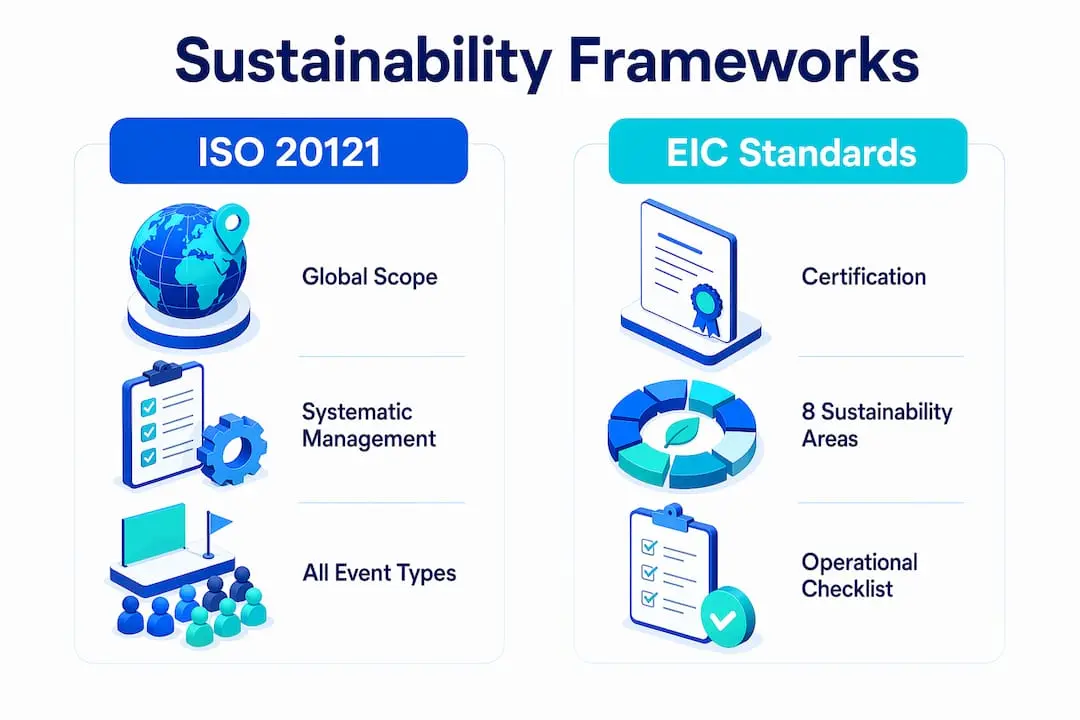
Pro Tip: Use ISO 20121 as your management system and the EIC Sustainable Event Standards as your operational checklist. The two frameworks complement each other well, and using both gives you stronger documentation for sponsor reporting.
Adopting a framework also protects your team from scope creep. Without a defined structure, sustainability efforts tend to cluster around visible, front-of-house actions like branded recycling bins, while back-of-house waste and supply chain emissions go unaddressed. A framework forces you to cover the full picture.
What operational practices embed sustainability throughout the event lifecycle?
Sustainable conference solutions and eco-friendly event management both depend on the same thing: decisions made early and enforced consistently. Operational sustainability is not a post-event report. It is a series of contractual and procurement choices that determine what is actually possible on the day.
1. Embed sustainability at the contract stage
The sustainability decision is the contract. Catering fuel type, waste collection method, and sanitation services are all locked in at the procurement phase. If your contract does not specify biodiesel generators, composting collection, or low-emission transport, you cannot retrofit those requirements later without significant cost and friction. Write sustainability clauses into every supplier contract before you sign.
2. Manage back-of-house waste as a priority
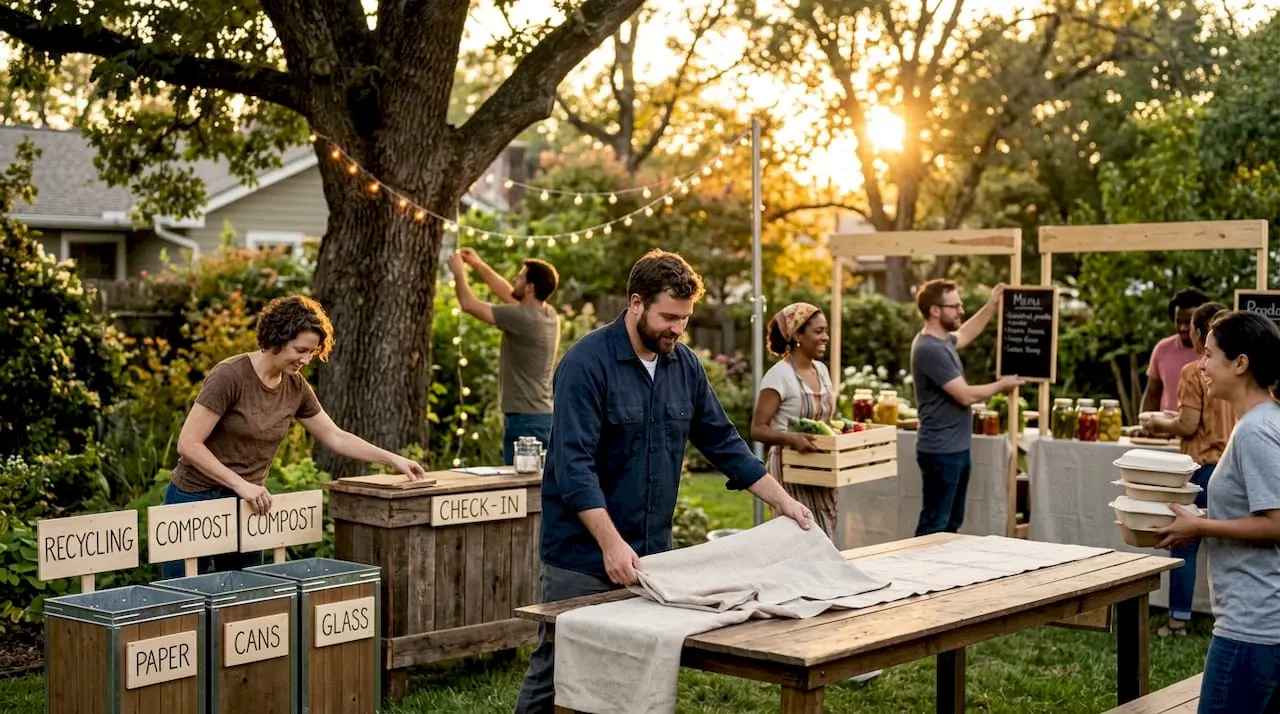
Most events focus recycling efforts on visible, front-of-house areas. Back-of-house waste is where the majority of waste volume actually occurs, and it is where most events fail their own targets. Kitchen waste, packaging from deliveries, and crew catering all generate significant volumes that never appear in a front-of-house recycling report. Appoint a dedicated back-of-house waste monitor for any event above a few hundred attendees.
3. Choose plant-forward catering and local suppliers
Food accounts for around 30% of global greenhouse gas emissions. Menu choices are therefore among the highest-impact decisions an event planner makes. Plant-forward menus reduce food-related emissions significantly compared to meat-heavy alternatives. Pairing that with local sourcing cuts transport emissions and supports regional food systems. Brief your caterer on both requirements at the outset, not as an afterthought.
4. Use digital tools for registration, tracking, and reporting
Digital registration eliminates printed materials at the point of highest volume. Beyond registration, digital tools let you track attendee numbers in real time, monitor supplier compliance, and generate accurate post-event reports. Real-time operational data platforms move your reporting beyond estimates and into verified figures that sponsors and certification bodies will accept.
5. Collect actual data, not estimates
Post-event sustainability reports built on estimates fail to meet sponsor expectations in 2026. Actual waste weights, measured energy consumption, and verified catering sourcing data produce reports that are credible and defensible. Build data collection into your operational plan from the start, assigning responsibility to specific team members or suppliers for each metric.
Pro Tip: Ask your venue for metered energy and water data as a condition of booking. Many venues can provide this, but only if you request it in writing before the event.
How do sponsor and attendee expectations shape green event strategies in 2026?
External pressure now drives sustainable event management more than internal values. Corporate sponsors in 2026 expect verified sustainability reports containing real carbon footprint data, waste diversion rates, and water usage before committing to partnerships. This is a structural shift. Sustainability reporting has become a sponsorship requirement, not a differentiator.
Attendees have moved in the same direction. Environmentally conscious events attract higher engagement and stronger word-of-mouth from audiences who align with those values. Conversely, events that make sustainability claims without evidence risk reputational damage when attendees or journalists scrutinise the detail.
The consequences of failing to meet ESG expectations are concrete:
- Lost sponsorship revenue: Sponsors with their own ESG reporting obligations cannot associate with events that cannot provide verified data.
- Reduced rebooking rates: Attendees who feel misled about sustainability practices are less likely to return.
- Certification barriers: Without documented evidence, events cannot achieve or maintain ISO 20121 or EIC certification.
- Competitive disadvantage: Venues and planners who can demonstrate verified sustainability performance win bids over those who cannot.
Lack of standard frameworks and baselines remains the most common reason event teams fail to meet ESG expectations. Adopting ISO 20121 or the EIC Sustainable Event Standards directly addresses this gap. For associations and membership organisations running annual conferences, the reputational and financial stakes of getting this wrong are particularly high.
Inclusive event design also intersects with sustainability goals. Planners working on inclusive event organisation in 2026 find that the same data-driven, stakeholder-centred approach that supports sustainability also strengthens accessibility and community outcomes.
Key takeaways
Sustainable event management succeeds when sustainability is embedded in contracts, measured with real data, and governed by recognised frameworks like ISO 20121 and the EIC Sustainable Event Standards.
| Point | Details |
|---|---|
| Set measurable targets early | Define specific goals such as waste diversion rates and carbon reductions before issuing supplier briefs. |
| Use recognised frameworks | ISO 20121 and EIC Sustainable Event Standards provide systematic, certifiable approaches to green event management. |
| Embed sustainability in contracts | Catering, fuel, and waste requirements must be written into supplier contracts at the procurement stage. |
| Prioritise back-of-house waste | Most waste volume occurs behind the scenes; appoint a dedicated monitor to track and report it accurately. |
| Collect actual data for reporting | Verified figures from real-time tracking tools satisfy sponsor ESG requirements; estimates do not. |
Why I think most events get sustainability backwards
After years of working with event planners and membership organisations, the pattern I see most often is this: sustainability gets treated as a communications exercise rather than an operational one. Teams spend time designing branded recycling stations and writing sustainability statements for the event website, while the catering contract specifies no composting and the generator runs on standard diesel.
The uncomfortable truth is that treating sustainability as marketing rather than a core supplier requirement undermines every visible effort you make. A beautifully designed recycling point means nothing if 70% of your waste is generated in the kitchen and goes straight to landfill. The back-of-house problem is not glamorous, which is exactly why it gets ignored.
The planners I have seen get this right share one habit: they write sustainability requirements into contracts before they negotiate price. Once a supplier has committed to composting collection or a plant-forward menu in writing, the conversation shifts from “can we do this?” to “how do we do this?” That is a fundamentally different starting point.
My advice for 2026 is to pick one framework, either ISO 20121 or the EIC Sustainable Event Standards, and use it to audit your last event honestly. You will almost certainly find that your front-of-house performance looks reasonable and your back-of-house performance does not. That gap is where your next event’s sustainability plan should start. If you are newer to this area, the event management courses for nonprofits available globally offer structured grounding in both frameworks and operational practice.
— Rob
How Colossus supports your sustainable event management
Running environmentally conscious events requires the same thing as running any well-managed event: accurate data, clear workflows, and tools that keep your team aligned from registration to reporting.
Colossus brings event registration, attendee tracking, supplier communication, and post-event reporting into a single platform. For associations and membership organisations, that means your sustainability data sits alongside your membership records, making it straightforward to report verified figures to sponsors and certification bodies. Our event management software is built to support the full event lifecycle, and our membership management features give your organisation the infrastructure to make every event count.
FAQ
What is sustainable event management?
Sustainable event management is the practice of integrating environmental, social, and economic responsibility into all phases of event planning and delivery. It is governed by frameworks including ISO 20121 and the EIC Sustainable Event Standards.
What measurable goals should I set for a sustainable event?
Specific targets include diverting 80% of waste from landfill, reducing per-attendee carbon emissions by 25%, and sourcing 100% of catering locally. Precise, quantified goals drive accountability and satisfy sponsor reporting requirements.
Why does ISO 20121 matter for event planners?
ISO 20121:2024 is a globally recognised standard that shifts event sustainability from inconsistent individual efforts to a systematic, measurable management approach. Certification under the standard provides independent verification that sponsors and certification bodies accept.
When should sustainability decisions be made in event planning?
Sustainability decisions are most effective when made at the procurement and contracting stage. Catering, fuel, and waste management requirements written into supplier contracts before signing determine the actual sustainability outcomes of the event.
How do sponsors use sustainability data in 2026?
Corporate sponsors now require verified sustainability reports containing real carbon footprint data, waste diversion rates, and water usage before committing to event partnerships. Events relying on estimated rather than actual data risk losing sponsorship opportunities.