Email marketing platforms for nonprofits: 2026 guide

TL;DR:
- Nonprofit email marketing platforms integrate automation, segmentation, and tracking to enhance donor engagement and fundraising. Choosing the right platform depends on organizational size, automation needs, and budget, with revenue metrics being more reliable than open rates. Effective strategies involve multi-channel communication, lifecycle mapping, and data-driven segmentation to build long-term supporter relationships.
Email marketing platforms for nonprofits are specialised digital communication tools that combine automation, segmentation, and performance tracking to help organisations convert one-time donors into long-term supporters. Platforms such as Constant Contact, Mailchimp, and MailerLite have built nonprofit-specific features, discounted pricing, and pre-built templates that general business tools simply do not offer. The right platform does more than send newsletters. It automates donor journeys, tracks fundraising revenue, and integrates with your CRM to give every supporter a personalised experience. This guide covers what to look for, how leading platforms compare, and which metrics actually matter.
What features should nonprofit email marketing platforms include?
The best email marketing software for nonprofits does more than deliver messages. It replaces manual, one-off sending with a system of automated workflows, targeted segments, and measurable outcomes. According to RallyUp’s nonprofit email guide, treating email as a system rather than a broadcast channel is the defining difference between organisations that scale their fundraising and those that plateau.
When evaluating options, prioritise these features:
- Automation workflows. Welcome sequences for new subscribers, donation thank-you emails, event reminders, and lapsed-donor re-engagement flows should all be configurable without coding. Constant Contact, for example, offers beginner-friendly automation with guided setup for these exact flows, making it accessible to small teams with no dedicated marketing staff.
- Segmentation. The ability to group contacts by giving history, event attendance, volunteer status, or communication preference is what separates a generic blast from a targeted appeal. Platforms like Mailpro support contact tags and advanced segmentation alongside a drag-and-drop editor with over 600 responsive templates.
- Deliverability infrastructure. A message that lands in spam raises no money. Mailpro delivers over 97% of emails within one hour, with IP reputation monitoring built in. Deliverability above 98% is achievable for well-maintained nonprofit lists, and it should be a baseline expectation, not a bonus.
- Nonprofit-specific templates. Fundraising appeals, volunteer recruitment emails, event invitations, and impact reports each require a different structure. Platforms that provide purpose-built templates save significant design time for lean teams.
- CRM and donation software integration. Connecting your email platform to your donor database means every communication is informed by real giving behaviour, not guesswork. This is where platforms like ActiveCampaign and HubSpot earn their higher price points.
- Transparent, nonprofit pricing. Free plans and discounted tiers exist across most major platforms, but the details matter. Pricing models vary considerably, and add-ons can inflate costs well beyond the advertised rate.
Pro Tip: Separate your operational emails (event confirmations, receipts, membership renewals) from your marketing campaigns within the same platform. This keeps your reporting clean and prevents donors from feeling over-communicated. Mailpro specifically supports this distinction in its workflow architecture.
How do leading platforms compare on usability, automation, and pricing?
Choosing the best email marketing platform for nonprofits requires matching platform strengths to your organisation’s actual capacity. A small charity with two staff members needs something different from a national federation running multi-chapter campaigns. The top nonprofit email platforms in 2026 include Constant Contact, Mailchimp, MailerLite, Brevo, ActiveCampaign, HubSpot, GetResponse, Campaign Monitor, and Moosend.

| Platform | Free plan | Nonprofit discount | Automation depth | Best for |
|---|---|---|---|---|
| Constant Contact | No | Yes (varies) | Beginner-friendly | Small to midsize nonprofits |
| Mailchimp | Yes (limited) | 15% off base plan | Intermediate | Growing organisations |
| MailerLite | Yes | Yes | Intermediate | Budget-conscious teams |
| Brevo | Yes | 20% off paid plans | Advanced (multi-channel) | Donor engagement at scale |
| ActiveCampaign | No | Yes | Advanced CRM-driven | Complex automation needs |
| HubSpot | Yes (limited) | Yes | Enterprise-level | Large nonprofits with CRM focus |
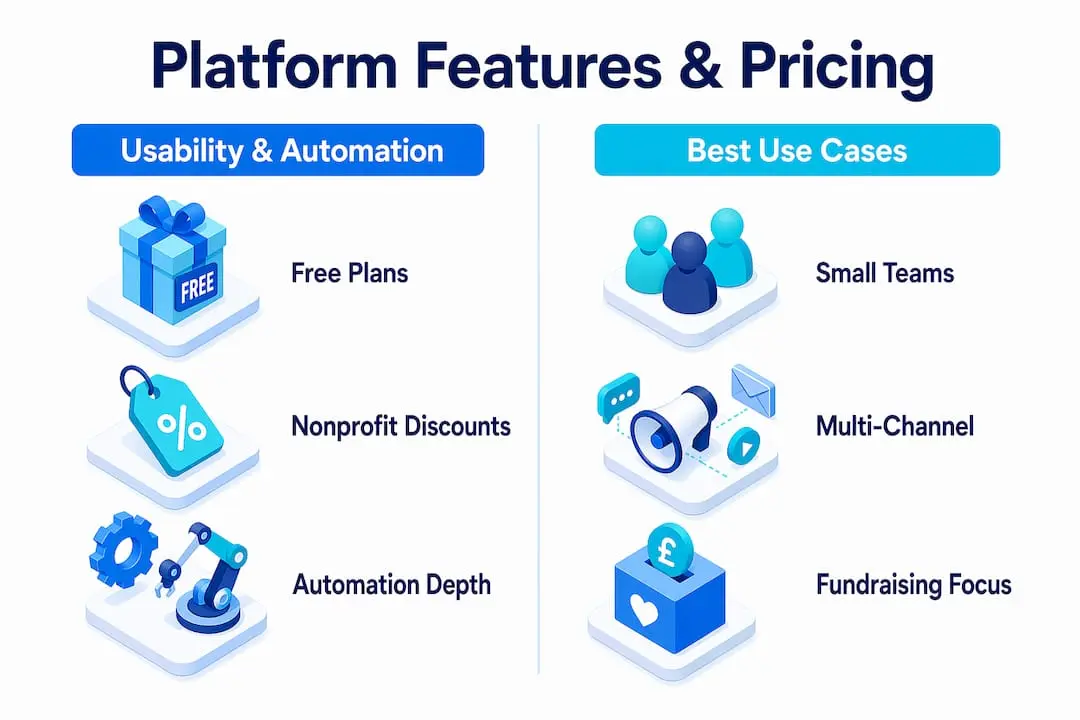
Mailchimp’s discount deserves scrutiny. The 15% nonprofit discount applies only after the initial paid billing cycle and only to the base plan price. Add-ons and historical unsubscribes that inflate contact counts can push the real cost significantly higher. At 5,000 contacts, discounted Mailchimp Standard costs approximately $85 per month compared to $39 per month for comparable alternatives. That gap matters when every pound saved is a pound available for programmes.
Brevo takes a different approach. It offers 20% off paid plans for eligible NGOs and builds multi-channel messaging (email, SMS, and WhatsApp) into a single contact timeline. This makes it particularly effective for organisations that want to reach donors across multiple touchpoints without managing separate platforms.
Pro Tip: Before committing to any platform, request a nonprofit verification call with the sales team. Many platforms offer additional concessions, extended trials, or onboarding support that are not listed publicly. Negotiating before you sign is far easier than renegotiating at renewal.
Which metrics should nonprofits track to measure email success?
Vanity metrics mislead. Open rates, in particular, have been distorted by Apple Mail’s privacy features since 2021, making them an unreliable indicator of genuine engagement. Focusing on conversion and revenue metrics rather than opens and clicks produces better fundraising decisions.
The metrics that matter most are:
- Revenue per 1,000 emails delivered. This is the single most useful number for fundraising email programmes. Nonprofit email delivers approximately $58 per 1,000 emails, with an open rate of 28.59% and a deliverability rate above 98%. Use this as your baseline and measure every campaign against it.
- Click-through and response rates by campaign type. Fundraising emails and advocacy emails perform very differently. In 2025, fundraising emails achieved around 0.59% click-through and 0.05% response rates, while advocacy emails reached up to 2.3% click-through and 1.4% response rates. Benchmarking against the right category prevents false conclusions.
- Gift conversion rate. The percentage of email recipients who complete a donation is the clearest measure of campaign effectiveness. Track it per campaign and per segment to identify which audiences respond best to which messages.
- List hygiene indicators. Unsubscribe rates above 0.3% per campaign signal a relevance problem. Bounce rates above 2% signal a data quality problem. Both degrade deliverability over time.
Consistent reporting discipline matters as much as the metrics themselves. Working directly with your platform’s support or account team to investigate sudden drops in revenue per 1,000 emails delivered can surface technical issues (such as IP reputation changes or spam filter triggers) before they cause lasting damage to your sender reputation.
What advanced strategies can optimise nonprofit email campaigns?
Once your core automation and segmentation are working, the next level of performance comes from treating your email programme as part of a broader donor engagement system rather than a standalone channel.
-
Adopt multi-channel messaging. Brevo’s approach of combining email, SMS, and WhatsApp within a single contact record reflects a broader shift in donor communication. Multi-channel campaigns reach supporters on their preferred channels with timely, contextually relevant messages. An event reminder sent via email and followed up by SMS on the day achieves significantly higher attendance than either channel alone.
-
Segment by giving behaviour, not just demographics. Platforms like Emma specialise in segmentation by giving history and engagement level, enabling personalised messaging at scale. A lapsed major donor should receive a fundamentally different email from a first-time small donor, even if both are being asked to renew their support.
-
Map the full donor lifecycle. Automation workflows should cover the entire relationship: acquisition, first gift, second gift, upgrade, lapse, and reactivation. Each stage requires different messaging, timing, and calls to action. Building automated, segmented campaigns with regular performance tracking is what separates organisations that grow their email revenue year-on-year from those that see it stagnate.
-
Implement governance for multi-chapter organisations. Emma’s platform allows decentralised campaign creation for local chapters while maintaining centralised brand control and consolidated reporting. This model prevents brand inconsistency without removing local teams’ ability to communicate with their own communities.
-
Integrate with your CRM. Connecting your email platform to a CRM system means every communication is informed by the full history of a supporter’s relationship with your organisation. Colossus’s CRM software is built to support exactly this kind of integration, giving nonprofits a unified view of donor behaviour across all touchpoints.
Pro Tip: Review your email list segmentation strategy at least once per quarter. Donor behaviour changes, and segments built on last year’s data will produce diminishing returns. Refreshing your segments based on recent giving and engagement data is one of the highest-return activities in email programme management.
Key takeaways
The best email marketing service for nonprofits combines purpose-built automation, transparent nonprofit pricing, and revenue-focused metrics to turn donor communications into a measurable fundraising asset.
| Point | Details |
|---|---|
| Match platform to team capacity | Small teams benefit from guided tools like Constant Contact; complex organisations need CRM-driven platforms like ActiveCampaign. |
| Scrutinise discount terms | Mailchimp’s 15% discount excludes add-ons and applies only after the first billing cycle; always calculate total cost. |
| Prioritise revenue per 1,000 emails | This metric is a more reliable fundraising indicator than open rates, which are distorted by privacy features. |
| Use multi-channel messaging | Combining email with SMS and WhatsApp, as Brevo enables, increases donor reach and event attendance. |
| Segment by giving behaviour | Personalising messages by donation history and engagement level consistently outperforms demographic-only segmentation. |
Why platform choice is only half the battle
I have worked with enough nonprofit teams to know that the platform decision gets far more attention than it deserves. Organisations spend weeks comparing Mailchimp against MailerLite, then launch with no automation beyond a welcome email and no segmentation beyond “everyone on the list.” The platform is not the strategy. It is the infrastructure.
The teams that get real results from email are the ones that invest in the workflows before they invest in the features. They map their donor journey on paper first. They define what a lapsed donor looks like, what a major donor prospect looks like, and what a volunteer who has never given looks like. Then they build the segments and automations to match. The platform almost does not matter at that point, because the thinking is already done.
The other thing I would caution against is underestimating deliverability. Most organisations only notice a deliverability problem when revenue drops sharply. By then, the damage to sender reputation can take months to repair. Monitoring revenue per 1,000 emails delivered on a weekly basis is the early warning system that most teams skip entirely. Do not skip it.
Budget realistically, too. The advertised nonprofit discount is rarely the full picture. Factor in add-ons, contact count growth, and the cost of any integrations you need. The digital fundraising strategies that produce the best long-term results treat email as one component of a connected system, not a standalone tool.
— Rob
How Colossus supports nonprofit organisations beyond email
Effective email marketing does not operate in isolation. It performs best when connected to the systems that hold your donor data, manage your events, and track your membership relationships. Colossus is built precisely for this kind of connected operation.
Our platform brings together membership management, event planning, CRM, and email marketing within a single environment. This means your donor communications are always informed by up-to-date membership status, event attendance records, and giving history, without manual data exports or reconciliation. For nonprofits looking to move from disconnected tools to a unified engagement platform, Colossus offers the infrastructure to make that transition practical and scalable. Explore our event management software to see how integrated communication and event data can improve your next fundraising campaign.
FAQ
What is the best email marketing platform for small nonprofits?
Constant Contact is widely regarded as the best starting point for small nonprofits because it offers beginner-friendly automation and guided setup for common workflows such as welcome emails and donation thank-yous, without requiring dedicated marketing staff.
Do nonprofit organisations get discounts on email marketing software?
Most major platforms offer nonprofit discounts or free plans. Brevo provides 20% off paid plans for eligible NGOs, while Mailchimp offers 15% off base plan pricing, though that discount excludes add-ons and applies only after the initial billing cycle.
Which email metrics matter most for nonprofit fundraising?
Revenue per 1,000 emails delivered is the most reliable fundraising metric, with the nonprofit sector averaging approximately $58 per 1,000 emails. Open rates are less reliable since Apple Mail’s privacy features distort them.
How does multi-channel messaging improve donor engagement?
Combining email with SMS and WhatsApp, as platforms like Brevo support, allows nonprofits to reach donors on their preferred channels. This approach increases response rates, particularly for time-sensitive communications such as event reminders and end-of-year appeals.
How many emails should a nonprofit send per month?
There is no universal rule, but consistency matters more than frequency. Most successful nonprofit email programmes send between two and eight emails per month, with the cadence adjusted by segment based on donor engagement level and campaign calendar.