Developing online learning programmes that work

TL;DR:
- Successful online programmes start with clear organizational goals and learner needs to ensure alignment and effectiveness.
- Designing accessible, purposeful content using universal principles like UDL and embedding WCAG standards early enhances learner engagement and inclusivity.
Most organisations launching online programmes face the same frustrating reality: learners start strong, then disengage. Completion rates drop. Outcomes are hard to measure. The course gets rebuilt, relaunched, and the cycle repeats. Developing online learning programs that genuinely improve learner outcomes requires far more than uploading slides to a platform. It demands structured thinking, principled design, and a clear evaluation framework from day one. This guide gives you exactly that. Whether you are creating online courses for the first time or redesigning existing digital learning for your membership organisation, what follows is a practical, research-backed process from planning through to impact measurement.
Table of Contents
- Key takeaways
- Planning your online programme development
- Designing learner-centred, accessible content
- Executing course development in phases
- Measuring the impact of your programme
- My perspective on what actually works
- How Colossus supports your learning programme
- FAQ
Key takeaways
| Point | Details |
|---|---|
| Start with goals, not tools | Define organisational objectives and learner needs before choosing platforms or content formats. |
| Design for accessibility from the start | Embed WCAG 2.2 standards throughout development to prevent costly late-stage rework. |
| Use a phased production plan | A 30-60-90 day structure separates strategy, production, and launch for better predictability. |
| Measure beyond completion rates | Apply the Kirkpatrick framework to assess real behavioural change and business results. |
| Platform navigation is instructional design | Simplified, consistent navigation reduces cognitive load and improves learner focus. |
Planning your online programme development
Before a single piece of content is created, the foundation of your programme must be solid. Skipping this stage is one of the most common reasons online training development fails. Organisations rush to production because there is pressure to launch, and the result is a course that technically exists but does not serve anyone well.
Aalto University’s 2025 framework for new degree programme development mandates clear strategic fit and stakeholder alignment as prerequisites. That principle applies equally to organisational online learning. Before building, you need clarity on the following:
- Organisational goals: What specific problem does this programme solve? How does it connect to your broader strategic objectives?
- Learner needs: Who are your learners, what do they already know, and what do they need to be able to do differently after completing the programme?
- Stakeholder mapping: Who needs to be consulted, who will champion the programme internally, and who has authority to approve content and resources?
- Accessibility requirements: What obligations does your organisation have under equality legislation, and how will you meet them?
- Market and partner analysis: Is there existing content you can licence or adapt? Are there subject matter experts outside your team who should contribute?
A full lifecycle approach that incorporates market research, instructional design, and learner support planning from the outset consistently produces better outcomes than ad hoc development. Adopting this mindset at the start sets every subsequent stage up for success.
Designing learner-centred, accessible content
Content design is where many well-intentioned programmes go wrong. Teams select an authoring tool, open a blank template, and start building. The tool becomes the driver of the design, and the learner becomes an afterthought.
eCampusOntario warns explicitly against this tool-first mindset. Effective interactive content is purposeful. Every activity, animation, or branching scenario you build should exist because it advances a specific learning outcome, not because the platform makes it easy to include. Cognitive load matters enormously here. Learners have limited working memory, and packing a module with flashy interactions that are not connected to clear objectives actually reduces learning.
Universal Design for Learning (UDL) offers a practical framework for designing courses that work for a genuinely diverse audience. The UDL principle is tight goals with flexible means, meaning learning standards remain high while the pathways to achieving them are varied. In practice, this means offering content in multiple formats, providing choice in how learners demonstrate understanding, and building in multiple points of engagement rather than relying on a single modality.
Accessibility compliance is not a final checklist item. WCAG 2.2 standards should be embedded into your build process from the earliest stage. Retrofitting accessibility after development is complete is expensive in time and resources. Building it in from the start prevents that entirely.
Pro Tip: Create a brief accessibility checkpoint document aligned to WCAG 2.2 and attach it to your content template. Each module author signs off on it before submission. This distributes responsibility and catches issues early rather than at quality assurance.
When designing multimodal content, consider how video, audio narration, text summaries, and interactive scenarios serve different learner preferences. A professional development course for your association members, for example, might pair a ten-minute recorded panel discussion with a reflective exercise and a short knowledge check. That combination respects different learning styles without tripling your production budget.

Executing course development in phases
Once your design blueprint is ready, execution needs structure. Without it, development expands to fill whatever time is available and launches get delayed indefinitely.
A 30-60-90 day phased plan provides a practical framework:
- Days 1 to 30 (Architecture and validation): Finalise learning objectives, map course architecture, validate content with subject matter experts, and confirm platform selection.
- Days 31 to 60 (Production): Develop modules, record assets, build assessments, and conduct internal reviews. Treat each module as a discrete product with its own quality standard.
- Days 61 to 90 (Platform build, testing, and launch): Upload and configure content in the platform, run a pilot with a small group of real learners, gather feedback, and refine before full release.
This structured timeline prevents the common pattern of perpetual development. It also creates natural approval gates where stakeholders can review progress without disrupting production.
Choosing your production approach
| Approach | Best suited for | Key consideration |
|---|---|---|
| Traditional (human-authored) | Complex, nuanced content requiring expert input | Higher time investment, highest credibility |
| AI-assisted | High-volume, foundational knowledge content | Requires thorough editorial review and fact-checking |
| Hybrid | Most organisational programmes | Balances speed and quality effectively |
Platform usability deserves as much attention as content quality. UCL’s 2026 Moodle update reduced visual clutter specifically to lower cognitive overhead and improve learner focus. The lesson is clear: treat platform navigation as part of your instructional design, not a technical afterthought. Consistent menu structures, clear progress indicators, and minimal distractions keep learners focused on the content, not on figuring out where to click next.
Pro Tip: Before your pilot launch, ask five people who have never seen the course to complete the first module without guidance. Watch where they hesitate or click incorrectly. Navigation problems that feel invisible to the designer are immediately obvious to a fresh user.
Pilot testing is non-negotiable. Even a group of ten learners will surface issues that internal review misses, from broken links and confusing instructions to assessment questions that test recall rather than understanding.
Measuring the impact of your programme
Once your programme launches, the temptation is to measure success by completion rates and satisfaction scores. These numbers are easy to collect and feel reassuring, but they tell you almost nothing about whether your programme is working.
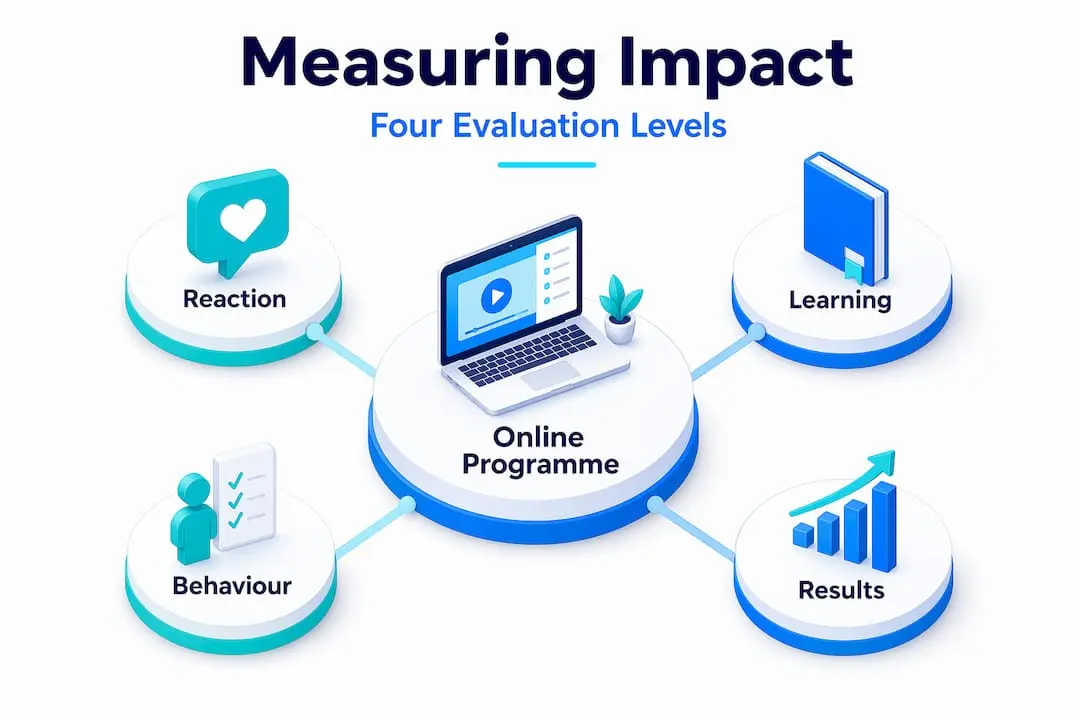
The Kirkpatrick evaluation framework provides a far more useful structure. Kirkpatrick’s four levels assess:
| Level | What it measures | How to collect data |
|---|---|---|
| Reaction | Learner satisfaction and perceived value | Post-course surveys |
| Learning | Knowledge or skill gained | Pre and post assessments |
| Behaviour | Transfer of learning to the workplace | Manager feedback, observation, 30-day follow-up surveys |
| Results | Organisational impact | Productivity metrics, retention data, membership outcomes |
Most organisations only collect Level 1 data. The real return on investment lives at Levels 3 and 4.
For ROI assessment, tracking results over 6 to 12 months after programme completion provides the clearest evidence of impact. This is particularly relevant for membership organisations running professional development programmes, where you can connect learning activity to renewal rates, event participation, or advancement in member roles.
Iterative improvement is built into this process. When your evaluation data shows that learners consistently score well on knowledge assessments but fail to change behaviour, the problem is usually in the transfer design. That insight points you toward specific fixes: more realistic scenarios, job aids, or follow-up reinforcement activities. Knowing how to track learner achievement systematically makes these patterns visible before they become embedded problems.
Gathering feedback at multiple points, not just at course completion, gives you richer data. Brief in-course pulse checks, optional discussion forums, and structured post-programme interviews with a sample of learners all contribute to a more complete picture of programme effectiveness.
My perspective on what actually works
I have seen a lot of online learning programmes built by genuinely talented, well-intentioned people that still failed to produce meaningful results. Looking back, the common thread was rarely the content itself. It was the process.
Teams that succeed in online curriculum creation share one consistent trait: they treat collaborative role enactment as a priority. That means instructional designers, subject matter experts, and technology leads are not working in parallel silos. They are actively building shared understanding of what the programme needs to accomplish, and they are comfortable revising their own assumptions when someone else’s insight improves the design. That kind of trust is not automatic. It requires structured dialogue and deliberate reflection, not just regular meetings.
The other pattern I have observed is what I call fragmented architecture. A course has excellent videos, a solid quiz, and a decent discussion forum. But they are not connected by a consistent learning logic. The integrated course approach resolves this by treating every component as part of a unified system, where content, assessment, and feedback all serve the same defined outcomes.
My honest advice on stakeholder buy-in: do not present your programme as a technology project. Present it as an answer to a specific problem your organisation is trying to solve. When leaders see a clear line between the programme and a business outcome they care about, approval and resourcing become much easier to secure. Meaningful engagement is never about adding more features. It is the result of designing every element with a clear purpose.
— Rob
How Colossus supports your learning programme
Building a high-quality programme is only half the challenge. Managing the stakeholders, tracking learner progress, and coordinating the operational side of delivery requires the right tools working together.
At Colossus, we offer a unified platform that brings your membership management features together with CRM, event management, and virtual training tools in one place. Whether you are managing enrolments, tracking engagement across your member base, or coordinating the logistics of a multi-session learning programme, our platform gives you the visibility and control to do it efficiently. Explore how Colossus can support your online learning engagement strategy and help you deliver programmes that drive real results for your organisation.
FAQ
What is the first step in developing online learning programmes?
Start by clarifying your organisational goals and conducting a learner needs analysis before selecting any tools or platforms. Aligning your programme to strategic objectives from the outset, as recommended by Aalto University’s development framework, prevents misalignment during production.
How do you measure whether an online programme is effective?
Use the Kirkpatrick framework to evaluate programmes at four levels: reaction, learning, behaviour, and results. Completion rates and satisfaction scores alone do not indicate whether learning has transferred to the workplace or produced measurable organisational impact.
What does Universal Design for Learning mean for online courses?
UDL means designing courses with flexible means of engagement and expression while maintaining high learning standards. It ensures your course reaches learners with different needs, preferences, and abilities without requiring separate versions.
How long does it take to develop an online learning programme?
A structured 30-60-90 day plan covers strategy and architecture, content production, and platform launch in sequence. More complex programmes with significant subject matter expert involvement or bespoke media assets may require a longer timeline, but the phased approach keeps development predictable.
Why do learners disengage from online programmes?
Disengagement most often results from fragmented course architecture, unclear objectives, or a lack of purposeful interaction. When content, assessment, and feedback are not connected by a consistent learning logic, learners lose the thread and motivation drops.