Best email marketing software for nonprofits: 2026 guide

TL;DR:
- The best email marketing software for nonprofits integrates fundraising, donor management, and supporter communication in an affordable platform. It should include features like segmentation, automation, CRM integration, and mobile-responsive templates to boost engagement and donations. Organizations must choose tools based on size and capacity, prioritizing integration and advocacy support for long-term success.
The best email marketing software for nonprofits is defined by its ability to connect fundraising, donor management, and supporter communication within a single, affordable platform. Email remains the backbone of nonprofit digital fundraising, with email-sourced revenue reaching $2.40 per subscriber in 2026. Nonprofit email open rates average 25–30%, and any campaign falling below 20% signals problems with sender identity, list hygiene, or subject line quality. This guide gives nonprofit professionals a practical framework for evaluating email marketing tools against the specific demands of mission-driven organisations.
What is the best email marketing software for nonprofits?
The best email marketing platform for nonprofits is not simply the one with the most features. It is the one that fits your organisation’s size, budget, technical capacity, and integration requirements. The industry term for this category is “nonprofit email marketing software,” which refers to platforms purpose-built or adapted to support donor communication, fundraising campaigns, and supporter engagement at scale.

Core features to prioritise
Choosing the right tool starts with understanding which features actually move the needle for charities and NGOs. Generic email tools built for e-commerce often lack the CRM hooks and donation-tracking fields that nonprofits need.
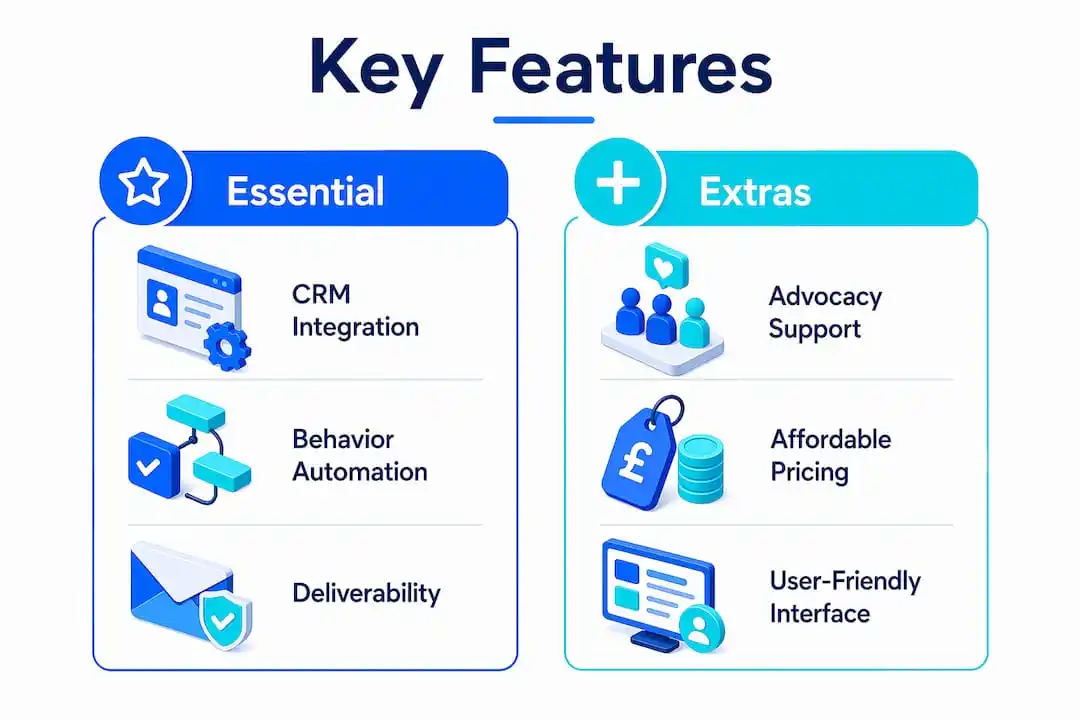
- Segmentation and automation. Behaviour-based automation, such as triggered emails after a donation or event sign-up, is the single most effective way to personalise outreach at scale. Sophisticated behavioural segmentation based on giving history and engagement level is essential for higher return on investment.
- CRM integration. Platforms that connect directly to your donor database prevent data silos and eliminate manual data entry. Integrating email with CRM systems saves staff time and enables the kind of personalisation that increases conversion rates.
- Nonprofit discounts and free tiers. Many platforms offer discounted or free plans for registered charities. Evaluate the actual subscriber limits and feature restrictions before committing.
- Deliverability tools. Look for built-in spam testing, domain authentication support (SPF, DKIM), and list-cleaning features. Poor deliverability kills campaigns before they reach the inbox.
- Mobile-responsive templates. A significant share of donors read email on mobile devices. Templates must render correctly on small screens, and donation landing pages must load quickly on mobile connections.
- Advocacy email support. Not all email types perform equally. Advocacy emails achieve a 2.3% click-through rate and 1.4% response rate, compared to 0.59% and 0.05% for direct fundraising emails. Platforms that support petition-style or action-alert formats give your organisation a significant engagement advantage.
Pro Tip: Always send from a named person rather than a generic address. Emails from “Maria at City Foodbank” consistently outperform those from “info@cityfoodbank.org” in open rates, because recipients respond to human senders.
How does organisation size affect software choice?
Organisational size, budget, and the presence of dedicated marketing staff are the three variables that most reliably predict which type of email marketing solution will work for a given nonprofit.
-
Small nonprofits (under 5,000 contacts). All-in-one platforms with built-in donor CRM functionality suit small teams best. These organisations benefit from free or low-cost tiers that bundle contact management, basic automation, and email templates. The priority is ease of use over advanced analytics, because small teams rarely have the bandwidth to interpret complex reporting dashboards.
-
Mid-sized nonprofits (5,000–50,000 contacts). At this scale, segmentation and automation become critical. Mid-sized organisations typically run multiple campaign types simultaneously: year-end appeals, monthly giving programmes, event invitations, and advocacy actions. A platform without robust list segmentation will force staff to manage these streams manually, which is both error-prone and time-consuming. Scalable platforms with API access to donation tools are the right fit here.
-
Large nonprofits and NGOs (50,000+ contacts). Enterprise-grade platforms with advanced analytics, A/B testing at scale, and dedicated deliverability support are appropriate for large organisations. These teams usually have dedicated marketing staff who can use sophisticated reporting to refine campaigns. The cost of these platforms is justified by the volume of revenue they help generate. Email marketing for nonprofits at this scale accounts for a meaningful share of total online revenue.
-
Organisations in growth stages. The most common mistake at the growth stage is over-investing in a complex platform before the team has the capacity to use it. Start with a mid-tier solution that offers upgrade paths, rather than committing to an enterprise contract prematurely. Balancing cost against features is a discipline, not a compromise.
The role of dedicated marketing staff cannot be overstated. A sophisticated platform in the hands of an under-resourced team will underperform a simpler tool used consistently and well.
Best practices for maximising email fundraising results
Permission-based email outreach is the most effective long-term engagement strategy for nonprofits, cited by 86% of organisations as their primary channel, ahead of paid advertising and events. That statistic reflects a fundamental truth: your email list is an owned asset, and owned assets compound in value over time.
The following practices separate high-performing nonprofit email programmes from average ones.
- Build and protect your list. Treat your subscriber list as a strategic asset. Every contact added with explicit permission is more valuable than ten contacts scraped from an event sign-in sheet. Treating the email list as an owned asset reduces donor lapse below the typical first-time donor retention rate of 20%.
- Use advocacy streams to warm up supporters. Most nonprofits send donation appeals too early in the supporter relationship. Advocacy emails, such as petitions, surveys, and action alerts, build engagement and trust before you ask for money. Organisations that use advocacy emails to build long-term relationships see dramatically higher eventual donation rates.
- Segment by giving history. A lapsed donor who gave three years ago needs a different message than a first-time donor who gave last month. Segmenting by recency, frequency, and gift size is standard practice in direct marketing and applies equally to email.
- Optimise subject lines and sender names. Subject lines under 50 characters perform better on mobile. Sender names from real people, not departments, improve open rates consistently.
- Track conversion, not just opens. Open rates tell you whether your subject line worked. Conversion rates tell you whether your email raised money. Year-end appeals show higher donation conversions than Giving Tuesday campaigns, which means timing and campaign type both matter.
- Nurture one-time donors. Most nonprofits lose the majority of first-time donors within 12 months. An automated welcome series followed by regular non-ask content keeps new donors engaged long enough to make a second gift.
Pro Tip: Test two subject lines on a 20% sample of your list before sending to the full audience. Even a 2-percentage-point improvement in open rate translates to meaningful additional revenue at scale.
For more on effective email strategies tailored to the nonprofit sector, the principles above apply across organisation types and sizes.
Common pitfalls in nonprofit email marketing software use
The most expensive mistake in nonprofit email marketing is choosing a tool based on ease of use alone. Nonprofits that select platforms without evaluating CRM integration end up with disconnected systems that require manual data reconciliation, which wastes staff time and degrades data quality.
- Ignoring deliverability. A beautiful email that lands in the spam folder raises no money. Sender reputation depends on consistent sending volumes, authenticated domains, and clean lists. Using a generic “noreply” address actively damages deliverability. Personalised sender names significantly improve open rates and signal to inbox providers that your email is legitimate.
- Underusing automation. Most platforms include automation features that go unused. Welcome sequences, donation acknowledgements, and lapsed-donor re-engagement flows can all run without staff intervention once configured. Leaving these idle is a direct cost to your fundraising programme.
- Neglecting list hygiene. Sending to stale or invalid addresses increases bounce rates and damages sender reputation. Regular list cleaning, at minimum twice per year, is a non-negotiable maintenance task.
- Misreading engagement metrics. High open rates on a poorly segmented list can mask low conversion rates. Always connect email performance data to actual donation outcomes, not just inbox behaviour.
- Ignoring mobile donation pages. An email optimised for mobile that links to a desktop-only donation page loses the conversion at the final step. Mobile optimisation must extend beyond the email itself to every page in the donor journey.
Charities that connect email and CRM data avoid the most damaging of these pitfalls, because integrated systems surface the right information at the right time without manual effort.
Key takeaways
The best email marketing software for nonprofits combines CRM integration, behaviour-based automation, and deliverability tools to convert supporter engagement into measurable fundraising revenue.
| Point | Details |
|---|---|
| CRM integration is non-negotiable | Disconnected systems create data silos that reduce personalisation and waste staff time. |
| Advocacy emails outperform appeals | Advocacy content achieves click-through rates nearly four times higher than direct donation emails. |
| Sender identity affects deliverability | Emails from named individuals consistently achieve higher open rates than generic addresses. |
| Organisation size drives software choice | Small, mid-sized, and large nonprofits have distinct automation and analytics needs. |
| Your list is a strategic asset | Permission-based lists with regular hygiene reduce donor churn and compound in value over time. |
What I have learned from watching nonprofits choose the wrong tool
The pattern I see most often is this: a small nonprofit picks the most recognisable email platform because it is easy to set up, then spends the next two years manually copying donor data between systems. The tool works fine for sending newsletters. It fails completely at the moment it matters most, which is when the organisation needs to send a targeted year-end appeal to donors who gave between £50 and £200 in the past 18 months but have not given this year.
That kind of segmentation requires your email platform to talk to your donor database. Without that connection, you are sending the same message to everyone, which means your best donors receive the same email as someone who signed a petition once and never donated. That is not just inefficient. It is actively damaging to donor relationships.
The second thing I have observed is that nonprofits consistently underestimate the value of advocacy email streams. Organisations that run regular action alerts, surveys, and campaign updates build a warmer, more engaged list. When the year-end appeal arrives, those supporters already feel connected to the mission. The data backs this up: advocacy engagement runs up to 28 times higher than direct fundraising email engagement. That gap is too large to ignore.
My honest recommendation is to start with integration as your primary selection criterion, not price or design. A platform that connects cleanly to your CRM and donation tools will outperform a prettier, cheaper alternative every time. Programmes like LuxGive demonstrate how digital engagement tools, when properly integrated, can build sustained supporter communities rather than one-off transactions.
— Rob
How Colossus supports nonprofit email marketing and engagement
Colossus brings email marketing, CRM, and membership management together in one platform, which means your donor data, event registrations, and email campaigns all live in the same system.
For nonprofits that have struggled with disconnected tools, Colossus removes the manual work of syncing data between platforms. The CRM software gives you a complete view of each supporter, and the email marketing tools use that data to send targeted, personalised campaigns without extra steps. Explore the full range of membership and engagement features to see how Colossus can support your fundraising goals and supporter communication from a single, unified platform.
FAQ
What makes email marketing software suitable for nonprofits?
Nonprofit-specific email marketing software combines donor CRM integration, advocacy email support, and affordable pricing for registered charities. The most effective platforms connect email performance data directly to donation outcomes.
What open rate should nonprofits aim for?
Nonprofit email open rates average 25–30% in 2026. Rates below 20% indicate problems with sender identity, subject line quality, or list hygiene that need addressing before scaling campaigns.
Are advocacy emails more effective than donation appeals?
Advocacy emails achieve a 2.3% click-through rate compared to 0.59% for fundraising emails. Building engagement through advocacy content before making donation asks produces stronger long-term fundraising results.
How important is CRM integration for nonprofit email tools?
CRM integration is the single most important technical criterion for growing nonprofits. Platforms that connect to your donor database prevent data silos, enable precise segmentation, and eliminate manual data entry that costs staff hours every week.
What is the best affordable email marketing option for small charities?
Small charities should prioritise platforms with free or discounted tiers for registered nonprofits that include basic automation and contact management. The priority is finding a tool that connects to your donation platform, even at entry level, rather than choosing solely on price.